
| A note from Merrox, Master of the Hall of Records:
Sadly, this shall be the final report filed by Tarliman Joppos. From an account given by his bodyguard, Threndok of the Vorst, Tarliman died in his sleep during his second night on the island of Thera, apparently of natural causes. As a final duty, his guards brought his personal effects, including this record, to the Great Library. As well, they have delivered his ashes, which shall be enshrined in the Hall of Fallen Heroes. Barsaive and the world beyond have lost a scholar of great intellect, a dwarf whose enthusiasm for knowledge inspired those around him. Rest well. |
Dispatch from Tarliman Joppos to the Hall of Records at
Throal:
Greetings and well wishes. Garlen grant you are feeling better than
I am. The moment at hand finds me convalescing from the results of a decision.
You may recall that, some months ago, I sent a record from Anghali G'Hosteren, detailing that city. In it, I recounted my interlude with a seller of fortunes, a remarkably perceptive old woman who saw much in my past and apparently in my future. Her words have indeed been prophetic.
Following my departure from the trading city, I joined a merchant caravan going to Vivane. We rode through the remnants of the once proud lands of Ustrect and Cara Fahd. I will provide the details of that journey in a separate writing, for it deserves its own treatment apart from this missive. On arriving at Vivane, I decided to make arrangements to travel further in swiftness, as the region around Vivane has been thoroughly detailed already, and I sought new territories. Thus, I made my way to the Theran Quarter, made contact with the Geographical Society and consulted as to air travel.
Threndok, one of my Vorst guards, shook his head sadly over my decision to travel by airship to the next large city in the direction of Thera. He proclaimed that my haste would be my undoing, that only by slow and careful steps, making certain of every inch of the way, would I arrive safely at my eventual destination. He recommended that we join a different caravan, traveling under the scarlet banner of the House of Jovidan, a powerful mercantile consortium from Travar. It would be slow, however, and we would spend far too much time in lands already well documented.
So I took ship with Latrillo Ventani, an Air Sailor Adept and regular plyer of the southern trade routes. He promised me a swift journey to Galedon, the obvious next step and the last one before Thera itself. From there, he said, I could easily take ship to the Golden Isle. So, the following morning, I and my guards boarded his vessel, he unfurled his sails, hoisted a bright golden banner with a sigil of wings and a sword and we set sail for Galedon.
It was then that I recalled the old woman's prophecies. Looking back through my notes, I found her exact words: "The red banner brings safety. The yellow banner brings pain, but with it, knowledge." Well, by then it was far too late to alter the situation, and I would just have to deal with whatever consequences my decision brought.
The first few days of the journey were quiet. On the evening of the fifth, however, disaster struck. Out of heavy clouds above us swooped another airship, sky raiders leaping over its sides and dropping unerringly onto our deck. The crew fought valiantly, but were swiftly outnumbered, and outclassed from the very beginning by the well-trained Adepts of the sky raiders. One confronted me, struck the sword from my hands and demanded I open my trunk, which I did. The troll seemed irritated that it was full of scrolls, books and clothing, and not of gold and jewels. Snatching me up by the front of my robes, he pressed his nose to mine.
"I am Kalix Bonegrinder of the Iron Claws, Sky Raider and Adept of the Fifth Circle! You will tell me who you are and where your treasure is!"
I mustered what calm I could under the circumstances, drawing upon my own Discipline, and replied, "I am Tarliman Joppos, Scholar and Adept of the Seventh Circle, holder of the chair of City Lore at the Hall of Records in Throal. You have seen my treasure. It is knowledge, contained within those books. I have little else to offer."
His eyes narrowed. "Scholar from Throal, eh? Well, write this down. Today the Iron Claws took this ship and all its riches. Let the world know that this is our territory, and we exact a price from those who would pass through without our permission. Tell your friends in Throal that Kalix spared your life so you could tell his story."
I suppose I must have nodded acquiescence, for by then I couldn't speak. His grip had nearly cut off my wind and I was spending all my effort to continue breathing. He dropped me onto my trunk, then whirled to contend with one of my guards.
I lost track of the fight in the process of securing my trunk, for just then the ship lurched to one side, and began dropping rapidly. The next thing I knew, another of my guards heaved the trunk overboard, then seized me and leaped. We fell into the top of a tree, our descent slowed by its foliage and by my guard's occasional grabs at passing branches. As it was, we hit the ground hard, although not so hard as our ship, which crashed a little distance away.
My trunk survived the impact reasonably well, picking up a new crack in its side and having to be dug out of the hillside where it struck. On the other hand, I landed badly and suffered a broken arm. One of my guards, Tivok, died fighting the trolls, the other three surviving with various injuries. We dealt with Tivok's remains in the Vorst manner, building a pyre and setting it ablaze, then walking away swiftly. My arm was set by Gotir, a skilled healer as well as a fighter, and he pronounced it good enough until we could seek additional help. Dividing up the contents of the trunk into packs, we set off in search of the nearest inhabitation.
We had not long to travel. The next morning, shortly after we had broken camp, we encountered a patrol of soldiers, dressed in Theran uniform. Their leader introduced himself to us as Lenrissian Kalidol, and inquired as to whether we had been on the airship. He apologized profusely for not coming to our aid more swiftly, but the base had only one airship and it had been engaged. Besides that, the conflict had occurred on the border of disputed territory, and he had no wish to cause an incident by trying to assist.
Lenrissian ordered his men to cut branches and rig a sort of crude sedan chair for me. Taking our packs and providing some healing potions, he escorted us to his unit's base a half day's journey further. Two of his men he sent further on to recover what they could from the crash site, which happily included my trunk. At the base, a small fort deep in the woods, we were all attended to by the military healer, who reset my arm and made sure I wouldn't lose any use of my hand. He also cleared a developing infection in Threndok's leg, and gave us all herbs to speed our healing. The unit commander, Shantea Mallesin, came to see us and express his sympathies regarding our recent loss. He also made arrangements for our remaining possessions to be recovered from the wreckage of the ship.
Far from the haughty imperialists I had expected, my first contacts with Therans were in fact friendly, outgoing, helpful and courteous. Conversely, the Iron Fists, whom I had heard described as the most civilized of troll clans, turned out to be savage fighters and vicious brigands, at least the ones who descended upon us. A most enlightening experience indeed, paid for in pain, as the old fortune-seller predicted.
Commander Mallesin arranged for an armed escort to take us further, all the way to Galedon. So here we are, one less than when we set forth. We have found knowledge, at a dear price.
On the History of the City
Some of my colleagues may take exception with the positive light in
which I present many aspects of the Theran Empire. I feel that I would
be false to my Discipline if I were to slant my writings to cast an unfavorable
light on all that I report. While it is true that the Empire as a whole
practices the abomination of slavery, many of its citizens do not. Whether
or not to hold slaves is a matter of debate within the Empire, and in time
the slaveholders may come to realize the error of their ways. In the mean
time, it would be unfair of me to describe every Theran as despicable,
especially as many of them have been like any other Name-giver: people
residing under a government that they may or may not agree with, but owing
their loyalty to it nonetheless.
I ask that this report be received in the same manner that it is writ: as an attempt to report what I have found fairly and impartially, without interjecting the opinions of the writer unnecessarily into the facts of the matter.
Founding and Early Days
Galedon dates back to the early days of the Theran Empire. Founded
originally as a way station for transport of materials to the School of
Shadows during its initial expansion, a settlement grew up around the warehouses
and caravanserais. As the School evolved into Thera, Galedon rose from
a storage depot to a city based on mercantile interests. These roots in
trade, negotiation and competition among Houses shaped the culture of the
city for centuries to come.
As senior members of the trading Houses moved to the city, they demanded more amenities. A library was built, never to rival the Eternal Library but sufficient for the populace. An amphitheatre was excavated, there being no natural depressions sufficient for such. Over the years, improvements were made -- a roof added over the more expensive seats, a shell erected behind the stage to enhance the sound. Eventually, slaves were brought in and an arena was built for lower forms of entertainment: staged combats between champions of rival Houses or between slaves.
As the city grew older, and its ruling class continued to be prosperous, intrigue and decadence settled in like two halves of the same jaded coin. Where in the early days Houses competed honestly and openly against one another, now they plotted and spied. Pleasures grew more opulent, more involved, more expensive in terms of resources and side effects. Then came the Scourge.
Concerning the Scourge
Being a Theran city, Galedon had no trouble at all acquiring the citadel
method. Great stores of True elements were amassed, some of the Houses
turning great profits and others being ruthlessly crushed in the scramble
for survival. When the Horrors began to manifest in serious numbers, the
shield went up and the city settled in for the next four centuries.
During the time of the Enclosure, as the natives refer to it, what had
been a means of competition became a pastime. Bored nobles, deprived of
their normal outlets, began complex plots against one another for lack
of anything else to do. Intrigue became a way of passing the time, and
after many years an ingrained habit. According to the rumors, this is when
assassination became a profession. I have been unable to verify the existence
of assassins in Galedon, but tales of them are rife. See the section entitled
On the Rumors of Assassins, further on in the record.
Galedon After the Scourge
The governor ordered the shield brought down after being signaled from
Thera that the Scourge was over. I do know that there was some sort of
arcane communications device used to pass this message into the citadel,
through the magical defenses, but its nature is a well kept secret. Whether
such devices are still in use throughout the Empire is a matter for speculation.
At any rate, when the citadel was opened, the Houses immediately scrambled
to resume the old contracts and nail down new ones for the transport of
goods and passengers to and from the Golden Isle.
The following two decades saw upheavals of lesser and greater natures in the hierarchy of the city. Power changed hands sometimes unexpectedly, fortunes rose and fell and distant cousins occasionally found themselves in charge of a House after the closer line mysteriously died. At last, however, the shifts faded, like ripples in a pond will settle, and a coherent power base emerged.
At this time, an appointed Imperial governor rules Galedon, under approval
by the central powers at Thera, and is advised by a council composed of
members of the predominant Houses and leading guilds. Trade has very nearly
resumed its pre-Scourge levels. A rising tourist market also swells the
coffers as visitors come to sample the complex pleasures of Galedon, said
to be able to arouse even the most jaded of tastes. On the one hand, the
city is a model of commerce, serving as an important routing point for
cargoes bound for Thera itself. On the other, the atmosphere sinks further
into decadence as visitors demand more and more elaborate diversions.
On the Layout of the City
Built originally on the shores of the Venives, the straits that run
south-southwest from Okonopolis down to the sea, Galedon's elite began
moving into a nearby crater long before the Scourge. The great bowl-shaped
depression was apparently caused by a massive explosion or the fall of
an extremely large object hundreds of years previously. Nobody really cares
about the theories now, since the elementalists pronounced the area stable
and construction began on what would later become the city's Citadel. The
center of power still remains in the Caldera, even though the predominant
work of shipping is done on the shoreline nearby.
Galedon divides into three primary regions, Dockside, Cliffside and The Caldera. Most of the city's trade still passes through Dockside. Ships of the air and sea make port each day, offloading cargoes from all over the Empire, taking on shipments for the Golden Isle itself and all its possessions. Through the crowded streets pass longshoremen and ship crew, passengers and clerks and merchants. Restored after the Scourge, the streets are still straight as a ruler, but many of the colonnades have fallen, the arches crumbled and the original buildings collapsed during the ravages of the Scourge. Rebuilding has been more economical, the styles more utilitarian, less elegant. While still obviously a Theran city, the true art of the architect is now reserved for the Caldera. Dockside has lost much of its identity and can't be told at a glance from any other port of call.
Between Dockside and the Caldera stands Cliffside, primarily a residential community for Dockside workers and those not yet fortunate enough to find a home in the Caldera. The Dockway, a stone street wider than Vivane's Greatwalk, cuts through the center of Cliffside, forming the main artery between Dockside and the Caldera. Pedestrian bridges have been built over the Dockway to allow foot traffic to pass from one half of Cliffside to the other without being run down by the wagons and carriages.
Entry to the Caldera is through The Cut, a natural break in the west side of the wall, down a long approach through a well-guarded pass and going between the columns that helped focus the wards for the Citadel. New gates are being constructed at the top and bottom of the Cut, along with new barracks and way stations for the watch that patrols the vital passage. Rumor has it that Governor Miklos may soon create a new division of the watch specifically to guard the Cut. Most travelers must proceed down a long stairway, almost like Throal, stairs and stairs and stairs with landings big enough to hold hostels and taverns. The ramps to the left and right are reserved for cargo wagons going down and up respectively. Passenger carriages are not allowed on the ramps. Owners of such carriages must maintain carriage-houses at the entry to the pass. There are sedan chairs for those who can afford their hire (eight silver per person going down, twelve going up) for the three-mark walking journey down (a good five marks going back up), and cable cars with their pulleys driven by teams of mules at the top for the truly wealthy residents and their guests, at a cost of two gold per person. A faster cable carries message capsules for documents that have to go back and forth between the House heads and their companies. There's also a row of heliographs at the top of the caldera, to flash messages over the wall of the caldera. I'm told that each House has its own mirror and its own code, that changes frequently to keep other Houses from intercepting private and business communications.
Galedon in the Caldera is a city of terraces and stairways, of overlooks
and balconies and great monuments of buildings rising from the valley floor.
The arrangement has sorted itself out into a vertical banding of the regions.
From the top down, these are Highslope; Upper Trades, or The Upper; The
White; Lower Trades, or The Lower; Downslope and The Flat. The floor proper
of the caldera, The Flat, is taken up by the central powers and by those
trades that require large expanses of flat space. Downslope tends to be
an extension of the Flat, primarily occupied by support buildings for housing
servants and goods used by residents of the Flat. At the north and south
ends of the Flat, the two primary schools of the city extend from the Flat
well into Downslope. The lower levels of the walls are inhabited by the
merchant and tradesman classes, hence Lower Trades. Further up the slopes,
where the view is good but the travel is still reasonably easy, the wealthy
have their homes in a band of ostentation that encircles the Caldera, a
girdle of white marble and hanging gardens known as the White because of
the primary building stone. Above them and beyond the White Wall in Upper
Trades are the poorer tradesmen, and perched on the steepest slopes near
the top of the crater, the region known as Highslope, are the homes of
the very poor. While it may seem odd that the most destitute would have
the best view and a high ground advantage over the wealthy, it's not quite
like it seems. The slopes at the top are the least stable. From time to
time, the ground gives way and one of the shacks goes tumbling down, frequently
taking others in its path with it until the whole mess fetches up against
the White Wall. Also, travel to the top levels is arduous, and strictly
controlled, since it must pass through carefully regulated corridors in
the White. Carrying anything that could annoy the wealthy through the official
routes simply isn't allowed.
Appearance of the City
While originally of classic Theran architectural design, the physical
layout of Galedon has seen numerous innovations over the centuries. The
initial settlement was laid out with long straight streets, hollow-square
homes enveloping secluded gardens, and elegantly tapering business and
governmental structures with colonnades and arches in the Imperial style.
Within the Caldera, however, building on the slopes forced changes in the
design of homes, at least for the more well to do.
Across the Flat, many of the buildings are constructed of pale grey native granite taken from the eastern slope, or from a quarry just outside the Caldera to the East. Buildings in the Upper and Lower are more usually of wood, and in Highslope of light wood, closer to huts than homes. The White is the jeweled belt of the city, its terraces and balustrades of gleaming white marble from the eastern quarry, many of its buildings faced with the same white stone if not made entirely of it. Throughout the city, plant growth is lush, the fertile soil of the Caldera spreading a blanket of green everywhere the ground is not covered. Walkways vein the bowl of the city with brown and grey, packed earth and laid stone forming the arteries for pedestrian traffic. Very few vehicles and beasts are allowed into the Caldera, and none on the slopes. Lifts operating at a slant in hidden shafts take care of bringing heavy and large goods to the residents of the slopes. Similar hidden shafts carry wastes back down, the tunnels eventually joining into a single outlet that empties into the river where it exits the Caldera.
While the Citadel's elemental shields were raised, their effect on the view must have been spectacular. Imagine looking out over the Caldera floor from one of the estates in the White, seeing the buildings rising from the dense plant growth like a lost city in the jungle, and over it all the shimmering red-gold canopy of the Citadel's main wards, crackling with veins of incandescent blue fire. I can easily understand the love of power that grew in this place. You have only to take your breakfast out on the terrace, spending your morning gazing out and down over the vista spread before you, to experience the feeling of command that such a view brings. Living with such would naturally engender a lust for control, and with many Name-givers feeling as if they alone owned the city, competition for power would heat more swiftly than a pot over a bonfire.
Dockside has some of the same problems that the dock quarter in Ardatha has. Many of the buildings were put up quickly, so that commerce could resume after the Scourge. Now, with business rolling along at a brisk clip, tearing down the hastily-erected wooden structures and putting up honest stone would cause a terrible interruption. Some of the more prominent businesses, such as Tonisitoa Shipping, that have House resources behind them, have put up stone edifices while maintaining their old wooden offices, then transferred their operations in only a day or two using a small army of hired laborers. Sole proprietorships and smaller businesses, however, as well as enterprises such as taverns where location is paramount to their trade, cannot afford to do this. As a result, many of the older wooden buildings are still in heavy use, and showing signs of wear. Fire is a major hazard in Dockside, as is collapse of the oldest and most hastily constructed buildings. Unfortunately, it takes the building falling down or burning up to get some of the businesses in Dockside to rebuild. The streets here are wide enough for wagons to pass, a frequent occurrence especially around the warehouses. Foot and wagon traffic is heaviest during the early morning and the late afternoon, as ships arrive and depart on the morning and afternoon tides respectively.
Between the two regions is a high stone wall, currently lined with scaffolding at its north and south ends as new stonework extends the decades-old wall to match the city's expansion. The gatehouses that stand to either side of the Dockway are likewise of recent construction, the old gatehouses having been torn down to make way for larger buildings capable of supporting the iron-reinforced wooden gates that can swing out across the Dockway from either side. Tolls are collected here, a copper for a person on foot, a silver for one on horseback and a minimum of four silver for a wagon, with the price going up according to size and weight. Passengers in the for-hire coaches that ply the route between Dockside and Cliffside are expected to cover the six-piece toll in addition to their fare.
Cliffside is characterized by streets growing progressively narrow as
they move further from the Dockway. Hard by the artery that links Dockside
and the Caldera, the lanes are wide enough for two beer-wagons to pass
abreast. A few blocks away, one wagon passing causes everyone else to move
aside. By the time the further reaches are attained, two horses may have
trouble passing one another without their riders coming to be on intimate
terms. The buildings also grow progressively closer and smaller. At the
side of the Dockway, three and four story stone edifices with walkways
between them stand forth proudly, each independent of the other. The Dry
Market, halfway between the Dockway and the edge of Cliffside, is mostly
two-story buildings, with the lower half of stone and brick and the surmounting
part of wood and plaster, often with exposed framing. The upper stories
tend to overhang the lower, sometimes enough that the alleys are in permanent
shadow, and a person standing at the window of one house could easily hand
something across to a person in the window of the next. Merchants display
their wares hung from the upper windows of their shops, increasing the
overhead clutter so badly that trolls catch their horns in the dangling
merchandise. Occasionally one of the windowboxes comes crashing down under
the weight of the exuberant plants grown by the residents, causing breakage,
injury and confusion. At the periphery of Cliffside, the homes and shops
huddle together as if for warmth, sharing walls and sometimes roofs. They
rarely go over a single level, like troops afraid to put their heads up
for fear of archers. Wood and brick are the primary materials, stone being
too expensive for most of the inhabitants. Fire is a constant concern in
the poor areas, as it is in any city.
Notable Locations
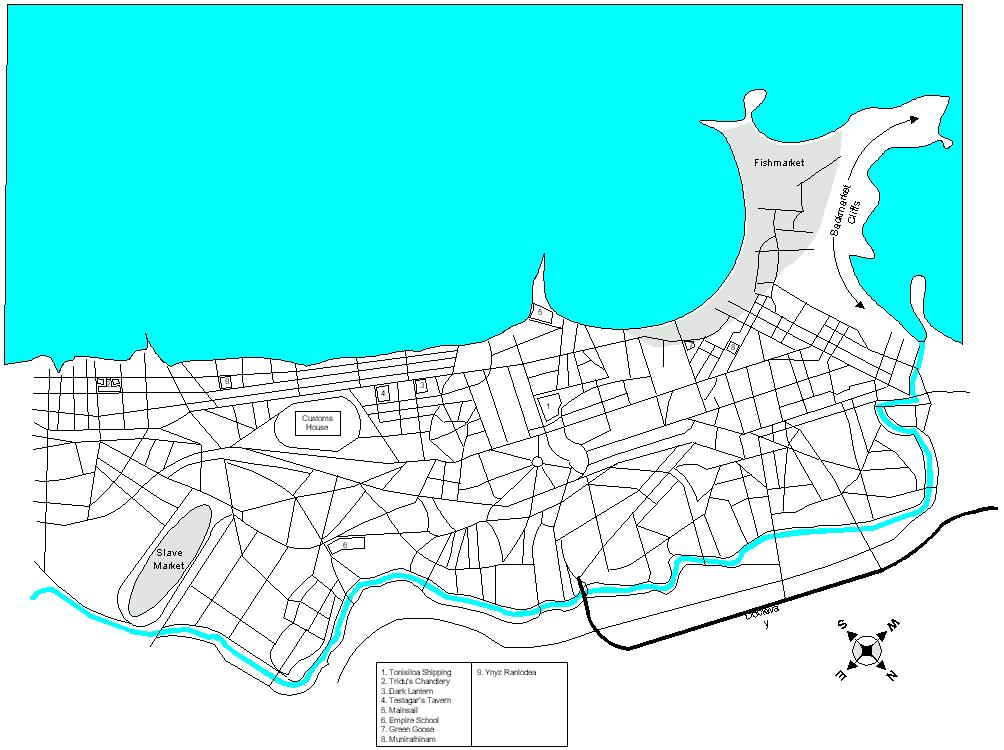 Dockside
Everything from small coastal fishers to Theran warships to oceangoing
t'skrang sidewheelers finds port here. Getting large ships in and out of
the harbor requires taking on a local pilot and following a guideboat.
The harbormaster's pilots normally charge one silver per ton (loaded weight)
for harbor and docking fees. This rate can fluctuate according to the captain's
relationship with the harbormaster.
Customs House
Standing tall at the center of the docks, the current Customs House
was built from the plans of the original on approximately the same site
after the Scourge. The impression of indestructibility and timelessness
bows the head of many a ship captain, accustomed to a world where change
is constant and inevitable. The central tower with its four corner spires
casts a long shadow over the docks, giving the building its local nickname
of The Sundial.
Here, the offices of the Harbormaster hum with activity throughout the
day, as cargo taxes are paid, slip assignments are obtained, and disputes
among sailors and merchants are resolved. Around the back, the Harbor Patrol
maintains its office and its gaol, where drunken sailors recover their
sobriety and offenders against the Harbor Code spend their nights, the
days being given over to hard labor under the watchful eye of the Patrol.
Upstairs, rows of clerks maintain the records of the docks, accounts and
ship's papers and records of mastery. The central tower holds the apartments
of the Harbormaster, where the holder of the office can survey their domain
at leisure. To each quarter about it, lesser towers serve as lookout points
for the Harbor Watch and the offices of the Harbor Signal Corps, their
signal officers and weather-forecasting elementalists. Each of the outer
towers has its dome painted a different color, giving a further set of
landmarks for finding one's way in Dockside. Ropes strung from the outer
towers to the central carry signal flags, visible from out in the bay with
a spyglass. Every sailor knows to look to the towers and their signal lines
for the weather, news of arrivals and departures and emergency information,
learning the code of flags early in their career.
The Fishmarket
Wrapping sharply about the curve of the shoreline bluffs at the north
end of the docks, as the cliffs rise above the piers, the Fishmarket began
as a meeting point between the fishermen who worked the channel, and the
people of the city. Once a trading point is successful, it draws more vendors
the way honey draws flies. Within a generation, the Fishmarket expanded
to the bustling marketplace it is today. While the day's catch is still
offered down at the low end of the market, closest to the piers, the high
ground has been taken by merchants selling the cargoes of ships passing
through, farmers from up the coast hawking their crops, local craftsmen
offering their services and the inevitable entertainers of all stripes.
Today, the Fishmarket is a riot of colorful tents and brightly painted stalls, a roar of many voices bargaining all at once and the smells of exotic perfumes, pungent vegetables, fish and sweat and dust. Business is done quickly, with haggling down to the polite minimum, so that the deal can be concluded and the next customer served before they move to the stall next door. Only about half of the people seeking bargains here are private citizens, the remainder being buyers for concerns further inland. Much of the goods offered in the Caldera pass through the Fishmarket on their way to more upscale merchants.
Visitors looking for good deals should exercise caution. While the most
amazing things are offered for sale, some of the merchants taking advantage
of the speed of business to move illicit goods semi-openly, prices can
be higher than usual and the pressure to buy quickly very strong. Questors
of Chorrolis use the noise and confusion as cover to exercise their abilities,
charging exorbitant prices for trinkets, then folding their stalls and
being away before the glamour wears off and greed gives way to regret.
Thieves also work the area, not only pickpockets and cutpurses but fraud
artists who boldly convince their victims to hand over their hard-earned
silver for empty promises. The best strategy is to enter the bazaar with
no more silver than you are willing to part with, and a clear idea of what
you are pursuing.
Slave Markets
Two primary markets exist, one in Dockside and one in Cliffside. Crowded
and noisy, the Dockside market is for slaves bound elsewhere in the Empire,
and is attended primarily by slave traders and ship captains. The occasional
mine boss also turns up, bidding for new labor to replace the workers swiftly
worn out by the fierce toil of the mines to the east of the city. Normally,
slaves sold in this market are from nearby lands, and the risk of escape
and flight is deemed too great for them to be sold to local owners, but
the mines offer little chance of this. Not only are there few routes out
of the depths, but the harsh labor soon leaves the slaves unable to make
the journey.
By contrast, the Cliffside market is nearly humane. Its slaves are either those bred to captivity or domesticated in distant places. The barbarism of carrying Name-givers off from their native lands to forced labor in another place, no matter how gently padded the bars of the cage, is a topic for another treatise. An amphitheatre carved into the stone of the Caldera wall serves as the center of the market, with the pens (more like dormitories than the stockades of Dockside) being carefully downwind. On those rare occasions when the wind shifts, air elementals keep the smell away from the customers. Vendors circulate throughout the audience, purveying chilled drinks, food both hot and cold, perfumes, small trinkets and lists of the day's available merchandise. An air of indolent decadence pervades the place, like the smell of a midden kept masked by scented oils. Slaves are paraded up onto the dais at the focus of the curved seating section one at a time, their virtues extolled and bidding handled with reserved subtlety. In contrast, Dockside has four stages, and slaves are normally sold in lots, with much shouting of insults and encouragement by the audience and auctioneer respectively. Whether in dust and heat or comfort, though, the business remains the same: the buying and selling of Name-givers as if they were so many cattle.
Enough; I cannot maintain objectivity.
Tonisitoa Shipping
One of the few non-Carinci mercantile interests in Dockside, Tonisitoa
was one of the first freight companies in Galedon, formed by a consortium
of Naseyn nobles to import goods for local use. Food and other consumable
imports still form approximately two-thirds of the concern's business.
The other third is primarily composed of transient goods, bound for other
ports of call. The company brings in a few items by special request, having
space for hire on their ships for nobles of the right families with sufficient
funds.
Before the Scourge, Tonisitoa opened offices in other Theran ports,
including on the Golden Isle itself. Once the Scourge was over, these offices
swiftly re-established contact with the headquarters in Galedon, linking
up a number of ports in trade. As one of the first companies to re-establish
itself post-Scourge, Tonisitoa enjoys a strong advantage over its competitors.
Its agents signed a large number of farmers to exclusive contracts, consigning
their crops to Tonisitoa for many years, an exclusivity that has been enforced
with arms when words will not suffice. Tonisitoa Shipping does not take
kindly to other companies encroaching on their territory. Some of their
captains have gained notoriety for conflicts with terrible beasts or would-be
pirates out on the open sea, mounting the heads of their vanquished opponents
on the bow of their ship to further enhance their reputation for ferocity.
Tridu's Chandlery
Wedged in between a sailmaker's and a pierfront tavern, Tridu's Chandlery
does not appear much different from the usual Dockside business catering
to the shipping trade, the Carinci mark on its shingle telling only of
a certain quality of goods. Its limited frontage, however, belies the size
of the establishment. Once through the door and the small front room, lined
with used items of low value to reduce the temptation to thieves, the customer
finds himself in a two-story high shop filled with everything a ship could
possibly need for a successful voyage. From rope in twenty-three grades,
to sea chests, to buckets of pitch, to expensive brass and glass encased
compasses, Tridu's can supply all of the hardware and maintenance supplies
required to operate an ocean-going vessel.
The interior of the shop is rigged like a ship, with rope ladders going up to the shelves lining the walls all the way to the ceiling, ropes hanging from the transverse beams and everything lashed and stowed as if the store were about to weather a storm. Owned and operated by t'skrang from the Ryeefa niall, the clerks seem to enjoy their work, clambering through the rigging after items and swinging across the shop as if it were the deck of a riverboat. The proprietor, Enayid Tridu, is of lean and tall build, with bright green skin and a vivid purple crest, usually dressed in a bright white shirt, a heavily embroidered red vest and blue trousers, the shipboard costume of his niall. He mans the till at the entry to the main room of his shop as if he were the captain of a ship astride the bridge.
Occasionally items are for sale in the back room, admission to which
seems to be based on introductions. While the main room carries all of
the standard gear, I am told that the back room contains items for defense
against pirates and the like. I assume this to mean ship's weaponry, but
lacking both an introduction and the intent to purchase such items, I was
unable to verify what may or may not be for private sale. Certainly, if
Tridu deals in ship's guns, he would have to do so quietly to avoid conflict
with the city's elementalists, who like to keep a corner on the market
for such items.
Amphitheatre
Well inland of the center of the docks, where bedrock can be reached
before the water table, lies the original city amphitheatre. Local legend
has it that a great many strange markings had to be scoured from the stones
after the Scourge before the facility could be used once more. Certainly,
it's easy enough to verify that peculiar stains reappear whenever the weather
turns bad. Productions in such times have a way of going sour, taking a
darker tone that the playwright intended. The guard tends to keep a closer
eye on the amphitheatre at such times.
For the most part, however, the amphitheatre serves its old, pre-Scourge, purpose -- entertainment for the Dockside populace. Plays, musicians, political gatherings and rituals presented by the cults of the Passions keep the amphitheatre busy on a daily basis. So busy, in fact, that occasionally two groups show up at the same time, both convinced that they have the right day. In one situation like this, my guards and I were actually offered gold by the stage manager of the players to drive the Questor of Chorrolis and his followers away. Of course, not being one to risk offending the Passions, I declined.
The amphitheatre is operated by the Dockside city council, through the
office of Public Works. They charge a nominal fee, based on the type of
presentation. Questors of Dis or Astendar, less-known playwrights and troubadours
are charged only a few silver, while Questors of Chorrolis, the most popular
player companies and visiting adepts pay in gold. The fee for use of the
facility appears to be based on the expectation of return from the audience.
Typical Encounters
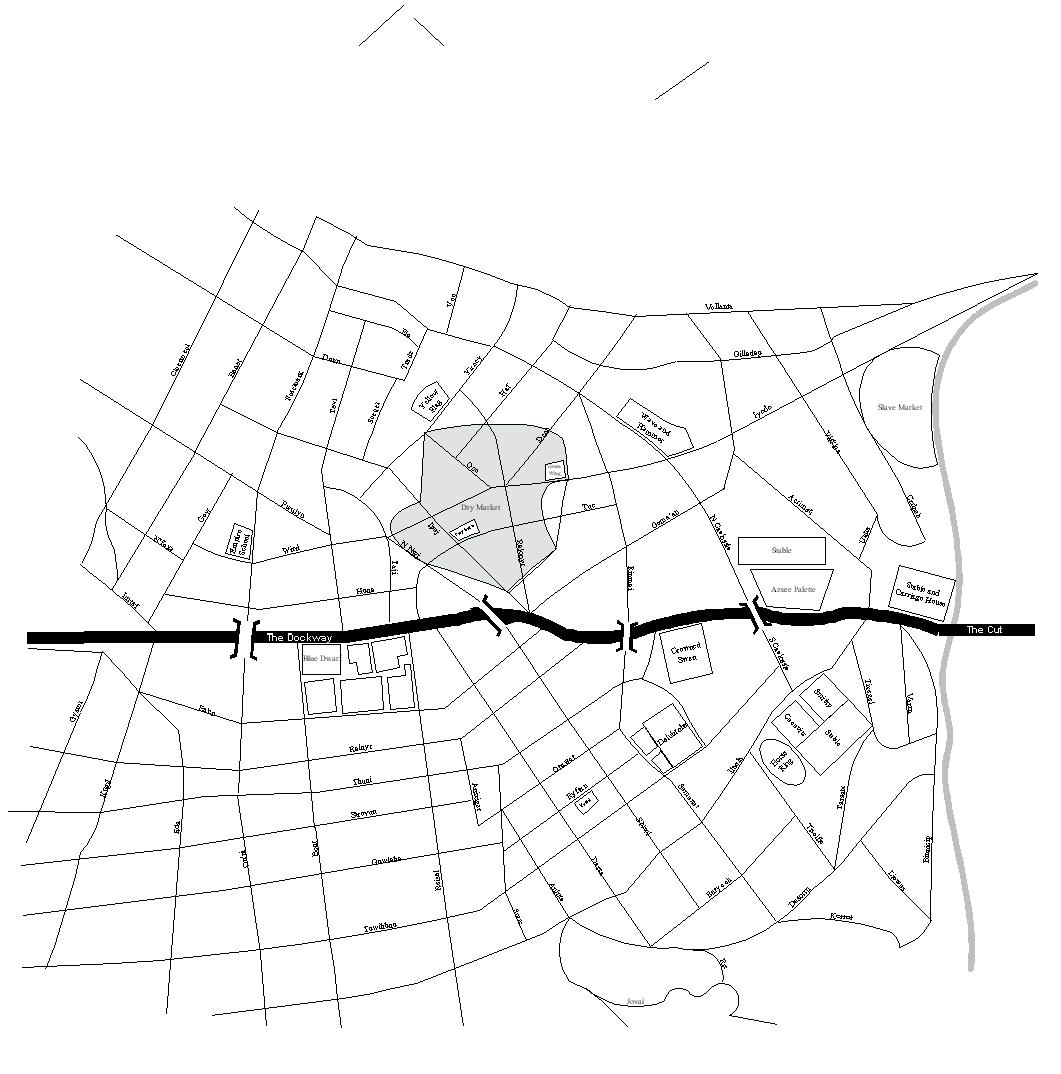 Cliffside
Like the Fishmarket, the Dry Market is a bustling, noisy place, but not as random in its layout. Where the Fishmarket grew in a largely empty place and developed into a tangled maze of tents and stalls, the Dry Market has grown around a public square surrounded by existing buildings and streets. While more orderly, it feels also more cramped. The press of the throng gives ample opportunity to pickpockets and cutpurses, so keep your silver in an enspelled pouch or around your neck if at all possible. Items for sale here tend to be more aboveboard, as the watch patrols more heavily than down in the Fishmarket. Unusual and semi-legal items are occasionally available, but the contacts to find them are harder to make, and may require introductions by trusted go-betweens. Considering the tight control in this city over spellcasting and summoning supplies, charms and other items of a magical nature, developing contacts with the underside of the marketplace may be the only way that independent magicians can pursue their Art.
The merchants here are very persuasive. I thought myself a worldly dwarf,
well-traveled and able to resist the importunings of the bazaar. It's very
nice, but I really didn't need a new drinking horn.
Four Roses
Halfway down the Cut is a leveled area with a pair of taverns, where
the weary traveler may pause in the hours-long hike through the pass that
connects Caldera and Cliffside. The better of the two is on the north side,
bearing a sign of four yellow roses in a spray emerging from a tankard.
The Four Roses is under the proprietorship of Avder Guoneanke, a patient
human woman who seems to do as much business in salt water basins for foot
soaks as tankards of ale. Many travelers pause here in their journeys up
and down the Cut, partially for rest and partially for the atmosphere,
as tales of travel are encouraged in the common room. The building sprawls
upward, spreading over the face of the Cut's north wall. While this makes
navigating the interior a bit tricky, with all the flights and half-flights
of stairs, short halls and blind turns, it does mean that every room has
a window looking out over the Cut Road.
The food here is decent enough; the quality is good, although the menu
is unpredictable, based on whatever Avder can get from shipments going
by and the cheapest of the offers for consignments directly to her establishment.
Bread and cheese are always available. The content of the stewpot varies
wildly. Ale is another issue entirely. Avder's cousin is a brewer up in
Cliffside, and he sends a wagon down the Cut twice a week with barrels
bound for the Caldera, and a couple to drop off at the Four Roses along
the way. While they don't have a proper stout, you really can't expect
to find such a thing in establishments run by non-dwarfs unless they're
catering to a predominantly dwarfen clientele. In the Halls of Throal,
every tavern has stout, regardless of the race of the proprietor. Avder's
clientele has a good deal more elves and humans and orks, the first glad
of her extensive wine cellar and the last no doubt miffed by hurlg being
as notably absent as stout. Value received for the traveler's silver is
good overall. The side benefit of hearing tales from every traveler stopping
by who can be convinced to speak, not hard considering that Avder gives
a free ale to anyone telling a good story, makes a stay at Four Roses a
must for anyone wanting to get a feel for the city and its place within
the Empire.
Preytern's Scrolls and Such
A busy emporium located at the corner of Tuc and Ipaj in the Dry Market,
Preytern's deals in things written. The front of the shop, which does a
good two-thirds of the business, is packed with desks, each one occupied
by a copyist or clerk, who for a few coppers a page will make clear and
exact copies of any document or produce a new one at your behest. For a
silver or two, they'll check your sums, and for a few more, they'll even
do them for you. Many of the local Name-givers whose literacy is not up
to writing their own correspondence or filing their own taxes come here
to have letters written and official forms produced. Access to messengers
and private carriers of regular postal routes is available here, as are
boxes where you can receive mail if you either have no permanent address
or do not wish to give yours out. The clerks will even read your mail to
you, if it is in a language you do not read or above your literacy skills.
More elaborate work is done in the back of the shop. Here, engravers, scriveners and limners ply their trades, turning out documents that are true works of art. Elaborate copies of business licenses for display, marriage contracts, title deeds and other important documents are produced here. Books are also copied and bound in this part of the shop, the smells of leather and glue underlying the crisp scent of paper like old friends standing by waiting to be noticed. Shelves to the right as you go back are lined with copies of books that can be purchased, either the original or for a lesser price a new copy, the owner charging a higher price for taking the knowledge out of his store entirely.
Once past the bustle of the front of the shop, mostly open to the street with just enough walls to keep the materials from blowing away in an errant breeze, and on through the dusty interior, past the high desks of the artists and the shelves of books and racks of scrolls, up a winding, narrow staircase too small for an obsidiman or troll to even consider climbing, you arrive in the inner sanctum. Here on the second floor, in a cluttered chamber lined with bookshelves, stacked with papers and scrolls and maps and books left open to significant passages, the master of the emporium holds his court. Genseth Preytern is at first difficult to spot. The elven wizard embroiders his robes in patterns of grey and brown, with the occasional dab of pale color, and blends into his surroundings like the lizards of the Servos Jungle. His beard is long, but still a light brown in color, elves not showing their true age until very late in life. Here, he pursues his studies, and answers questions from those customers who make it past the clerks, past the limners, and past the large ork (did I mention him?) who stands guard at the base of the stairs.
Genseth is very well read, and can deal with queries not only of a magical
nature but of historical, geographical and military knowledge. He has delved
into the True Patterns of objects, searching out their secrets; unbound
charms and cursed items from their bearers; and translated works in ancient
and arcane tongues for other magicians lacking his facility with language
and the work of the mind. He prefers to do all of his work in his study,
and will only leave it for a high price and for an extremely unusual and
interesting investigation. While his prices may seem high, normally quoted
in gold rather than silver, Genseth is a wizard of the Tenth Circle, well
established in the community for many years, reliable, and highly knowledgeable
in his Art. His license, displayed in the back section of the downstairs
shop, is a magnificent work, heavily embellished, with renewal dates going
back to before the Citadel wards were brought down and the city opened
at the end of the Scourge.
The Vessel With The Pestle
Not a terribly distinctive sign, the shingle of this apothecary shop
bears a golden cup with a thick rod emerging from it. Well off the beaten
path, on Ryftan between Darra and South Nwi, the shop nevertheless has
a steady clientele, most from the surrounding neighborhood. For many years,
Taneligu Duvisl, the elven woman who owns the shop and lives over it, has
dispensed healing herbs and advice to the Name-givers of northwestern Cliffside.
Her stock is small, but she has nearly every medicinal herb known, and
can compound potions, tonics, teas and poultices to cure nearly any complaint,
which she always dispenses with suggestions as to how best to use them
and how to avoid the complaint in the future.
I could not help but notice the large sigil of Garlen on the wall behind
the counter, and a matching sigil worked in silver on a chain about her
neck. When I asked her if she were a Questor, however, she smiled sweetly
and told me that a Name-giver's relationship with the Passions was a private
matter. With such a polite refusal, I could not press the issue, no matter
how great my curiosity. I settled for petting one of her cats, which had
leapt up on the counter and was insistently pushing its head under my hand.
She did acknowledge that she is the primary source of healing information
in her neighborhood. The residents I spoke with had nothing but good to
say of her, and told me innumerable tales of various illnesses and injuries
that she had treated with amazing success. I dislike leaving a mystery
unexplained, but will have to let the reader draw their own conclusions
as to the source, nature and extent of her healing abilities.
Wave and Hammer
Most Name-givers see only the metal goods shop with its sign of a blacksmith's
hammer floating above the sea. Few are aware that behind it lies the only
weaponsmith Forge in Cliffside. The goods in the shop, ranging from nails
to kettles to swords, are all produced by the members of the Wave and Hammer
Forge. While some of the items are expensive, the price reflects their
quality. Weapons may be brought to the shop for repair and for study, the
Forge always needing items with which to try its apprentices.
The elder I spoke with, a muscular elven woman Named Dalesu, said that
her Discipline took no notice of political divisions. If a weaponsmith
from Throal itself came by, she'd personally see to it that he got room
and board, and she'd be delighted to exchange knowledge with him regarding
their craft. She also mentioned that her Forge had a dispensation in its
licensing to allow for transient workers, which would cover said Throalic
weaponsmith and allow him to earn his keep during his stay without having
to be licensed himself.
Typical Encounters
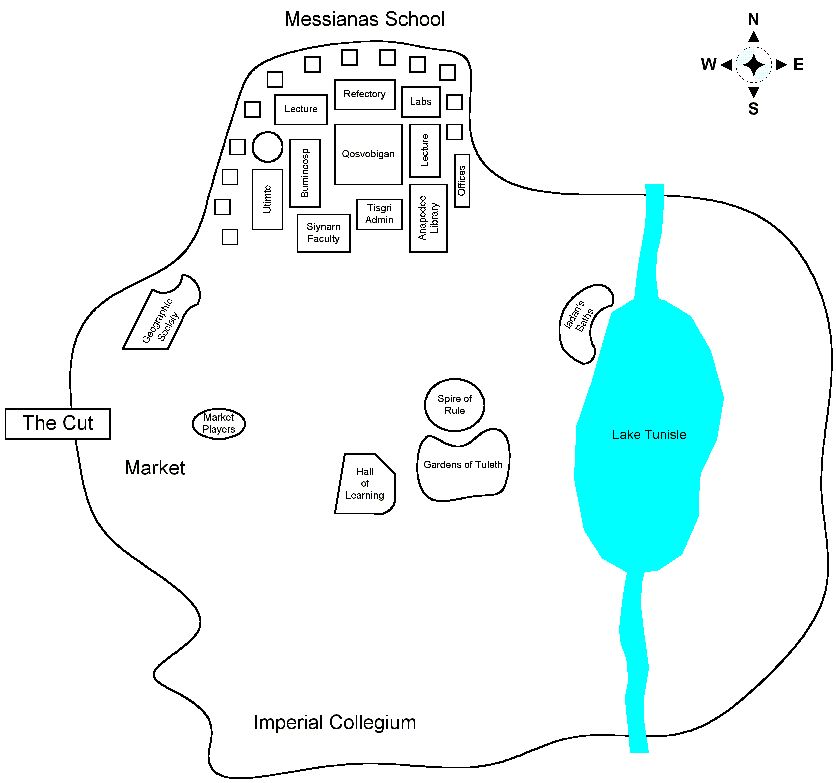 The Caldera
Enterprising food and drink vendors bring their pushcarts to the entrances
of the Gardens, as they are not allowed to hawk their wares within. Luncheon
finds most of the tables occupied. The dinner hour is quiet, as most people
prefer to meet at more formal dining facilities for the evening meal. During
the night, the occasional guard patrols the Gardens, but generally leaves
alone anyone who does not appear to be in distress. In the arbors, the
guards make their presence discreetly invisible, so as not to disturb anyone
choosing the private areas for a tryst. If trouble does arise, most of
the guards who patrol the Gardens carry wands that quietly incapacitate,
provided by the upper-form students at the Messianas School as part of
their required work.
Geographic Society of Galedon
Operating under the auspices of the Geographical Society of Thera,
such as the one in Vivane that lent me such invaluable aid, the Geographical
Society of Galedon occupies a solid, respectable structure in the northeast
of the Flat, midway between the Cut and the Messianas School. The ground
floor holds a collection of artifacts and documents donated by Society
members, a small but highly diverse assemblage, well worth perusing. On
the second floor are the offices of the cartographers, chroniclers and
Pursewarden of the Society, as well as the dining hall, the parlor and
the library. On the third floor are the guest quarters, provided to visiting
members of the Society and the occasional traveling scholar. The top floor
is reserved for the offices and rooms of the chair and vice-chair of the
order, and the private collection, items too valuable or potentially dangerous
to be on display in the ground floor hall.
Among other artifacts in the private collection that I was able to view
were the Spear of Davros, the personal weapon of a pre-Scourge Horror Stalker,
one of the founders of the Discipline; the journal of Tian Elduath, an
elven wizard who helped translate the Books of Harrow, and later came to
Galedon to found the Messianas School; and the Box of Souls, a chest of
metal and crystal that supposedly can entrap the spirits of living beings.
According to the documentation, the Box holds (among other spirits) Elialen
Ravitagur, the Indrisan nethermancer who built the Box as a waystation
for moving his soul from an old body to a young, fresh one; Urtvur Blood-drinker,
the chief of a troll raider tribe from Vasgothia who went utterly mad and
led his clan in a rampage against Theran outposts ten years before the
sealing of Thera; and Irdz'pagh, a Horror and quite possibly the one that
drove Urtvur mad. The chair of the Society assured me that the Box was
far safer locked up here, behind the protections of the Society's walls,
than in the storage rooms of the Eternal Library itself. Not even the wizards
and elementalists of the Messianas School had been able to broach the building's
formidable defenses, in their quest to take possession of the journal of
Tian Elduath. I have not slept nearly so soundly after that night, however,
knowing that the soul of a Horror lies only one story above me.
Hall of Learning
The central library of Galedon, its collection pales in comparison
to that of the Messianas School or the Imperial Collegium, but those entities
reserve access to their holdings to students, faculty and visiting scholars.
The Hall of Learning makes its works available to all. While treatises
on the deeper aspects of the arcane or point by point discussions of the
battles of the Imperial military will not be found here, maps of the Empire
and works discussing its regions certainly will be, along with books on
farming techniques, general knowledge of most crafts pursued by Empire
citizens, and a fascinating treatise regarding the history of the invae
in the Theran Empire. The imposing three-story building is lavishly decorated
with murals and sculpture of Imperial history and depictions of the dangerous
beasts formerly native to the region and the hunts that rendered the area
safe for colonization. Its mosaic floors map the Caldera, the immediate
surroundings of the city and the shoreline upon which it resides. Paintings
of every former official of the city who had the slightest hand in the
financing of the facility line the walls of the entry hall. Entrance, search
and copyist fees are comparable to those of the Hall of Records in Throal.
Spire of Rule
Rising fifteen stories above the Caldera floor, a full three levels
higher than any other structure, and with a two-story-high needle atop
to add yet more height, the Spire of Rule stands like the gnomen of a sundial:
obviously the center and guide of its surroundings. It tapers from a broad
complex of offices at its base to the Governor's apartment at the top in
a graceful sweep, the sides curving inward sharply at the bottom, the arc
smoothing toward the top. Many Name-givers have expressed the opinion that
the Spire looks more as if it grew than was built. Faced in black basalt
from the quarry in the southeast of the Caldera, and trimmed with gold
at the cornices and on the claws and beaks of the carved stone beasts adorning
the ledges between each level, the Spire is a commanding presence in the
Caldera.
The ground level is taken up with the government offices most often visited by the average citizen. These include the Tax Assessor, the Bursary, the Office of License Inspection, the Registry of Deeds and Claims and the Registry of Names. Here the citizenry pay their taxes, receive government funds for contracted work, apply to have professional licenses granted, reviewed and renewed, and file the paperwork for land and property transfers, births, marriages, divorces and deaths. The papers to prove the identity of any Galedonian citizen are here, in the Registry of Names, as well as to track their relatives by both blood and legal relationship. Likewise, the ownership of any piece of real estate, be it a well, a bridge, a building, or the land a structure occupies, can be traced in the Registry of Deeds and Claims.
The upper levels of the Spire house the offices of the licensing boards and officials. Generally, the more important and the higher in social rank the office, the higher in the Spire it is located. Thus, the office of Public Waste Management is on the second level, right above the main public offices, while the office of the Board of Magicians is near the top, only a level removed from the apartments of the governor. A clever person will note that this means that not only do supplicants to the Board have to climb all those stairs to get to the office, but so do the Board members. Waiting on a landing midway between the entrance of the Spire and the office before or after hours, or during the nooning, gives the prospective supplicant a chance to buttonhole his or her favorite Board member, and present a case in less formal surroundings. Such a clever Name-giver will no doubt be able to determine in advance which Board members will react favorably to such an approach, and which will not.
I met up with an interesting woman here, a dwarf of reasonable financial means who made her living acquiring property from the dead. Suzo Lyrkarttner spends her days methodically paging through the records, cross-referencing title deeds with certificates of birth and death. When she finds a death certificate that lists no next of kin, and a title deed in the same name with no recent transfer of ownership, she takes the papers to the tax office. If the back taxes on the property have not exceeded half its worth, then she pays the back taxes and assumes ownership of the property thereby. Suzo then turns around and sells the property on the open market, usually for quite a tidy profit. She laughed when I told her that her scheme was likely to become less profitable. After all, she'd explained it to me in detail, and I'd written it down for the benefit of the Hall of Records.
"Few people have the patience," she told me. "I go for days, sometimes
weeks, without finding anything. Then sometimes when I do find a nice bit
of property, it's all tied up in a dispute over a will, or some cadet branch
of the family trying to inherit. Of course, I have to go and look at the
place and decide if it's worth buying. Last week I had one, sounded so
good, but there was the most Passions-cursed awful tavern right next door,
with drunks passed out in the alley in the middle of the day. Nobody'd
pay good silver for property like that. No, I don't think I'm in any trouble
for competition. But I'll tell you this." She leaned close and dropped
her voice to a conspiratorial whisper. "I can tell you things about who's
related to who and who owns what that would curl your beard. The clerks
at the registries don't know those books half as well as I do. And not
all my money comes from buying up abandoned property. I've made good silver
tracking things through the records, and reporting them to the right people
-- or making sure they're never found." With that, she polished off the
ale I'd bought her and would say no more, insisting that she had to get
back to the Spire before the tax assessor closed his office.
The Arena
Built well before the Scourge, and preserved through it with the rest
of the Caldera, the Arena has been a focus of Galedon's social life for
hundreds of years. Other, similar, facilities exist in Dockside and Cliffside,
but they are always referred to by name -- Gondol's Arena, the Red Arena.
Only one in the city is simply The Arena. Gladiatorial combats are not
the only events held here, although blood sports seem to be as popular
among the upper classes as the lower. Mass rituals in celebration of the
Passions, performances by Troubadour adepts of legendary standing, and
the trials of particularly notorious enemies of the Empire have also filled
the ten thousand seats with eager spectators.
The best areas are marked off with low stone walls and the sigils of the Great Houses. Seats here come with slave attendants, magics to keep bad weather at bay and choice refreshments. The lesser areas are served by enterprising vendors, who haul their goods up and down the ramps between the stone benches carved out of the hillside crying their virtues and cost, and pay a percentage of their takings to the Arena Council for the privilege.
Chambers below the Arena serve as holding pens for condemned criminals and slaves waiting to face the dangers of the exhibition floor. Successful gladiators are housed well away from the squalor of the pens, and only have to endure them briefly on days when they must fight. The rest are kept in conditions worse than the animals used in some of the shows. At least the beasts can count on fresh water, regular feedings and sunlight. Machinery to raise and lower scenery for theatrical productions and the cages of beasts to be unleashed on the victims takes up another area. Routed around these subterranean rooms are the sewers and water feeds, to wash away the wastes from the public and private garderobes.
Roniv Aepskuenos, the arena's Pitmaster, is a large and burly ork from a cadet branch of House Zanjan. He carries himself with the usual gruffness and straightforward efficiency of his House and his race. What some people may see as callous indifference to the blood and death of the arena, he views as being more aware of the briefness and ultimate meaninglessness of life. People die, he says with a shrug; enjoy what time you have. His responsibilities include buying slaves and beasts for the bloodier events, and acting as stage manager for the beast and gladiatorial shows. Occasionally, he acts as a talent scout for the arena, sizing up likely contenders among the free citizenry for armed competition. Any time new adepts arrive in the city, and their legend includes tales of great combats or spectacular magics, Roniv pays a call to offer the adepts a chance to earn some gold fighting or doing special effects (if they're licensed; if not, he could help them get their paperwork in order).
Elatl Vislumisz, the arena's top illusionist, is a short, slender elven man. I found him to be abrupt, impatient and exacting to a fault, a difficult person to deal with. No wonder the other illusionists in the arena are unhappy; they work for a taskmaster who is impossible to please. Being of House Qelirc, Elatl is always searching for ways to outdo the Narlanthi or make them look bad, frequently managing to outmaneuver them in contract bidding for the arena. Unlike some of his more scrupulous relatives, and scruples being such a relative thing in this city, Elatl will take goods and work of less quality for more silver from a competitor of the Narlanthi just to spite his House's rivals.
Not every Name-giver linked to the Arena in the public mind are in the
employ of the facility. Feov Binzuto, a tall human man with long honey-blonde
hair in a complicated braid and usually dressed in brightly colored robes,
describes himself as the necessary opposition that the government needs
to keep its officials honest. They, in turn, refer to him as a rabble-rouser
and a nuisance, when they are being polite. At least one high government
official has privately accused him of being a Questor of Raggok, or worse,
Lochost. Such charges, however, have never been made publically. As the
charismatic leader of the Open Window, a group dedicated to letting the
light of day into government proceedings, Feov frequently organizes rallies
at the Arena. His rants, unfortunately, not only inspire the citizens to
keep an eye on their government, but seem to also cause a rise in civil
disobedience and domestic violence. No riots have occurred yet as a result
of his harangues, which is fortunate for him, as that would get him arrested
as an enemy of the state, popular public figure or not. Feov plays a dangerous
game, using the public eye as a shield against attack. As long as he keeps
the attention of the public, no one moves against him for fear of creating
a martyr. If his entertainment value wanes and his popularity falls, however,
he could easily disappear one night.
Typical Encounters
Within the Caldera, as I said, are inns of Guild and better quality. Private resorts do a thriving business here, some of which require letters of introduction from previous guests to obtain reservations. A few of the estates in the White are known for private entertainments, and there are rumors that others may even indulge desires on the part of their guests that may cross the line of legality. Sufficient silver will buy any pastime in this city, or so I am told.
Food likewise ranges from pushcarts to extravagant feast halls that require introductions. Prices and quality are both higher within the Caldera. Dockside does not offer any dining better than a tavern, while Cliffside actually has a few good dining halls.
As usual, I have reviewed a number of lodgings and dining establishments
throughout the city.
Dark Lantern
Region: Dockside
Rating: *
Pricing: *
Hard by the piers, this ramshackle two-story wooden building seems
to stay up only because the woodworms have all seized one another's tail.
Getting in requires careful negotiation to avoid the leavings of last night's
departing drunkards, and occasionally one of the drunkards themselves.
Inside, the smell is held down only by the fact that the windows have no
glass and the shutters are left open year 'round regardless of the weather.
Tables by the walls are much less popular when it rains. The bartender
is a surly ork by Name of Deren, who probably gained his disposition from
drinking too much of the sour, thin beer he serves.
For the traveler who is short on silver or in too much of a hurry to
seek better lodgings in Cliffside or the Caldera, this is one of the best
of a bad lot. Look for the sign with the flameless lamp, and remember to
bring your own blanket, as I've heard that the vermin are bad. Breakfast
and dinner are available, but should be sought elsewhere, as the cook was
thrown off his last ship for making the crew ill.
Testagar's Tavern
Region: Dockside
Rating: **
Pricing: **
A block and a half away from the Dark Lantern, the neighborhood is
much improved. From warehouses and dockside bars and houses of ill repute,
the transition to chandlers and shipping offices and taverns gives one
hope for the city. At the corner of Increase and Waggoner's, Testagar's
holds a good location for the dining business, and does a brisk trade for
all three meals. The tavern is owned by Testagar of House Carinci, captain
of Carinci's Evenstar Rising, who bought it as a shore investment. He and
his crew show up about once every half year, check the accounts, skim off
some of the profits and enjoy a huge feast that quite probably accounts
for the rest of the profits. Then they sail off, not to be seen again for
another half year.
Meals are very basic tavern fare. The stew had no more than the usual
amount of unidentifiable objects, the bread was hard but unmolded and the
cheese actually quite edible. They have the advantage of being close to
the docks, so their wines and ales are recent imports. Be cautious of the
wine and let it settle in your tankard, as the cask may have come off the
ship only that morning. While not the cheapest place to eat in Dockside,
it's relatively clean and you get what you pay for, which last is a large
recommendation as far as I'm concerned. A good number of the warehouse
and shipping clerks take their nooning here, so someone with sharp ears
could easily track the day's cargoes from their chatter. Private dining
and rooms are not available.
The Mainsail
Region: Dockside
Rating: ***
Pricing: ***
Probably the best inn and tavern in Dockside, the Mainsail is frequented
primarily by the command crews of visiting ships. Sailing memorabilia line
the walls, the honor place being given to the mainsail of the Silver Dragon,
the flagship of the Galedon fleet during the war with the coastal pirates.
Kept safe through the Scourge by the descendants of the owner of the previous
Mainsail, it's said that the sail was the core pattern item for the Silver
Dragon, and that any ship whose captain rigged the sail and knew how to
weave its pattern together with his own ship's could have the same luck
and prowess as the Dragon. Getting the sail away from Taxuf Tivoroder,
the current owner, would be difficult. Getting a room is not much easier,
as ship commanders have first refusal. The meals are generally plain fare,
but well seasoned, made from fresh ingredients and served in large portions.
Windlings should note that tankards and dishes of their scale are not available.
Blue Dwarf
Region: Cliffside
Rating: ***
Pricing: **
While a rowdy place full of mercenaries, draftsmen and heavy laborers,
the Blue Dwarf gains standing for the quality of their fare and the lower
than normal fees charged. With their clientele being primarily humans and
orks, with the occasional troll or dwarf, the food is largely meat and
bread, stews and pies, traditional plain fare. Prices are commensurate
with the average, but the portions are half again as large. My guards and
I quickly discovered that we could order for three and feed four with ease.
Their ale is dark and strong, not quite a proper stout but certainly drinkable,
and served in very large tankards. I would suggest that elves and windlings
avoid the Blue Dwarf, as the first may find the fare too plain and heavy
for their tastes, and the latter may very well be accidentally crushed
in the press. At the nooning, competition for tables becomes fierce and
many customers end up eating their meals standing in the street in front
of the building.
The Crowned Swan
Region: Cliffside
Rating: ***
Pricing: ****
I found this establishment to have pretensions above their capabilities.
They cater to wealthy travelers, Theran officials of low rank who cannot
find lodging in the Caldera and merchants who do not have House connections
in the city. Barsaivian accents will turn up the noses of the staff. I
was told that rooms were not available, nor could I get a table in their
dining hall, yet a Theran courier who came in after me was immediately
provided with a key and a menu. Security was poor, as I was able to wander
about unchallenged through the guest room halls and into the service areas.
The menu I took lists the usual Theran dishes, skewed toward human and
elven palates, but the prices are high. Like so many of this sort of establishment,
they charge for the presentation. For as much silver as they charge, each
dish should be accompanied by a quartet of musicians and a juggler. It's
said that they offer most services a traveler could desire. I wouldn't
know.
The Azure Palette
Region: Cliffside
Rating: ***
Pricing: ***
A much more reasonable accommodation for the more well-to-do traveler.
The staff here are more concerned with the color of your coin than the
flavor of your speech. As long as you comport yourself like a civilized
Name-giver, you'll have no trouble obtaining rooms and meals, along with
other amenities. Prices and services are on the level of Guild inns of
Barsaive. The decor is decidedly Galedonian, with canopied beds equipped
with insect netting, couches upholstered in soft fabrics, and high arches
in the doorways. My guards were very uncomfortable here, and thankful that
we did not stop more than the night before returning to our lodgings in
the Caldera. Threndok was concerned that all of this comfort would dull
his edge and leave him vulnerable to the dangers of life. He failed to
see the humor in it when I suggested he ignore his bed and sleep on the
floor. Vorst. Hmft.
Dining is superb here, the wine cellar well stocked and the kitchen able to produce that masterpiece of Theran culinary art, the uyglar. Specialty dishes are offered according to the shipments that have arrived that morning. The servers will inform guests who appear well-heeled enough to afford them, to avoid embarrassing guests who might not have as much silver. I'm told they occasionally send out hunting parties when rare and tasty animals are spotted in the region, in order to procure the ingredients for their more innovative cuisine.
The establishment's name derives from its sign, a large artist's palette
stained heavily with light blue paint, set on pegs over the door. The clerk
informed me that it once belonged to the painter who executed the murals
on the inner walls of the building, grand, sweeping scenes of the surrounding
countryside and the more noble pursuits of members of the Empire. If watched
for a time, some of the murals will begin to move, playing out scenes from
the Empire's past. Local legend, so the clerk told me with a smirk, obviously
not believing it himself, says that the artist wove secrets of Theran history
into the murals, but that only someone possessed of deep knowledge of the
artist herself and a key item could unlock the visions stored in the paint.
The Flame
Region: The Caldera, Lower Trades
Rating: ***
Pricing: ****
With its entrance dominated by a brass bowl the size of a troll's bathtub
holding a roaring column of fire, the Flame can be seen from all the way
across the Caldera. Some Galedonians dismiss it as being too flashy, but
it does a brisk trade among visitors to the city and the more well-to-do
tradesfolk. Offering both hearty and elegant repasts, its dining hall caters
to the tastes of most Name-givers. Beware the Maracian roasted goat. Orks
and trolls may find its spiciness amusing, but I required another tankard
of ale to quench the flames. With its rooms divided into two wings, the
east and west, the Flame serves two quite different markets. To the west,
rooms are available by the night or the week, with or without attendants.
To the east, rooms are offered by the hour or the night, with or without
companionship. There seemed to be a great deal of people in black, some
of them in not much of it, scurrying about the east wing. Prices are half
again as high as you might expect, but then that's normal for establishments
in the Caldera.
The staff tells me that the Flame is owned by an elementalist, one of
those responsible for maintaining the stability of the Caldera. They said
that as long as the fire burns in the bowl out in front, the region where
the Flame resides will stand. Apparently a few times the fire has changed
color, and the owner has immediately gone into seclusion with a few close
friends, also elementalists, until the flame returned to its normal tones.
The Rose Colonnade
Region: The Caldera
Rating: ****
Pricing: *****
Classic Theran architecture translated into the vertical, the rows
of ornately carved columns fronting the building's three levels give it
the appearance of a much taller structure. I found the pink granite and
the constantly repeating motif of roses a bit disturbing, far too reminiscent
of elven styles within the demesne of the Blood Wood. This far south, though,
thorns are just thorns and the locals can view a rose without looking for
droplets of crimson.
Well beyond the quality of a Guild inn, the Rose Colonnade's services are priced accordingly, with the additional inflation of a Caldera establishment. Expect to pay handsomely. Tipping equally well is required to receive prompt and courteous service more than once. Food served here is designed for elven palates, and may not satisfy orks or trolls. Their wine cellar is well stocked, so I am told, although I am no expert on Theran vintages.
Entertainments are likewise geared toward more refined sensibilities. Troubadours of good talent, who know the Theran repertoire, find frequent employment in the public areas, the private dining suites and the feast halls. Paintings and sculpture by artists from all over the Empire are on display throughout.
Currently, a convocation of illusionists is taking place, with followers of that Discipline from all over the Empire staying at the complex. Many of their meetings and workshops are closed to the public, but exhibitions of their Talents may be seen in the grand dining hall every evening. Having that many illusionists about makes dealing with everyday matters somewhat problematic. I was in the middle of discussing the menu with one of the kitchen staff when a very attractive dwarf woman came up to me. Pouring forth a gush of flattery, she proclaimed her admiration of my scholarship, and her opinion that I must be terribly brave to confront such horrible dangers in the pursuit of knowledge. I was quite taken with her, naturally, and gave her my undivided attention, completely ignoring the poor cook. Just as the man was about to leave and return to his duties, the dwarf woman vanished, revealing a windling in the robes of an illusionist. She laughed and told me that I should not be so easily distracted from my calling, or my reputation would suffer. Finishing the review of the menu while still smarting from the embarrassment was not easy.
Later, the incident gave me cause to think. This woman was, I believe,
the first windling I have encountered within the Empire, certainly the
first one as merry as those in Barsaive. What has happened to the windlings
of the Empire? Surely they are not all found within the ghareez?
Icefall
Region: The Caldera
Rating: *****
Pricing: If you must ask ...
Done in white marble with a blue cast to it, carved in elegant folds
and with light quartz embedded in strategic places, Icefall looms over
the Flat like a glacier, a wall of ice scarcely held in check. Within its
cool embrace, nearly any thirst may be quenched. I admit, I have seen a
good many things on my travels, and like to think myself a dwarf of refined
tastes and broad experience, but the elegant decadence of Icefall threatened
to overwhelm me. Decor elaborate and subtle teases the senses. Tableaux
with hidden meanings turn out to be living slaves, and what I took at first
for a human maiden standing unclad at the reception desk was on closer
approach a statue painted in lifelike fashion. Scents of exquisite cookery,
rare incense and the occasional whiff of intoxicants float through the
air, borne on currents fanned by captive air elementals. Music plays constantly
from behind carved screens, the artists hidden and placed so that echoes
misdirect the listener. Rooms are not available, only suites, and most
dining is either there or in private salons.
From what I was able to observe, many inhabitants of Galedon use the facilities to conduct trade, hoping that their competitors lose track of the business at hand in the flurry of sensual distractions. Meetings to discuss and close contracts worth thousands in gold are held here, as are convocations to plot the tangled threads of the complex tapestry of Galedonian politics. Many sell-swords and even adepts find employment guarding such events, providing they can handle the sybaritic environment without losing track themselves of the task.
More exquisite and hedonistic establishments exist, I am told, but are
reserved for the extremely wealthy, the most highly placed, and those they
favor. You only discover their existence when you achieve the social rank
to attend them.
Schools and Collegia
Literacy is every bit as important to the Therans as it is to the people
of Throal. Every bureaucracy requires a constant supply of new clerks and
scribes to keep it running smoothly. Even the poorest neighborhoods have
access to basic schooling, and the child who shows an aptitude for letters
or numbers can rise above the poverty of their origins, just as in Barsaive.
The more I see of the people who make up the Theran Empire, the less easy
it is to dislike them. Their government is still the enemy of Throal, and
the practice of slavery is still loathsome, but the general populace, especially
the common people, are so much like the people of Barsaive that it is hard
to keep the differences in mind.
The ancient system of apprenticeship is practiced as widely in the Empire as it is in our own lands. Many children are sent off at an early age to learn a trade, often precluding attendance at a state-run literacy school. Some of these do not achieve proper reading and figuring capabilities until they reach journeyman in their craft and have the time to spare for training outside of their field.
Dockside
Down in Dockside, there is only one school, run by the government.
It teaches children (and the occasional adult) basic reading and figuring.
Promising students who complete the available lessons are sent to the more
advanced school in Cliffside. While the school does have a proper Name,
being the Guleso Tpoget Academy of Literacy, Docksiders refer to it simply
as the Empire School, or the Dockside School if discussing it and the Cliffside
establishment.The building was damaged recently, its windows broken and
a fire deliberately set. Classes are being held at a warehouse down the
street until the damage can be repaired. I can think of no reason to attack
a school, unless those with no talent for literacy are jealous of the chance
it offers for others to climb out of their mean surroundings and make a
better life for themselves.
Cliffside
Cliffside houses numerous schools and private tutors for students who
show great promise at the Empire schools and can afford further training.
Most of the schools in Cliffside are sponsored by various trades, to provide
a pool of potential new workers. Thus, there is a clerk's school, a copyists'
school, a school for teaching basics of carpentry, and so forth. Each of
these is maintained by a group of tradesmen, who invest silver to cover
the costs left over after the students have paid their fees, and in return
receive exclusive rights to recruit graduates into their businesses. Many
of the private tutors also provide research services and the abilities
of their Discipline, if any, to the public for a fee. Magical knowledge
is unevenly represented here. While wizards may be found with relative
ease, nethermancers and illusionists are scarce and the only elementalists
in Cliffside are the ones who either could not get into the organization
within the Caldera, or who ran afoul of its politics and were posted outside
the more desirable region.
Mozerl Rogosh is one of the latter. I found the tall, cadaverous human at his customary place, at a table in front of the Green Wing, sipping an ale and casting a jaundiced eye on the passing crowd. After I bought him a more expensive stout, he agreed to talk with me.
"It's all under a dynasty," he said, "but not any one House. You'd think there would be a House monopoly on elemental magic, as there is in so many other cities. No, this is a dynasty across House lines. It all dates back to the elementalists who first secured the Caldera. Their students and children, the ones who took up the Discipline, went on to become pre-eminent in their field. When time came to build the citadel, and put up the wards, the same lines took the contracts. There was never a real bidding process. They were simply handed the work by the Governor. All through the Scourge, they plotted and planned and made alliances and married for political ends and to increase the concentration of magical power. So what do we have now? A load of inbred politicians holding the reins, controlling who can and cannot practice the Discipline within the Caldera. If you're not of their lines, or willing to kiss their feet, it matters not how well versed you are in your arts nor how easily you may command the elements. Bah!" He polished off the stout and waved the serving maid over to fetch him another. "If I could but scrape up the silver to leave this stinking pesthole -- " And then his attention was taken up with the new tankard, and mine with fishing out a silver to pay for it, and so I lost the rest of his remark. Shortly after that, I lost his attention, as he slumped down in his seat and fell into a drunken sleep.
The elementalists within the Caldera do seem to be a cliquish lot. They
certainly won't speak with anyone without an appointment, and that secured
with a personal introduction. See my notes on The Flame for a peculiar
situation involving the followers of this Discipline within the Caldera.
Cliffside School
Nearly a replica of the Empire School down in Dockside, the building
for Cliffside's basic literacy academy is in much better repair. Officially
the Lanut Kwang School of Basic Education, the citizenry generally refer
to it as the Cliffside School to differentiate it from the Dockside School.
Training in the Theran language and in basic mathematics, history and geography
is available free of charge to citizens under the age of majority for their
race. Adult literacy classes are offered for a nominal fee.
Every morning, children swarm from all over Cliffside to the School, creating a traffic hazard. They never look where they're going, darting out in front of moving wagons, playing tag around the adults on the streets, and acting as children do the world over. I greatly enjoy telling the stories of my adventures to a willing audience, but not on the streetcorners. As soon as I was identified as an adept, my guards and I were overrun by small Name-givers asking more questions than could be answered with nary a pause for breath between them. Hardly had I begun to try to fit explanations to the queries, than the school bell rang, and the entire mob dashed madly off down the street, with one of my boot knives in their possession. I would strongly recommend staying off the streets in the early morning, until the bell has rung to summon the hordes to their daily confinement.
Competition in the Cliffside Empire school is fierce, as graduates in
good standing are nearly guaranteed a lifetime appointment to an Empire
post. More than once, House rivalries and attempts to compromise the Empire's
testing system have resulted in spilled blood. The lesser Houses, the ones
outside the Caldera, hold great store by the outcome of the classes. In
a city as prone to intrigue as Galedon, this means that students are vulnerable
to becoming pawns in House plots to ensure appointments to key offices,
so that future contracts may be secured with ease.
The Caldera
As usual, private tutors are available, many of whom in this region
have a waiting list and a very exclusive clientele. Money alone will not
procure their services. Connections and family background are vital, especially
for tutors who reside in the White. Anyone moving into the area who wishes
to take students must first acquire a permit from the council that governs
the subject. Licenses are expensive and few, and of course the committee
is formed of pursuants of the subject it governs. If you do not make a
good impression with the elementalists of the Caldera, you will not be
allowed to teach elemental magic, or even practice it within the Caldera.
See my notes on licensing under Concerning Government.
Schools likewise consider the background and potential power of a student before admitting him. Ability alone will only gain a place at the Empire literacy academy. Licensing and dynastic control over both the faculty and the makeup of the student body are more severe than with private tutors.
Three tutors and two schools stand out and bear closer examination.
Jevex Purworafi
One of the city's most widely renowned nethermancers, Purworafi originally
comes from Indrisa, having settled in Galedon in his youth. Many years
ago, he led a team of adepts who drove the Horror Bone Crown from the city,
firmly establishing his place. Now in his old age, Purworafi takes the
occasional student, preferably one who has already passed his Journeyman
Circles, and reveals to him the deepest secrets of the nethermantic arts.
Purworafi resides in the White, at the north end of the Caldera. While his house is not large for its neighborhood, it is nonetheless imposing, encrusted as it is with small sculptures of beasts both real and fantastical, and magical sigils in complex patterns. Disturbing to the eye, these are more than decoration. The nethermancer's home is said to be better protected against magical assault and astral invasion than the central demonstration hall at the Messianas School. The families to either side tend to avoid crossing in front of his home, and I cannot say that I fault them for it.
It is said that Purworafi can see the souls of those who come before
him, and has twice singled out a child for training long before even the
child's parents suspected their offspring of magical capabilities. I do
not know the truth of this. I only know that I passed the elderly human
one day in the Gardens of Tuleth. He was dressed in robes of cinnamon and
azure, richly embroidered with designs that hurt the eye if studied too
long. Leaning heavily on a staff, he was closely attended by a young Maracian
dwarf boy dressed all in black who struggled manfully under a load of books.
As he passed my table, he glanced toward me, and our eyes met for the briefest
of instants. A cold shudder swept through me, and I knew without the slightest
doubt that he had seen all the way to the core of my being, held every
secret of my life, knew my Pattern more thoroughly than I did myself. Then
his gaze traveled on, and in the aftermath my only clear thought was that
despite the throng, he seemed to have no trouble progressing at his own
pace. The path cleared before him, and I understood why. Passions save
me from nethermancers.
Vetl Iec
An elven member of the House of Medari, Vetl Iec trains the progeny
of her House in history and philosophy. From the first days out of the
nursery through adulthood, Vetl's lessons form the core of their understanding
of the Empire, its past, its present and the ideals that shape its future.
A woman of stately grace, she carries herself with the dignity that befits
the person who shapes the minds of her House, and the self-deprecating
humor of a scholar of history who is aware of her significance in the multi-millennia
span of the Empire.
Residing at the estate of J'tiag Ongbikyom, the patriarch of House Medari in Galedon, Vetl makes it clear where her loyalties lie. The guest-house where she lives, set well back behind the white marble walls of the estate, is small and easy to miss against its resplendent surroundings. She has never married nor had children of her own, being wed first to her calling.
While she refuses any student who is not of her House, she nonetheless
enjoys the conversation of other scholars, and may be found in the evenings
at the Gilded Scroll in Lower Trades. Anyone who can at least hold their
own in discussion may be able to learn some fascinating bits of history
from her. Vetl also presents a lecture once a month at the Hall of Learning,
in which she discusses a notable event from the past and what lesson could
be learned from it in light of current events. These lectures are attended
by high-ranking members of the city government, and occasionally even visitors
from Thera itself. Admission, at the last such lecture thirty silver, must
be purchased months in advance to assure a seat, and even then those of
low rank may be bumped for a visiting dignitary.
Nisiqo Osif
An aging t'skrang woman of stern aspect, Nisiqo was the premier dancer
in the city for many years. Now with her limbs gnarled and stiff, she still
rules the world of dance as the leading choreographer and dance teacher
in the city. Other performing arts teachers defer to her in matters of
stage presentation, body movement and selection of musical accompaniment.
Holding court in her studio in Cliffside, the cost of that much space being
prohibitive in the Caldera even for an artist of her stature,. she rarely
appears in the Caldera any more due to the rigors of traveling down the
Cut. Even in a sedan chair, the trip is difficult for her. Every morning
finds her banging out rhythms with her staff and tyrannizing her students,
who while they fear her would do anything for her. Training under Nisiqo
guarantees a place in the most prestigious dance companies of the Empire,
if you survive.
In the evenings, her gregarious t'skrang nature takes her down the block
to the Stars and Garters, a tavern frequented by Cliffside's artist community.
There, she has dinner and whiles away the late hours in the company of
her friends and contacts -- dancers, playwrights, actors, setbuilders,
troubadours, musicians and composers, and even the occasional sculptor,
painter or theatrical illusionist. A great deal of business in the performing
arts world is transacted around her table. Just being in the background,
you can meet and talk with people who get things done in the city. Actually
obtaining a seat at Nisiqo's table puts you in the company of the most
powerful members of the artistic community.
The Messianas School
Operating under the authority of the School of Shadows in Thera, the
Messianas School is the only training academy for the magical arts in Galedon.
Anyone who does not attend the School must make private arrangements to
learn magic in theory and practice. As with the remainder of the city,
elementalists are predominant, with wizards second in terms of the number
of faculty positions held, then nethermancers and illusionists collectively
coming in a distant third. One would think that there would be a stronger
illusionist presence, especially in a city as given to intrigue as this,
but if there are more, they are well hidden. Rumors are quietly told of
a secret order that meets in Cliffside, but I was unable to chase them
to ground. Those I spoke with seemed either completely in the dark on the
subject, or nervous and unwilling to speak with me ever again.
Occupying the north of the Flat, the school is an odd melange of architectural styles, each building having been designed in a competition among the city's architects. The composition of the selection panel varied from one to the next, and so did their tastes in structures. Fortunately, there are many trees to shield some of the more clashing designs from each other, and somehow the campus resolves into a harmonious whole. Between the eccentricities of the campus itself, and the eccentricities of the faculty and students, a certain charm is achieved, leaving the visitor feeling to be in the company of his favorite uncle, the one who can always be counted upon to liven a dull dinner by doing something completely unexpected and possibly inappropriate.
Central to the collegium is the Qosbovigan Lecture and Demonstration Hall. Named after a nethermancer who gave his life to uncover a vital secret of the Horrors in the days before the Scourge, it's said that his ghost occasionally appears to people wandering alone within, especially in the service tunnels below or in the watch-turrets high above. All of the more complex exhibitions of spellcasting and summoning are held in the main hall, whose wards are replicas (at lower power, due to the falling-off of mana) of those that protected the Caldera during the Scourge. The two subsidiary lecture halls and the classrooms upstairs are shielded by the wards over the building itself. Used primarily for theoretical classes and the occasional demonstration of a minor working, they do not need the terrific protections of the main hall. The building is done in the old Theran style, after the School of Shadows, with heavy columns and narrow, peaked arches. On either side of the main entrance, a granite lion lies gardant on a plinth of green marble, the stones repeated inside in the granite columns supporting green marble bowls of light quartz to illuminate the entry. Portraits of many of the previous faculty hang throughout the building, with the current dean and governing council frowning at the main doors from the wall opposite.
Close by stands the novice residence. Bumincosp Hall looms over the campus the way a kila hangs over a doomed village, an imposing, forbidding edifice of dark grey stone that may without warning plummet from the sky, causing substantially more damage to the ground below than to itself. Nicknamed Boom and Crash because of its proximity to the demonstration hall, living there encourages the early mastery of wards, silence spells and sleeping draughts. The residence for journeymen, Utimte Hall, is on the far side, where the noise from Qosbovigan is reduced. Only a short bit of lawn separates the two buildings, giving rise to one of the more notable architectural collisions on the campus. Utimte Hall's delicate spires and elaborate stained-glass windows, compared to Bumincosp, give it the semblance of a windling standing next to a troll. Students above the rank of journeyman normally make private arrangements for their lodging off-campus, and so do not have a residence hall dedicated to their use.
Scattered around the back of the campus, edging into Downslope, are the residences of the faculty, forming a rough horseshoe that encloses the campus on three sides. At the apex, on the slope to give it obvious precedence over the rest, sits the home of the Dean, an edifice hereditary with the title. Built in a modified form of the classic Theran villa in style at the founding of the Empire, the building sprawls delicately with neatly trimmed gardens encircling it like ripples in a pond. Only a single story, the pink marble walls enclose an interior, private garden at the center of the hollow-square design. Some previous Deans have used this garden to express their creative urges, or for therapy after a hard day riding herd on a fractious, egotistical faculty. The current holder of the office, an Elementalist of the Thirteenth Circle, an elven woman of House Narlanth by the Name of Nerenkilia Te'alo, prefers to use it for meditation and for receiving private social appointments. It is said that you can tell what the situation is by where she receives you. If the garden, then the issue is not dire, but if you are received in her office at the back of the house, you should cancel everything else and be prepared for world-shattering news, most likely to your detriment.
The refectory is worth noting, not so much for the quality of its repasts, as for its being one of two buildings in the city designed by Vostler Auraynt, the dwarf architect who also designed the Eternal Library at Thera. Its elegant lines blend in naturally with the surrounding landscape, giving the impression of something that grew rather than being built. Unfortunately, it's a case of an exquisite setting for a gem of poor quality. Meals for the students are no better than those in the meaner taverns in Cliffside. The faculty, of course, enjoys much better in their private dining hall on the upper floor, rank having its privileges.
At the front of the campus, the edge that faces the remainder of the Flat, are the library, the administration building and one of the two faculty office buildings. These three present the face of the school that most of the city sees, casual visitors to the campus being discouraged for tolerably obvious reasons.
Five stories in height, the Anapodee Memorial Library is one of the tallest structures in the city, surpassed only by the Spire of Rule and the watchtower at the base of the Cut. While its holdings do not in any way rival the Eternal Library, or so I am assured, it remains one of the larger repositories of wisdom in the Empire. Not only magical knowledge, but information on every subject known to Name-givers is stored there, as one never knows what abstruse bit of knowledge may be key to unlocking the deeper secrets of the arcane. That, and wizards do love their books. Admission is restricted to students, faculty and invited guests.
With its long, colonnaded front and high, peaked windows, the Noriat Tisgri Administration Building bears an uncomfortable resemblance to an astral being that I will not Name here. Some of the students make quiet, nervous remarks only half in humour about the building swallowing the occasional unfortunate, usually a novice, never to be seen again. All of the administrative staff have their offices here, ranging from the bursar to the registrar. Of the faculty, only the Dean maintains an office here, and only as a place to store papers that she intends to get to someday. Important documents are taken to her at her residence or at her laboratory.
Endowed by an adventurer with more gold than he knew how to spend, Siynarn Faculty Hall is an elaborate structure more resembling a miniature palace for territorial governance than a place for faculty of a magical collegium. Its numerous spires and glittering multicolored glass give it the air of a stage setting for a play set in some long-lost elven kingdom. Within, the passages wind and twist with abandon, frequently looping back upon themselves or ending abruptly. Stairs are infrequent, with inclined passages or gently curving ramps preferred for changing levels. Only the faculty and their assistants can find their way through the maze with any semblance of ease, and then only after they've had a few years of experience.
At the back of the campus, to the east of the refectory and wedged in
under the trees by the eastern arc of faculty homes, lies the faculty laboratory.
Quite possibly more dangerous than Qosvobigan on graduate examination day
for nethermancers, the two-story edifice is divided up into numerous small
laboratories, each assigned to a different faculty member. Security measures
are extreme, the fundamental principle of the free sharing of knowledge
among fellow magicians notwithstanding. No member of the faculty wants
another to see what's going on in their private research, at least not
until they're ready to announce their results. Free and liberal use of
elementals, guardian spirits and wards makes simply moving through the
hallways a risky business. Actually entering one of the laboratory rooms
without the permission of the owner would be a frightful task. Stories
are told of how one of the previous Deans very nearly died attempting to
open the laboratory of a faculty member who passed away peacefully in her
sleep, taking with her the commands to set aside the protections.
Imperial Collegium of Galedon
At the opposite end of the Caldera from the Messianas School stands
the Imperial Collegium. Courses include history, accounting, military theory
and officer preparation, natural philosophy and social finishing. Many
of the progeny of wealthy and prominent Houses who no doubt could arrange
private tutors attend the Collegium for the social and political connections
that are forged during the academic years.
The faculty includes several of the more noteworthy scholars in the city. Some of them are more approachable than others, so herewith I present a few rules of thumb for the visiting scholar who wishes to exchange knowledge with his fellow academics.
Erlyn Xeotmelare, a soldier of Araucanian origin, retired from his position as a military adviser to the High Council a few years ago, and now holds a teaching position as Dean of Military Philosophy. He cuts quite a striking figure, a tall, lean human with copper-brown skin and jet-black hair, dressed usually in dark green robes from his native land, brightly-colored feathers hanging from the shoulders and seams. Approaching him with either an unusual military artifact or delicacies from his homeland will put him in a talkative mood, ready to discourse on past military situations, the present tensions and general topics in his field. Do not expect him to compromise Theran security, however, and do not ask him to if you prefer your head to remain attached to your neck.
Historians will want to visit the Raneji Library and seek out its chief archivist, Taok Anieltos, a dwarf of cheerful disposition always ready to debate the past over a mug of stout. While a very old man, he still gets around quite well, and can tell you the location of every document in the building, a quite amazing feat considering its four levels of books, scrolls, maps, correspondence, journals and loose papers. Anieltos also holds the chair of the History department. His lectures are few but well attended, and almost certain to leave his compatriots arguing among themselves for weeks.
My time with Annike Walczewska was interesting, albeit a bit frustrating. The slender blond human woman is from the far north, beyond my native Barsaive, although I could not render the Name of her land in Throalic sigils in any way that satisfied her as to the pronunciation. She speaks not a word of Throalic, her Theran is not very good and she lapses into her native tongue or pauses when stuck for the right word. On the other hand, I found her to be a brilliantly intelligent person, and well worth the intense effort it took to have a conversation. Beyond that, she carries her advancing years with more grace than many, and if her charm is an example of how her people comport themselves, then perhaps King Neden should send a diplomatic expedition to the north. Passions know Throal could use polite allies. Getting back to the subject at hand, Annike is an alchemist, one of the many semi-adepts in our world who have developed a few Talents but do not have a Discipline. She teaches herb lore, the compounding of potions, and the like. Currently, she is engaged in studies to determine why potions work. Most lists of ingredients and processes were arrived at by accident, she explained haltingly, or through trial and error. Annike wants to be able to predict the results of changes in process and new combinations of ingredients. Rael Parlesanc, a wizard at the Messianas School, has taken an interest in her work, and in a rare example of cooperation between the two institutions is working with her on the research. Between her abilities with compounding potions and deep knowledge of herb lore, and his wizard Talents in research and investigation, I fully expect them to make a series of breakthroughs in the very near future.
The campus is necessarily compact due to land in the Flat being at a premium, and the collegium actually climbs the wall through Downslope and well into the Lower. An arc of faculty residences across the Flat and a half-circle of student dormitories up the wall form a circle around the campus, effectively presenting the back of the collegium to all approaches. The inward focus is repeated with the Deans' Hall in the center of the campus, and all of the lecture halls and other facilities facing the administration building. A predominating theme of solidity, of weight and strength pervades the architecture. Columns are wide for their height, buildings are squared off resolutely. There's a decidedly dwarfen touch to the designs throughout, with decorative moldings around the tops of the doors and windows, bright colors worked into the augmentations and trim. Visitors should make a point of looking up to see the fine work around the edges of the ceilings, and the murals in the more important buildings.
Mirgoi Hall has perhaps the most impressive of these. Known more familiarly as Deans' Hall, the two-story entrance boasts a ceiling-spanning mural of the Twelve Passions by the famous pre-Scourge artist Geyd Tusirt. Obviously, some sort of magic was worked into the mural, as the images of three of the Passions changed during the course of the Scourge. Galedon's citizens knew of the fate of the Mad Passions as it occurred, possibly something they might not have wanted to watch in the process. While still a masterful work, Name-givers do not pause to admire the mural nearly so often now, and hardly anyone climbs to the second-level railed gallery for a closer inspection. Further into the building, the halls are painted with scenes from the history of the Empire, most of the second floor being given over to the conquest of Indrisa. The arrangement of offices follows an obvious plan, with the most junior officials and the offices the students are most likely to need on the first floor, the senior officials on the second and the Dean of the Collegium on the third.
Between Deans' Hall and the student residences on the slope stands the Maatol Nuyqamer Hall of Natural Philosophy. Its ground floor houses the Collegium's museum, with specimens collected from the local area and all over the Empire. Some of the students find it amusing to guide visitors around to the left the long way, past the glass-fronted cases of butterflies and the rack of Araucanian spears, to come abruptly face to face with a stuffed brithan, mounted in a rearing pose with mouth open and claws raised. Knowing that any such animal encountered in the museum would not be alive, I did not fall for the prank, but I'm afraid Gotir has been in a foul temper since, as he immediately drew his sword and leaped to protect me. Vorst are not known for having a sense of humor, especially when they're the butt of the joke. On the second floor of the building are the lecture halls, frequently a bit smelly from preserved specimens being dissected, and on the third floor the offices of the faculty. I spent a fine evening with K'mar Nadonu, a troll naturalist of high standing, comparing notes on the plants we had encountered in our respective travels. She tells me that she plans a trip soon to Vivane Province. Perhaps she could be guided into the company of Evanten Farseeker, for surely they are kindred souls, committed to the study of everything living.
The Collegium's refectory enjoys a much better reputation among its
students than does that of the Messianas School, at the far end of the
Caldera. This is possibly due to its being part of the learning regime.
Every meal is served in formal style, with a fresh centerpiece and polished
silver on the table. While the food is not always tremendously elaborate,
it is nearly always of the finest quality. Occasionally, so I am told,
one of the serving platters will be sabotaged, to teach the students what
to do when they are served something either obviously wrong or not to their
liking. Proper etiquette is expected at all times. The hall itself is the
very model of a Theran formal dining room, with crystal sconces illuminating
subtle art on the walls and on pedestals in key places, a high, vaulted
ceiling embellished with clever small touches that do not distract the
diners from their meals and conversation, and comfortable chairs designed
for extended occupancy. I am told that at times the hall is cleared of
furnishings and turned into a ballroom, for instruction in dance and formal
gatherings, with the faculty playing roles ranging from important bureaucrats
whose favor must be curried to visiting adepts whose influence may not
be immediately obvious.
Concerning Entertainment
The people of Galedon have found a number of unique ways to pass the
time. From lavish feasts where the presentation of the elegantly prepared
dishes is more important than the eating of them, to savage blood sports
down in the worse ends of Dockside, entertainments in this city are more
complex, more intense than any place I have before visited. I hesitate
to think what may be available in Thera proper, after some of what I have
seen here.
As with everything else in Galedon, entertainments vary according to the region of the city. I feel that a discussion divided by geography will paint a clearer picture than an overview of the city as a whole.
Dockside
As with any city, some of the entertainment brings itself to the people
rather than the other way round. Even in the bustle and tumble of Dockside,
minstrels and jugglers and storytellers find a corner of a street or a
tavern in which to practice their arts. Here, though, their lives are a
little more difficult. In the Caldera, when a performance is appreciated,
silver is thrown, and when it's bad, a few coppers so the offending bard
will go away. In Dockside, the audience throws coppers when the performance
is good, and when it's bad, they throw knives. Some of the performers have
picked up juggling skills so that they can snatch the blades out of the
air and add them to their act, forestalling further throws and saving their
show and possibly their lives.
Storytellers
Storytellers are very popular in Dockside, people who can recount the
legends not only of great heroes of the past, but of the crews of ships
currently in port. Having the right tale to suit the mood can bring many
coins from an appreciative group of sailors on shore leave. A good storyteller
will have tales of amusing misadventures in his repertoire as well as stories
of heroic feats, and will know who has enough of a sense of humor to not
be angered upon hearing how they came back aboard after far too many tankards
of stout and mistook the bilge vent for the hatch to the forecastle, ending
up in the ship's sewage instead of their bunk.
The grand elder of the storytellers, Granny Ochlocknee, holds court in the Broken Spar, down between the deep-water docks and the barge tie-ups. A grizzled, nearly toothless human woman of advanced years, it's said that Granny knows every slip made by every officer, every strange occurrence both onboard ship and at other ports, and the smallest events of Dockside since the Scourge. Prying the tales out of her isn't that difficult, for the more common ones -- a tankard of ale and a few silver and she'll spin the yarns gladly enough. Peculiar and obscure tales may take some wheedling, though, or the offer of a tale she hasn't heard before. A good telling of a new story can jog her memory and bring forth all sorts of strange lore. The other storytellers of Dockside defer to her for the correct versions of tales and in disputes regarding territory or precedence. More than one minstrel also owes his allegiance to her, as her opinion holds great sway with the tavernkeepers. A bad critique can result in no hearth to claim.
Of the minstrels, a few have no worries as to hearths and places. Disicco
Longshanks, for example, can always find a patch of deck on which to spread
his cloak. The elven minstrel is a favorite of the sailors who ply the
southern and eastern routes, knowing their chanties and drinking songs,
as well as ballads about and from the lands along the way. He carries a
harp, as many elven minstrels do, but also travels with a massive Indrisan
stringed instrument nearly as long as he is tall, whose plangent twanging
blends interestingly with his clear tenor voice. Apparently many of the
sailors who ply the Indrisan routes have a taste for that land's long,
passionate love songs, and so Disicco never wants for drink, bed space
or passage when his feet grow itchy.
Pit Fighting
Down in Dockside, there are arenas where blood sports are practiced
using slave gladiators. I have seen this sort of thing before, in Servalen,
but there the combatants were either condemned criminals, who could win
their freedom by surviving the bout, or animals, or Name-givers participating
of their own free will for prize money. In Galedon, the fights are between
slaves kept for the purpose, or the occasional unruly slave who has been
more trouble to his master than his worth. While just as savage, brutal
and bloody as the pits of Servalen, the practice is even more abhorrent
here because of the lack of free will on the part of the combatants. Yet,
every night, the roughest of the Dockside element gathers in the galleries
above the pits, to consume bad beer and smoked meats, and to cheer on the
Name-givers condemned through no act of their own to fight to the death.
Large sums of silver change hands with every bout, and frequently more
fighting occurs outside the pit than inside when gambling winnings are
disputed. In the confusion of the nightly brawls, more than one old score
has been settled. Most Barsaivians should find these places repellant enough
to avoid out of good taste. Those who do not quite probably deserve the
fate that awaits them.
Gambling Dens
Where there are sailors and other transient workers, there are gaming
halls. Dockside is full of places to lose your money, and quite possibly
your life. Winning is difficult enough, considering how often the games
are fixed. Escaping with your silver is another challenge. Some of the
halls do not take kindly to people beating the house. Their proprietary
attitude toward money that enters the premises may come with an edge. Others
are haunted by thieves who lay in wait down the street for successful gamblers.
If you're looking to meet some very rough people who will gladly administer
a beating for a few silver, and make a body disappear for a gold or two,
then by all means the beer-soaked and smoky dens of Dockside are for you.
If you seek games of chance and skill in a pleasant atmosphere, where you
may actually see the next morning with your winnings and health intact,
then take yourself to Cliffside.
Cliffside
Cliffside finds itself caught between the rough brawling of Dockside
and the refined airs of the Caldera. Many of its more elegant inns, near
the Cliff, must cater to lesser nobility en route from one end of the city
to the other, or to visiting officials who for one reason or the other
do not stay in the Caldera. The free servants of these people are quite
likely to have similarly refined tastes in entertainment, and quite possibly
the silver to indulge themselves at least mildly. At the other end, by
Dockside, the atmosphere is rougher, although not nearly so bad as down
by the piers. Out in the fringes of Cliffside, near the slave market, are
a few pit fighting establishments. While Dockside must cater to the tastes
of sailors on leave, Cliffside has no such excuse.
Cliffside enjoys a higher percentage of Troubadour adepts than Dockside, although not so many nor of as high a Circle as the Caldera. Dockside does not have a playhouse, where Cliffside has one and a troupe of puppeteers who frequent the Dry Market, setting up their booth more or less in the same place each day as traffic permits.
Games of chance are nearly as popular in Cliffside as they are down
in Dockside. The traveler who wants to try his hand at jongleur or blind
raider will find a better crowd here, composed mostly of craftsfolk and
the occasional merchant. The stakes tend to be higher, in silver and even
gold rather than the copper-ante games of the Dockside gambling dens. Surviving
to get home with your winnings is a less risky proposition here, as most
gaming halls in Cliffside will have a guard presence, as well as mercenaries
of reasonable trustworthiness for short-term hire.
Yellow Flag Players
A loose coalition of actors, activists and rabble-rousers, the Yellow
Flag Players take their name from the saffron banner that flies atop their
playhouse on days when they take the stage. Normally, two works are presented,
the first being a classic work of popular appeal, and the other being a
political commentary thinly masked as a comedy. City officials are a favorite
target, residing in the Tower of Power, a structure wider at the pinnacle
than the base that invariably comes crashing down at the end from the bad
decisions of those at the top. One can only surmise that Xatuman Injitoa,
the chief playwright and lead actor of the Players, is well connected somewhere,
otherwise his insistence on portraying Governor Miklos as a petulant, wheedling
fool would surely result in his disappearance one dark night. The popular
works given first billing are usually adventure stories, filled with swordplay
and magic, often based (very loosely) on the actual exploits of noted Theran
adepts, and much more likely to have been overheard in a bar than read
from their journals.
Gambling Houses
While still not the genteel homes of games of chance that can be found
down in the Caldera, the gambling houses of Cliffside are in general a
vast improvement over the grimy dens of Dockside. Clean, decently ventilated
so that the smoke does not build up, and carrying a good selection of ales,
wines and preserved foods, they provide a far more preferable atmosphere
in which to concentrate on the next roll of the dice or turn of the cards.
The two most popular games here are jongleur, in which the objective is
to accumulate cards with a face value totaling as close to thirteen without
going over, and blind raider, a dice game in which bluffing is more important
than the actual roll. I spent a night playing blind raider, and found swiftly
that reading the expressions of the players, and choosing one's seat with
care, are vital to success. Each player at the table antes a coin, usually
a silver in Cliffside. Five dice are dropped into an empty tankard, then
the tankard is upended on the table, covering the dice. The current player
peers at the dice, shielding them from view of the others with the tankard
and his hand. The player then slides the tankard, with the dice under it,
to the player to his left, and announces the result of his roll. The receiving
player has to make a choice. If he believes the first player, he looks
under the tankard, shielding the dice from view of the others. He may then
take dice out from under the tankard if he desires, but must roll at least
one die and pass the dice to the next player, claiming to have made a roll
that beats what he himself was passed. If the receiving player does not
believe the passing player, he picks the tankard straight up, exposing
the dice. If the claimed roll is present, the passing player wins the coins
on the table, but if the claim is proven false, the receiving player gets
the stakes. Each time the tankard is passed, both players involved toss
in a coin. With a series of successful bluffs, the table stakes can rise
quite swiftly, the more so if the ante is silver and the bet gold.
Of the houses in Cliffside, the Purple Feather at the south end of the
Dry Market, Rolling Wheels at the Dockside end of the Dockway and the Silk
Albatross behind the Blue Dwarf enjoy the best reputations. Their ale is
unwatered, their dice regularly checked for tampering and tasked spirits
kept on watch for magical interventions. As usual, a few sell-swords hang
about, making themselves available as temporary bodyguards for anyone winning
large. I would advise travelers to avoid the dice-houses at the fringes
of Cliffside, as their squalid conditions are the least of their problems.
Some of these mean, smoky establishments are little better than the dens
of Dockside.
Tea Houses
Not to be confused with the genteel, upper-class tearooms of Ardatha,
Galedon's tea houses are lively, bustling places, more like taverns. Generally
open to the street along their front wall, instead of ale these places
serve tea made by boiling powdered tea-leaves with honey and the spicy
seeds of a native Creanan tree, producing a thick, sweet yet bitter brew
with a peculiar taste that only the natives truly love. People gather in
these places to discuss business, argue philosophy, eat and drink and simply
enjoy each other's company. Poets, singers, storytellers and jugglers wander
in, or come by at set times, picking up silver and a free meal if they're
good enough. With conversations stimulated by the potent brew, the mood
frequently grows lively, with colorful insults exchanged over the slightest
disagreement. Somehow, though, fights rarely break out, the customers keeping
their conflicts down to the occasional shouting match. Perhaps Garlen has
laid a blessing on these places, or perhaps simply the absence of strong
drink keeps the tea houses from turning violent the way taverns do. Whatever
the reason, the tea houses are popular social venues at all hours of the
day.
The Caldera
Many of the more lavish entertainments enjoyed by denizens of the Caldera
are held in private. While professional entertainers may be involved, the
events are held in homes up in the White. Family anniversaries, such as
the birthing-day of the heir of the House, require a sumptuous banquet
to be held. The fortunes of the House are represented by the expense of
the feast, and no House wants to appear pauperly, so entertainers of various
sorts are brought in to divert the guests in between a full day of removes.
Dishes are not so much eaten as admired and tasted, for to take more than
a mouthful of any one would mean passing up an opportunity later on for
lack of room. Even the largest troll would gain his fill, as each remove
normally consists of four dishes, and a proper feast lasts for a full day,
with two removes per hour. The more astute will notice the opportunity
to make business deals while their negotiating opponents are satiated and
in an expansive mood. There are rumors that the more devious will take
advantage of the chance to eliminate their rivals while their defenses
are lowered. It is considered bad form to bring a food-taster to a celebratory
banquet. Conversely, it would be inappropriate for a guest to collapse
from obvious poisoning, so that any move against a rival must take effect
hours later.
The wealthier citizens stage mock hunts on the Flat, often at the southern edge of the Gardens of Tuleth. There, they meet to spend the day comparing their hawks, arranging breeding between the various lines, and occasionally loosing their birds after a target bird released from a cage. Most of the day passes in conversation, with business and political deals being informally made in between the small talk, as birds are groomed and light wines consumed.
The Gardens are also host, four times a year, to exhibitions of sculpture and painting. Artists from the city and its environs compete in lesser shows to win a place in the quarterly events. Prices commanded for pieces exhibited at the Gardens are high enough that an artist who makes a few sales can live quite comfortably for the next quarter year. Patronage is sometimes awarded by noble Houses whose representatives are suitably impressed by the work on display. Frequently, artists in search of a patron will target their work to a particular House, choosing as their theme a notable event from the House's past, to flatter their potential patron.
At least one in recent memory chose a different tack. Novgilmi Bentl,
a dwarf painter of moderate repute, chose to exhibit a canvas portraying
the defeat of House Narlanth at the hands of a minor Horror, a shameful
event from before the Scourge. Whispers went through the crowd at the unveiling,
and few would stand close to the artist. However, Bentl was given patronage
the next day by House Qelirc, a long-time rival of Narlanth in magery circles.
His masterwork, a mural of Qelirc's founders in the front hall of the House's
manor, sadly remains unfinished, Bentl having been found dead two weeks
later in the arms of a prostitute.
Iadan's Baths
On the north-western shore of Lake Tunisle, at the inflow of the River
Seitz, stands a complex of bath-houses, entertainment halls, bars, gardens
and steam-chambers, collectively under the Name of Iadan's Baths. From
a lengthy interview with the owner, a portly dwarf who will speak for hours
about his establishment, I gathered that the Baths originated well before
the Scourge as simply a bathing-house. Many of the homes in the Caldera
did not, and some still do not, have indoor plumbing, with water being
propelled by tasked elementals through pipes to the wealthier regions.
To bathe, water either had to be carried up to the houses, or the residents
had to come down to the lake. Gersde Iadan's ancestor, many generations
removed, built the original bath-house to provide a private environment
for bathing, and to make a profit for himself and the soapmaker, oil and
unguent merchant, and laundress with whom he was originally in partnership
with. The associated concerns have long since been bought out by Gersde's
line, and the original bath-house was torn down before the Scourge to make
way for a larger and more elegant facility, but the Baths are still the
central attraction of the facility.
Most clients do not come here merely to bathe, however, and some do
not come to bathe at all, but to enjoy the associated entertainments. The
gardens, while not the rival of Tuleth, are elegantly appointed and have
many private alcoves for meetings or assignations.With the high quality
of the minstrels Gersde hires to amuse his clientele, some go to the Baths
for the show. Merchants bring clients to the Baths, hoping to strike a
better deal in the relaxed atmosphere. It is said that more business, both
of a private nature and of government, goes on in the baths than in the
Spire of Rule and the Markets. Once you have been scrubbed and oiled and
massaged, and are relaxing in the hot springs or the steam chambers, agreement
is much easier to reach.
The Market Players
Gaining their name from the location of their playhouse, at the north
end of the Caldera's Market, the Market Players focus on histories and
complex tragedies with deep philosophical overtones. Many audience members
retire to the tea-rooms and taverns across the road after each production
to argue its meaning. The actors frequently join in, their interpretations
often doing more to confuse the argument than to clarify.
The principal playwright, Uyuile Waliv, is a tall, slightly paunchy
human with his mostly-grey hair caught back in a loose ponytail and a scraggly
drooping mustache, who breaks with tradition by staying off the stage.
He manages the theater's accounts, directs the productions, handles subscriptions
and the hiring of bill-posters and criers for advertisement, and writes
most of the troupe's original works. Most mornings find him lounging on
the balcony over the theatre's public entrance, sipping kokulac from a
green ceramic tankard and watching the crowds go by as he ponders his latest
work. Through his business connections, he knows most of the arts community
in the Caldera, not only the actors but the carpenters, painters, limners,
costumers and musicians vital to the entire production. Unfortunately,
an introduction to a contact through him requires spending an hour or so
listening to him describe his latest work and being probed for comments.
On the Populace
Galedon's centuries of isolation from the mother of its culture resulted
in notable differences. Its citizens are more subtle, more treacherous,
more appreciative of sensual pleasures, a culture of hedonists who eliminate
their enemies with multicomponent poison at a feast instead of political
maneuverings. Even among the non-elves, every conversation, every word
has multiple levels, with insults, threats and deals flashing like steel
under the cover of polite repartee.
Concerning Daily Life
As in every city, the location, environment and makeup of the populace
place restrictions on the way of life, and encourage certain trends. Galedon's
predominantly hot, humid weather and the influences of Thera, Indrisa and
Creana have given the city a set of customs and a style that is uniquely
Galedonian.
Homes and Requirements of Living
Homes in Galedon, especially in the steamy environment of the Caldera,
have high ceilings and large windows to deal with the hot climate. The
wealthier families employ elementalists to provide tasked air elementals
for cooling and keeping the air circulating. Insect netting is draped over
the beds and across the windows. Window netting has a looser weave to allow
air to pass through, while bed netting is made with a tighter weave to
keep out small insects. With the tropical climate inside the Caldera, insect
repellants and bite unguents are a necessity. Many people in Highslope
die of insect bites because they can't afford the herbal preparations.
Galedonians who can spare a few silver keep at least one fly jar in their home. The more wealthy will have one in every room. Fly jars are made of glass, with a broad opening at the top, stopped with a large, flat cork, and a funnel-like opening in the bottom that reaches up into the interior of the jar. In making the jar, the glassblower starts by making a wide, squat jar, then cuts a small circle out of the bottom. He then heats the glass again, and forces the jar down over a cone-shaped form, stretching the glass of the bottom of the jar inward into a funnel shape, but leaving a ring at the base. Four or five small blobs of glass are then added to make short legs, to hold the bottom of the jar a finger's width above the surface it rests upon. To use the jar, the cork is removed, and honey or other sweet liquid is drizzled into the ring-shaped bottom, then the cork is replaced and the jar left out where flies can easily find it. The sweet liquid lures the insects up into the jar, where many will become stuck in the bait. Others will not be able to find their way back out through the narrow inner opening of the funnel. Once or twice a day, the jar is cleaned out, the dead and dying insects removed, and the bait refreshed. This odious chore is generally given to the youngest child in households that do not have servants or slaves.
During the height of the insect season, from mid-spring through mid-fall,
many of the inhabitants of the city, especially in the Caldera, go veiled
to protect their faces. In a city already rife with intrigue, having the
citizens go about with their faces hidden for half the year only adds to
the air of mystery. While a few Name-givers have attempted to make use
of this for nefarious purposes, they have quickly discovered that the watch
can recognize someone from a partial view of a face, a view through a veil,
or even from body shape and the way the person walks when their face is
completely obscured.
Concerning Symbols of Hospitality
When I first arrived in the city, I was mystified by the profusion
of small spheres displayed on doorframes and overhead on the lintels. Some
of the inns even had the sphere, painted in vivid orange tones, on the
corner of their sign. I have never been one to hold back my curiosity,
especially where customs peculiar to a region are concerned. I paused at
a Cliffside tavern to refresh myself and my guards on our way from the
docks to our eventual lodgings in the Caldera. There, over an ale of refreshing
coldness, the innkeeper explained the symbol.
"What it is, is exactly what it appears to be," he said. "It is an orange."
"The fruit?" I asked, wondering why the city seemed to have a fascination with such a bitter morsel.
"Ah," he said, "you have never eaten one of our blood oranges." So saying, he drew a wooden bowl of large orange-red globes from under the counter, and proffered one to me. I suppose my reluctance to consume anything with blood in its name, especially in the Theran Empire, its citizens reputed to practice all sorts of fell magics, must have shown plainly upon my face. He laughed, and, taking his knife from its place on his hip, split the orange upon a plate and slid it over before me.
The name became a bit more clear, as the pulp was a vivid red. The juice that puddled about the split halves was likewise carmine, but transparent and not the opaque of Name-giver blood. I steeled myself, picked up one of the halves and bit into it.
The shock of the intense sweetness, when I had expected something sour and bitter, set me aback. I had to suck quickly at the piece to keep the juice from dripping into my beard. This was as far from the few dried-up specimens I had encountered in Vivane as I was from the mountains of Throal. I confess that I finished off the half in no time, slurping greedily at the refreshing pulp as it cut the road dust from my throat better than the ale that sat forgotten in my tankard.
"Now you understand," said the innkeeper. "Many years ago, when the
city was new, one of the wealthier merchants, it matters not his House,
learned the secret of cultivating these oranges from the native farmers.
He began offering the fruit to all visitors to his home, to take the taste
of the road from their mouths and begin each deal with sweetness. His business
prospered well, and people who had dealt with him took up the custom themselves.
After a generation or two, the blood orange became the symbol of hospitality
in our city. Wherever you see the orange, beyond the door lies a welcome.
In the homes of anyone who can afford a few, an orange is still offered
to guests as they arrive. That'll be two coppers," he concluded, noting
that I had finished the other half as he spoke.
Death and the Dead
Each section of Galedon has its own way of dealing with the dead. Not
all races bury their dead, and those that do differ from each other in
their burial customs. The handlers of the dead must be trained in many
different funeral customs to handle the cosmopolitan population. This section
will not cover the basic customs of the Name-giver races, as those are
documented well enough elsewhere. Local variations, however, deserve mention,
and a detailed exploration of the differences forced upon the populace
by the city's environment is in order.
The primary concern is the weather. Galedon is located far south of Barsaive, in a region with very little cold weather. While this brings in two crops every year, it causes trouble with disposal of the dead. Bodies have to be dealt with quickly. With the city existing right at the edge of the straits, the water table is just below the surface throughout much of the land. Graves are simply not possible in Dockside or Cliffside; when the spring and fall rains come, the coffins would float right up out of the ground. The two cemeteries the city has are on the outer slopes of the Caldera, which keeps them above the water table but puts them on stony ground, with large expanses of bare rock. Mausoleums and aboveground crypts are the rule for burial of the dead. The city's t'skrang population are a notable exception to this rule, as they maintain their graves at the bottom of the strait.
Many of the Name-givers here have adopted the funeral pyre. The proximity of Indrisa, where burning is the normal means of disposal of the dead, may have provided an influence. It also precludes one's favorite uncle landing in the hands of the nethermancers. Thankfully, the natives of Galedon have not picked up the Indrisan custom of the bereaved spouse flinging themself into the pyre of their loved one, which, while I suppose does show the depth of devotion, leaves the House with one less claimant to the estate, and possibly as such is encouraged by the families. Removing the person closest to the deceased from the picture could only work to the advantage of the House's enemies in the tense political atmosphere of the Caldera.
In Dockside and Cliffside, the honeycart drivers pick up the dead from
the streets when they pick up the chamberpots. People who have the misfortune
to die destitute and homeless end up dumped into the straits south of the
city along with the rest of the honeycart load. There generally being no
homeless in the Caldera, thanks to the barrier of the Cut and the efforts
of the watch, those few denizens of Highslope who die away from their homes
are generally taken care of by the undertakers' apprentices for the practice.
The apprentices are also sought for some Highslope residents who die at
home, as, like all apprentices, they are terribly underpaid. For a few
silver, they'll take the body away and make sure that it ends up in the
base of someone else's pyre or in an unmarked grave in the pauper's field.
If no one claims a body or provides for it, the city's nethermancers may
legally take it away for their own use, a statute which seems to encourage
the proper disposal of the dead.
Notable Personalities
Dockside
Amombda Munirathinam
An elderly Indrisan troll, with dark skin and his horns inlaid with
gold wire, Amombda is a striking enough figure on his own. The brightly-colored
Indrisan robes he wears, purple and red with vivid embroidery, make him
absolutely impossible to miss. Formerly traveling with a merchant caravan
that plied the overland route between Galedon and his homeland, he finally
grew too old to continue making the journey, and settled in Galedon rather
than back in Indrisa. Why, I do not know; I would prefer to spend my old
age in my homeland, surrounded by my family and the people and places I
grew up with. Amombda does not answer questions about himself for the most
part, staring tiredly at the questioner as if he'd been asked what color
the sky is by a persistent child.
He lives in a ground-floor apartment at the back of a cloth merchant's shop down by the Fishmarket, and when not seeing patients spends his days at the Green Goose, a tavern at the south end of the Market, sitting at an outside table near the door. I tried the usual tactic of buying him an ale, but he declined to be interviewed, so I learned very little about him. He did remark that he sits at that table so that he can watch the world go by. After many decades of travel, he is content to stand still and let the world move around him.
Amombda still works as a healer, seeing to the injuries and illnesses
of the Fishmarket's vendors and workers. Much of his pay is taken out in
barter, food, herbs, even furnishings for his apartment. Coin is something
of a rarity for him, and gets his attention quite well. For the right amount
of silver, it's said, and the right approach, he'll take care of all sorts
of injuries discreetly, including ones that are supposed to be reported
to the watch. I do not know if this is true, but I do know that he seems
to have the usual caravan trader's disregard for the watch. After spending
most of his life out in the wilds where the only security is what you provide
for yourself, he has little respect for people who need someone else to
protect them, or for the protectors themselves. A troll should stand on
his own two feet, he said to me, and carry his own weapons. I took note
of the staff leaning against the wall next to him, easily as thick as my
wrist, and the fact that he did not seem lame enough to require it for
walking, and held my silence.
Anir Taugknol
A human woman of Creanan origin, Anir moved to Galedon over two decades
ago. Formerly a caravan trader, Anir saw a business opportunity in independent
warehousing. While all of the large trading concerns had their own facilities,
the increasing number of unaffiliated cargo vessels and merchants were
having trouble finding warehouse space. Their loads were normally too small
to take up an entire warehouse, and the then-current owners simply didn't
want to deal with anyone working on that small scale. Anir bought a warehouse
down by the swamps, and subdivided it internally into a dozen chambers,
each with its own door and lock. She then leased out each room to a different
merchant, some for a brief time, some for a longer term. When all of the
rooms were booked solid for the next half year, she bought another warehouse.
Now she owns a block of warehouses down by the swamps, another up by the
Fishmarket, and two similar blocks in Cliffside. Her facilities have been
used by more than merchants. Families store their belongings when moving
from one home to another. Artists have used the space to hold completed
works preparatory to exhibitions. Teams of adepts have even leased space
on a short term to hold their larger gear while visiting Thera. With all
of this business, occasionally a customer places something illicit or dangerous
in storage. Anir has had to deal with the watch more than once when contraband
was traced to one of her warehouses. Three times in the past year alone,
she has had to send her b'jados to resolve the situation when a dangerous
artifact was discovered in one of her rooms. While her service guarantees
security of goods placed in her warehouses, it does not guarantee privacy,
as the warehouse owner could be held responsible for damages from the warehouse's
contents.
Tafen the Black
Not a person one would usually take notice of, but nevertheless occupying
an important position, Tafen is one of the ratcatchers working the docks
and their environs. Called the Black, I believe, because of the layers
of ground-in grime that encrust his clothes and skin, Tafen is a dwarf
of strongly antisocial mien who gets along much better with the half-dozen
terriers who form his troops than with his fellow Name-givers. He and his
dogs may be seen poking around the warehouses, prowling underneath the
docks and roaming the alleys of Dockside in search of their prey, the oversized
rats brought into the city by the constant flow of waterborne traffic.
There is nothing quite so cunning and vicious as a ship's rat, except for
the dogs that hunt them. Stocky but narrow of shoulder and long of muzzle,
these dogs can fit through many of the same holes the rats themselves use,
and once they lay hold of their prey, they do not unlock their jaws until
their master commands so. Tafen is one of the few people with the patience
and stubbornness to train these dogs and work daily with them, being more
tenacious than his charges.
I have seen Tafen on board more than one ship, newly arrived and lying
off the piers out in the harbor. I surmise that the captain, being aware
of a stronger than usual rat presence aboard his vessel and not wanting
to pay fines for bringing pests into the city, had hired the ratcatcher
to thin out the population before he took a slip and had his ship inspected
by the harbor patrol. Such a position, while rendering one odious to society,
would afford a number of opportunities to see and hear things that otherwise
would go undiscovered. Not only that, but it would not surprise me if,
when going out to a ship lying at anchor in the harbor, or coming back,
the ratcatcher had more in his sacks than dead rats. Expensive things are
smuggled in small packages.
Urfonius Nuodai
An aging t'skrang woman with a taste for heavy gold jewelry and loud
red and orange robes, Urfonius has been the official Wizard to the Harbormaster
for the last thirty years. She's seen several administrations in the office
she serves, but like so many career bureaucrats occupies a niche that could
not easily be filled if she left. It helps that she's thoroughly competent
at her job. Overseeing the magical defenses of the Sundial, researching
potential magical problems, and checking the docks for Horror taint or
other astral irregularities takes up a good deal of her day. Beyond that,
there's never a day without some sort of crisis to toss her schedule right
out the nearest porthole. Despite the demands and the long hours, though,
Urfonius manages to keep a sort of cynical humor, a grandmotherly blend
of caring and asperity. She regards the Docks as her home, treating everyone
there with maternal care -- which occasionally means setting things to
right and dealing with unruly children. Marching resolutely into the fray,
Urfonius has been known to use her staff for more than conjuring and support
to get people to see things her way. Incidentally, her Name comes from
a song that was popular when her egg-parent was a youngling, which explains
why a t'skrang would be called by such a dwarfen appellation. Apparently
her egg-parent hoped that she would turn out male.
Ynyz Ranlodea
A quiet, impassive elven man of unremarkable appearance, Ynyz makes
his living ostensibly as an independent cargo broker, buying up goods brought
in by speculative captains and making his profits by finding a market for
the goods. This allows him to inspect many of the arriving ships' cargo
holds before anything is offloaded, a vital function to his true purpose.
Like most fanatics, he'll speak volubly of his obsession when asked the
right questions.
Ynyz is the leader of the Sands of Destruction, a living legend cult searching for Dis's Hourglass, an ancient artifact of unimaginable power. According to the tales, the hourglass, nearly two feet tall and made of untarnishable brass and indestructible crystal, belonged to the Passion Erendis, but was lost during the Scourge when the Passion changed. Now that Dis is one of the patron Passions of Thera, many people are searching for the hourglass. Its powers supposedly include the ability to enslave the minds of many Name-givers at a time, to keep slaves working after death, and to force Name-givers to exert all of their physical potential in a single act, performing far beyond the capabilities of their race but dying in the process.
According to the cult, it is in the nature of the hourglass to migrate, to move from one person to another, seeking its true owner. With the Passion changed from the Scourge, the hourglass is doomed to wander forever, or until the Passion recovers its pre-Scourge identity. Since Dis is one of the patrons of Thera, it is reasonable to expect the hourglass to try to make its way to the Golden Isle. The Sands of Destruction have placed agents in all of the cities that trade directly with Thera, in the hope of spotting the hourglass passing through and intercepting it. There may also be members of the Sands of Destruction roaming the lands, searching for the hourglass, and within the Theran intelligence community, in case the artifact does not travel through normal channels.
The cult, however, is not trying to take the hourglass to Thera, but instead is trying to prevent it from reaching the Golden Isle. An ancient document in the possession of the Sands of Destruction bears a legend telling of how, if the hourglass arrived on Thera and the sands were to subsequently run out, a great disaster would befall the island. The cult believes itself to be the only defense standing between Thera and total destruction.
How exactly the cult expects to hold on to such an item, that finds
its way into new ownership whenever its travels are interrupted, I was
unable to ascertain.
Yemata Elnar
An attractive, graceful dwarf woman unfortunately not interested in
scholarly types, Yemata earns her silver from the passing crowds in Dockside.
Singing, dancing, playing several instruments, juggling, telling stories
and performing sleight of hand tricks, she puts on a highly diverse show,
pulling in a good deal of coin. One of Granny Ochlocknee's favorites, Yemata
is well regarded in Dockside entertainer circles. She also has many connections
on the streets, preferring to move about rather than claiming any one corner
as her own. I am quite certain, considering the sharp eyes both the watch
and the Harbor Patrol keep on her, that entertainment is not her only business,
but it is impolite to enquire of someone whether or not they are a Thief
adept. What I can relate for certain is that for the right coin, she seems
able to provide introductions to just about anyone, or find most anything
if it exists in Dockside. Rumor has it that Granny Ochlocknee has already
chosen Yemata as her successor.
Cliffside
Bouziar F'nat
A teamster and caravan organizer, Bouziar started just a few years
ago as a driver for one of the mercantile houses that sends caravans across
the overland trade routes toward Indrisa and Cathay. The sturdy ork woman
rose quickly, even aggressively, in the company, and just recently founded
her own business. Given a budget, she'll put together a caravan, hiring
guards and drivers, buying supplies, inspecting wagons if the client provides
them and purchasing them if not, and planning the best route for the journey.
Twice a year, she makes the trip herself, leading a caravan and checking
out the route in person. Thus far, she's made a reasonable living and has
yet to lose a train to bandits or natural hazards.
V'nesi Qethengeb
A troll architect from Marac, V'nesi came to the city by herself ten
years ago expecting to oversee a single project and return home within
a year. When her designs were chosen by House Qelirc for their Cliffside
business concerns, V'nesi brought her entire household to Galedon, all
four husbands, two ancillary wives, seventeen children, dogs, horses and
household furnishings. When not at her drafting table, a massive slab of
hardwood that requires four adult trolls to move it, she can be found on-site
at any of three or four construction projects she has going at a time,
supervising the work and lending a hand where either great strength or
a delicate touch are required. With coordination worthy of a jeweler, she
can trace out the smallest details in her building plans, or fit a decorative
molding into a tight corner without putting so much as a nick in the wood.
V'nesi knows discreet ways into and out of many buildings, not only in
Cliffside but throughout the city, since she drew the plans for some, supervised
the construction of others, and speaks regularly with Galedon's other architects.
Gracious, well-spoken and fluent in six languages, V'nesi plays the game
of Galedonian politics well, earning commissions not only form her Qelirc
patrons but from other Houses as well. Her massive form, draped in layers
of off-white cotton in the northern Maracian style, is a familiar sight
at social gatherings in the Caldera and the wealthier regions of Cliffside.
Sivr Caeavitz
A tall, rangy elven man with dusty brown hair cut short for convenience,
Sivr is one of several animal breeders making their living providing mounts
and draft beasts for the many caravans that travel to and from Galedon.
Sivr specializes in horses, raising two primary breeds. The first, a lean,
long-legged variety with a bay or chestnut coat, originating from the hot,
dry lands to the southeast, is highly intelligent, swift, and courageous,
making good mounts for cavalrymen adepts as well as for the non-adept rider.
The other is deep of chest and broad of shoulder, with a dark grey or dun
coat, and comes from stock imported from Vasgothia. They work well in teams,
being calm and tolerant of temper, and are sold for pulling caravans and
cargo wagons. The actual breeding and training of the horses is done on
a farm south of the Caldera. Sivr maintains a residence and stockade in
southern Cliffside to transact business. He's only there himself one day
out of the week, to supervise the transfer of stock from the ranch, see
to the health of his animals and close any large or important deals. For
the rest of the time, his staff takes care of business for him. An inquiry
from an adept, however, will bring him into the city within a day, to ensure
that the adept is matched up with the best possible mount for his or her
needs. His animals consume his entire attention. While it is said that
he can identify any beast in his stable, walking away from him at night
in the rain, he calls all of his stable hands Genseth because he can't
remember their Names.
Tinirt Tasaoketmedi
One of the less social inhabitants of Cliffside, I nonetheless found
Tinirt to be intriguing enough to at least temporarily forgive her eccentricities.
A thin, nervous human woman of Creanan descent who habitually dresses in
shabby leathers and shaves her head for health considerations, Tinirt is
a falconer in the employ of Public Works, charged with keeping down the
city's bird population. As such, she spends most of her time prowling the
rooftops of Cliffside, loosing her falcons after the gulls and sparrows
that nest in the eaves and gutters. Her lofty existence, literally above
the concerns of most of the populace, lack of Name-giver companionship
and close identification with her birds have estranged her from Galedonian
culture. Her movements are quick and abrupt, her speech halting, and her
manner predatory yet nervous, tending to move rapidly away from anything
that she cannot seize and control. She is difficult to approach and more
so to speak with, yet she knows more of Cliffside than most people would
think. From her perch, she overhears conversations, sees activities, and
knows how to get atop every building north of the Dockway. I can only assume
that either she has connections with certain organizations or has been
disregarded as too strange to be a threat, given the scope and degree of
her knowledge. Without such, she surely would have been eliminated as a
potential hazard long ago, in the intrigue-ridden atmosphere of Galedon.
Zito Delubroha
One of the few obsidimen who live in Galedon, Zito is a carpenter who
specializes in building caravan wagons. Anyone can put together a flatbed
wagon for hauling cargo. It takes a highly skilled artisan to design and
build a true caravan, a home on wheels that reduces the task of making
camp to parking the wagons, building a fire and seeing to the animals.
While the construction of such a wagon takes several months, the wait is
worthwhile. Zito's caravans make use of every bit of space, wedging in
storage into every corner that isn't taken up by bunks, counters for workspace
and the cast-iron stove. The windows and doors are of the same quality
used in building houses. Leaf-spring suspension smooths the ride, so that
the dishes in the cupboards are still intact and usable at the end of the
day's travel. Zito paints his caravans in bright colors, with highly detailed
decorations around the doors, windows and the edge of the roof inside and
out. Spare wheels and hardware are provided with every new caravan wagon
as part of the package.
Rumor has it that some of the storage spaces are not obvious, to allow
for hiding valuables from brigands. Of course, using such hidden storage
compartments for taking items past the city watch and the tax assessors
would be against the law. Zito is an honest craftsman and will advise his
customers against such plans.
Rinrae Dheil
A Court Advocate, Rinrae pleads the causes of those accused of crimes
before the courts of the city. With a careful balance between calm logic
and impassioned argument, she negotiates settlements, seeks the truth with
diligence and fights for the exoneration of the innocent. While not a Questor
of Mynbruje, she certainly considers herself an acolyte of the Passion,
constantly reminding the courts that justice must be tempered with mercy.
The slim, attractive elven woman lost her right leg in an accident years
ago, a conflict with a wagon that ran off the Dockway or so I am told.
She walks with the aid of a crutch, which she has not hesitated to use
in court as an attention-getting device, having more than once deliberately
dropped it noisily to the floor during a crucial moment in the prosecutor's
argument, disrupting her opponent's train of thought to her gain. If you
find yourself in a disagreement with the watch over the actual course of
events, and are required to explain your point of view in court, and you
have the silver to afford her fees, which can range as high as a hundred
silver a day in a capital case, then by all means you will want someone
of Rinrae's skill, if not Rinrae herself, speaking on your behalf.
Caldera
Lirriniuk Silverstrings
An ork of House Zanjan who showed an early interest in music far greater
than his line's prowess at weapons, Lirriniuk is one of the few members
of his family not marching with the Sword of the Golden Isle. A troubadour
adept, his nickname comes from the harp he carries, strung with silver
alloy instead of the more usual nickel or gut. The harp was commissioned
for him by the Eighth Legion, in gratitude for his composition, The Siege
of Ahrmani, memorializing the six-month campaign in northern Indrisa. Lirriniuk's
powerful words and stirring music bring home the heroism, desperation and
determination of both sides in that epic siege to even the least martial
of Name-givers. Rumor has it that the harp was made by an elementalist,
and may have various powers. I have been unable to confirm or deny any
of the tales, so will not repeat them here.
Formerly the bard laureate of the Eighth Legion, Lirriniuk has moved to Galedon and taken up residence in the Caldera. He spends much of his time at the military base north of the city, gathering tales from the soldiers stationed there and weaving new ballads of heroic martial accomplishments. Far from being only a military bard, however, Lirriniuk is quite capable of performing at any occasion, having a wide repertoire of love songs, dances, historical ballads and Name-songs of various Houses. The passion with which he sings keeps him in demand for performances in the Caldera and elsewhere.
Lirriniuk has the tall, powerful build of the orks of his House, but
lacks the intense muscular development of a warrior. He oils his hair and
beard and curls them in tiny ringlets, keeping his beard trimmed up off
his chest but allowing his hair to fall loose to the middle of his back.
His skin is dark and his eyes black, like many of the orks of the region.
He prefers silks, bright jewel tones for his shirts and darker earth colors
for his breeches, and affects a pair of military-issue mountain boots.
His scimitar, while jeweled heavily, is still quite serviceable, and I
am told that while he is no adept of the blade, he is nonetheless highly
skilled in its use.
Deevtrecen Avtor
A midwife who works in Highslope, Deevtrecen is from the Avtor watchclan.
She grew tired of her family complaining about the bad area they were stuck
in, and decided to do something with her life to make it better. Apprenticing
to a Downslope healer at an early age, she began practicing in Highslope
as soon as she made journeyman, moving to the area when she attained mastery.
While she barely scrapes by, with patients who more often than not cannot
afford to pay her, and those who can paying her in kind rather than in
silver, she manages well enough to reduce the number of women dying in
childbirth by a significant margin. She doubles as a healer to the area's
children, treating their illnesses and injuries when she can, and calling
in favors in the Name of Garlen from healers in the Upper when she must.
Her activities have gained the notice of a few minor nobles, who are concerned
with the rise in population in Highslope. While it does mean having more
workers available eventually for the low-paying positions normally filled
by Highslope residents, there is also the potential of increased unrest
to consider. With more infants surviving, there will be more mouths to
feed, and more strain on the limited incomes of Highslope. Hunger breeds
discontent. If the White decides that good health care could destabilize
its relationship with Highslope, an accident could easily fall Deevtrecen
one dark night.
Gesmeth Arundian
I fail to understand how someone could distance himself so far from
his business as to lead a happy, contented life paid for by the sale of
Name-givers. Qualification of such a person as a nobleman is irksome, as
there is nothing noble about the commerce of the slave trade, but Gesmeth
is of House Qelirc, and high in its ranks. He carries himself as proudly
as if he dealt in jewels or precious metals, as well he might. Theran society,
after all, treats slaves as a valuable commodity, a resource to be exploited.
The fact that the nobility of Thera sees nothing wrong with a man earning
gold from the flesh and blood of his fellow Name-givers points to much
that is wrong with their society. Objectivity be damned. This person engages
in a loathsome pursuit, and yet comports himself without shame, moving
among the cream of his culture as if he belonged, which, by the beliefs
of that culture, he does. His existence, and the respect he is accorded,
shocks me to the marrow, and I cannot hold back my beliefs from my pen.
The slave trader is a tall human of graceful carriage, more like an elf in his ways and his dress than a member of his own race. His hair is a light brown, his eyes green, and his skin pale, making him stand out in this city of dark-skinned humans. His robes are always of the latest style. Working through a series of subordinates, apparently Gesmeth rarely visits the slave markets himself, only putting in an appearance when an exceptional Name-giver is offered for sale, and to look over the accounts. I suppose that keeping the dust and stench of the markets out of his nostrils helps him keep his conscience clear.
When he does make a public appearance, he is surrounded by four armed
guards, eight if he leaves the Caldera, all of them either fiercely loyal
to him for some unknown reason, or more likely enspelled, their wills enslaved
and dedicated to his protection. Whatever the truth, his guards will certainly
put themselves in the way of a weapon aimed at their master without hesitation.
In Vivane, I heard a rumor of a spider that can spin a thread to a person's
soul. Perhaps Gesmeth holds the threads. I can think of no good reason
to be so committed to protecting a man who deals in lives.
Gemedi Tioymtiu
A particularly tall and slim example of elven stock, Gemedi is a professional
revel organizer. For a fee, she puts together social events, arranging
food and drink hiring musicians and other entertainers, sending out the
invitations, and seeing that the site is decorated appropriately. Considering
that she keeps very close track of who's sleeping with whom, who has old
feuds and new arguments, and who would like to have an opportunity to speak
with someone else under the guise of a feast or dance, her events are always
interesting in many senses of the word. Rumor has it that some people have
retained her for her knowledge alone, paying to know details of relationships.
This has not been substantiated, and if it were, such an indiscretion could
harm her business. I was indirectly warned against trying to prove such
accusations, or pursuing such rumors, by a very well-dressed and well-mannered
ork woman with a jewel-hilted sword on her hip. Not wishing to be permanently
disinvited to Gemedi's parties, I left off my inquiries.
Usriel Iylentyn
While not the best goldsmith in the Caldera, Usriel is highly competent
at his craft. A dark-haired elf of unprepossessing mien, he seems most
comfortable fussing over a delicate wax sculpture, or forging small amounts
of gold into elegant jewelry. His journeymen, Olyntos, another elf, and
Kabaz, an ork, do most of the haggling with customers, with Usriel contenting
himself with the occasional quiet comment about the piece being bargained
for. With his shop close to the Cut, Usriel does a thriving business selling
small items to Name-givers on their way to see a loved one or a lover.
He keeps a generous stock of rings, bracelets, necklaces, earrings and
such sized to fit all of the Name-giver races.
Usriel also buys jewelry, gems and raw gold. I stopped by his shop after
a recommendation from a member of the Geographical Society, and received
a fair price for one of the jewels I carry in lieu of coin. He took me
into the back of the shop, asked very few questions about the origin of
the gem, and came to an offer swiftly. A brief exchange of counter-offers
later, I strolled out of the shop with a purse full of Theran gold, much
easier to spend than a jewel. Usriel affirmed, somewhat indirectly, that
he'd be willing to exchange coin as well, giving value for weight of foreign
currency. As I'm well out of Throalic silver at this time, I saw no point
in pursuing the possibility, but thought it worth noting down for fellow
travelers.
Wiyekeed Dostaighn
Yet another slender, elegant Theran woman (surely they must use some
type of magic to accomplish such a sameness of body), this time of human
stock, Wiyekeed owns a perfumery in Lower Trades, on the north slope directly
below the Flame. Somehow, she manages to balance out the scents wafting
from her establishment so that they always present a harmonious and not
overpowering blend. Soft-spoken and reserved, she discusses her work in
an oblique fashion, rarely referring to herself or her client, but instead
directing her speech and gaze to the scent at hand. Such a diffident air
makes me wonder what she has to hide, or what attention she is trying to
avoid. With a stock of essential oils that is in high demand in the White,
and a product that is applied directly to the skin, one might suspect a
link to certain organizations that would be interested in adding substances
to specific bottles. I hesitate to make any direct accusation, as the visitors
coming to her back door in the middle of the night could simply be purchasing
scents for illicit lovers, doing their shopping at such an hour to try
and keep their affairs secret. Certainly, if such a thing were going on,
negotiations to set events in motion would have to be handled through third
parties with great discretion.
Concerning Government
The basic structure of government in Galedon is the same as in any
Theran city, with an Imperial governor at the top, backed by the military,
and an oligarchy of ministers between the governor and the bureaucracy.
What makes Galedon different are the boards.
Lying below the ministers, but well above the general populace, the
boards are committees that oversee various trades and pursuits, composed
of followers of that pursuit. Each board is responsible for maintaining
the standards of its trade or art, much like a guild, but without the apprenticeship
training and fellowship of a guild. Boards are governing bodies that exist
to wield power, no more, no less. Pursuing any board-governed career without
the license granted by the board, which states that your skills are up
to the standards set by the board and that you have paid all the appropriate
taxes and licensing fees, can land you in the Imperial prison. Getting
the training to develop the required level of skill is your own problem,
not the board's. Because the boards are made up from the practitioners
of the craft or art they govern, and the board selects its own replacement
members whenever someone dies or leaves, each board represents a small
dynasty. Nepotism is the rule rather than the exception, with families
holding seats on a board for generations. Thanks to the Board of Magicians,
for example, the Qelirc have been able to maintain a pre-eminent position
for centuries, granting licenses to their House's elementalists much more
readily than to the nethermancers of House Narlanth.
Regarding Laws
Adepts visiting the city should be aware that Galedon has laws similar
to Vivane regarding the open carrying of weaponry. Anything larger than
a dagger is likely to invite an inquiry from the watch as to your intent.
This law is not enforced uniformly across the city. Down in Dockside, carting
around an axe across your back will earn you ample room to maneuver through
the normally crowded streets, but as long as no blood is shed the watch
is generally too busy to worry about weapons that are just being carried
and not used. Cliffside is a more respectable neighborhood. The watch there
is much more likely to ask questions of an armed Name-giver. Having weaponry
permits, especially papers identifying the bearer as a licensed mercenary
or bodyguard, will generally shorten the conversation. In the Caldera,
anyone carrying weaponry who is not obviously acting as bodyguard for a
nearby noble will be immediately arrested, escorted to the nearest watch
post, and there grilled as to their purposes. Questioning is never done
on the street in the Caldera.
Regarding The Watch
Each region of the city has its own watch, with the commanders of each
reporting to the central authority in the Caldera, and eventually answering
to the governor. Some form of magical communications are obviously employed,
as the central command can direct the watch in outlying areas in a crisis
far too quickly for even the fleetest of runners to be involved. What exactly
this is, I do not know, nor do I wish to lose the tip of my nose for poking
it into the wrong place. The guards in Galedon are very close-mouthed,
not amenable to being plied with strong ale and smooth words. While they
are unfailingly polite (at least in the Caldera) until a law is broken,
they maintain a professional reserve and a distance between themselves
and the Name-givers they protect. From the tales on the streets, their
families keep to themselves as well, with very few of their members either
taking up any other profession or marrying outside the watch families.
With this sort of clannishness, one could rationally expect any injury
to a guard to develop with ease into a blood feud.
Down in Dockside, the watch wear boiled leather armor, the sergeants ring mail and the officers chain or plate mail. All members of the watch here wear a helm with a bright orange crest, making them immediately identifiable. Weapons are not completely standardized, each watchman allowed to use his or her own personal weapon in place of the city-provided one if he or she so chooses. Officers will normally carry swords, for appearance if for no other reason, although a few of them are swordmaster or warrior adepts. Sergeants carry a pike with a wicked hook off the back of the blade as a badge of office. Guards are issued a mace and shield, or a sword and either a parrying dagger or shield. The average watchman is either an ork or a large human, with some dwarfs and the occasional troll. I saw no watchmen who were elven or t'skrang, and did not expect to see either windlings or obsidimen among the watch for tolerably obvious reasons. Families include the Epelinyr, humans holding officer ranks for the past five hundred years; the Fotil, orks with a proud tradition of walking the streets for thirty generations; and the Ganj, one of the rare troll watchclans with more honors accorded them than some regiments in the Arm of Throal.
Cliffside's watch is more polite, more refined, and less rough than Dockside's, but then Cliffside's watch deals with tipsy merchants and cutpurse thieves, a far cry from drunken sailors and the cutthroats of Dockside's back alleys. More dwarfs and elves show up among the watch, and fewer orks and trolls, there not being enough strenuous fighting on duty to interest the former or require the latter. Armor and weapons are lighter, more elegant, less obtrusive. Watchmen on patrol look more like city guards and less like the militia out on maneuvers in the streets. The patrol sergeants still carry pikes, but without the hook and with a little bit of decorative carving along the shaft, a little chasing down the blade. Their helm crests are bright green, giving the appearance of a confluence of birds to a meeting between Cliffside and Dockside units on the borders of their jurisdiction. Watchclans in Cliffside include the Teusenveld, humans known in watchclan circles for an annual feast where they prepare entire carcasses by roasting them in pits in the ground, basting the meat with a sauce of their own recipe; the Videfias, an elven family that has produced some of the finer swordmaster adepts in the officer ranks; and the Vaalt, an ork clan with more than the usual ability to control their gahad when dealing with an annoying civilian.
Down in the Caldera, armor is as much for appearance as protection. The would-be brigand quickly finds out, though, that the reflexes of the watch are as highly polished as their gear. Helm crests in the Caldera are a vivid blue, like that of the sea on a cloudless day. Many of the watch provide their own weapons, in order to have hilts with decorative work and brightly-dyed wrapping, scabbards embroidered with family emblems and protective spells, and blades chased with runes and ornate patterns. The pike of the watch-sergeant here is likely to carry a handful of bright blue feathers trailing from below the head, and to have a long, slender thrusting point, much more elegant than the massive hacking blades of the Cliffside and Dockside standard-issue weapons. Caldera watch officers come from well-placed families, and often attend the social functions of the aristocracy by invitation. While they do not normally marry into the ruling Houses, they are nonetheless considered a good match for the sons and daughters of high-ranking clans. Watchclans in the Caldera include Tathrbon, humans of nearly elven build who have patrolled Downslope and the Lower since the Caldera was founded; Epidrau, another human clan that started out as watchmen in the White, but rose to the officers thanks to careful maneuverings by the heads of the house over many years; and Avtor, a dwarf clan charged with enforcement in Highslope whose members have grown bitter over the centuries, stuck at the top of the Caldera in the poorest area while their fellows have enjoyed the benefits of life down on the lower slopes and the Flat.
The harbor patrol is a separate entity from the city watch, under the
control of the Harbormaster. Their armor is leather, with very little metal
due both to the weight and to the corrosive effects of salt air, and lined
with cork for padding and buoyancy. They all carry pikes similar to that
of a watch sergeant, with a hook like a gaff at the base of the blade,
useful as a weapon and for fishing things out of the harbor. The harbor
patrol travel in pairs, unlike the watch, but do their best to always remain
within sight of another pair, so that reinforcements are never far away.
While many of the harbor patrol are t'skrang, and thus not terribly concerned
about survival in the water, they nevertheless dislike falling in, as it
makes them look foolish and requires extensive cleaning of their gear afterward.
Helms are not practical, especially for t'skrang, but most of the harbor
patrol do wear a boiled leather cap for head protection, with a slit for
the crest if the patrolman is a t'skrang, and dyed a bright yellow for
high visibility in and around the water. For similar reasons, they wear
bright orange vests over their armor, also worn by their pilots and boatmen.
Claiming the harbor and its environs as their jurisdiction, the harbor
patrol are frequently in dispute with the Dockside watch over territory
and authority. More than one clever brigand has diverted attention from
his activities by arranging for a unit of the watch to be lured into the
path of the harbor patrol, or vice versa, and committing his crimes under
cover of the ensuing argument. The Dockside watch commander, Gaemev Iyazm,
a burly ork of House Zanjan with his jet-black hair oiled into braids in
the troll style, can frequently be found at Tuf's Tavern on Marac between
Strad and Cyric, a neutral ground between the watch and the patrol, arguing
with Harbormaster Pralytrarp over the latest clash between their respective
forces. That the two dislike each other is well known, as is the fact that
they will swiftly put aside their differences in the face of a major threat
to their area of the city.
Regarding the Military
As mentioned previously, the Theran military has a large base just
north of the city, to guard the trade artery that passes through Galedon
to the Golden Isle. Most of the Zanjan presence in the region is found
here, rather than in the city proper, although as discussed under the topic
of the watch some of its officers are of this House. The contingent at
Syurelith Fortress is sufficient to repel most attempts to interrupt the
flow of trade, and for that matter to halt all but the most intensive armed
incursions.
While most of the units stationed at the Facility are regular troops
of the Sword of the Golden Isle, one is a local innovation that thankfully
remains an experiment. The Furies are an elite troop composed of adolescent
slave girls, mostly of the human and ork races, enspelled for ferocity,
speed, and toughness, given weapons suitable for Vorst and used as shock
troops.
Does efficiency make a weapon evil? I think not. The way it is wielded
can be evil. Its owner can be evil. But a weapon is simply a weapon.
-- Threndok, guard to Tarliman Joppos
Whatever indoctrination these poor souls are put through completely
erases their compassion and individuality, leaving them savage killing
machines, more like a pack of blood monkeys than anything resembling a
Name-giver. Worse, the blood magics worked upon them take a fearful toll.
After approximately three years, they die, burned out by the terrific strain.
With their heads shaven, their unit insignia (a winged dagger enshrouded
in flames) tattooed on the right side of their scalps and their leather
armor dyed blood red, they present a fearsome appearance, the more so because
they sing going into battle. The sound of their high, clear voices chanting
a martial anthem is enough to send anyone who has ever seen them previously
running in stark terror. Whatever nethermancer conceived of such a twisted
plan, to turn the flower of youth into such a destructive force, must certainly
be in league with a Horror and cursed by Garlen.
Notable Personalities
Governor Miklos
A slender, dark-skinned and dark-haired human of House Thaloss, Miklos
rose from undergovernor to his current position after the previous Governor,
Reder, a Medari elf of well-known carnal appetites, was found to have embezzled
large sums of money from the city funds to pay for visits to discreet establishments
in the White. Reder protested his innocence all the way to the executioner's
block, to no avail. The records were far too clear. Miklos, who had assisted
in the investigation from the start, was named to replace his former superior
in the post, his past performance being notable for its lack of notability.
Miklos is a conservative, thoughtful man who dislikes large risks. He plans in the long view, laying the foundation in his first year for events that would not come to fruition until his old age. The chief complaint against him by the nobility is that he is boring. Apparently, he would rather review the city account books than attend the endless stream of social functions in the White. While he dislikes parties, though, he has made himself accessible for smaller social engagements, and hosts a weekly luncheon for the heads of the noble Houses and their retinues at his residence. Only the poor can complain of not having his ear, but then the poor only gain the attention of those in power when they become a problem.
On the other hand, the military is staunchly behind him. Since he took
office, Miklos has increased appropriations for the city's defenses, allowing
the construction of new breastworks, retaining walls, blockhouses and gates
to better control access to the Caldera and the city proper. Pay for the
soldiers has never been so much as a day late, and combat bonuses have
been available for anyone wishing to volunteer for the patrols that sweep
the region around the city, keeping the roads clear of bandits and hostile
creatures.
Harbormaster Sedm Pralytrarp
A t'skrang of Carinci descent, Sedm is only a step or two removed from
the lahala of her niall. Her skin is deep emerald, with bright blue down
her neck and across her hands, and her crest is tinged with orange along
the spines. Like all t'skrang, she loves bright colors and sparkly things,
so dresses in the most vivid silks she can find. Her crest carries a series
of gold rings through it that chime softly against each other when it rises
and falls. Only when she intends to be in the water is she without at least
three necklaces, a brooch or two, and a jeweled swordbelt carrying a gold-hilted
rapier. Around her at all times is a contingent of the Harbor Watch, chosen
for their attractiveness as well as their skill with weapons. Image is
important to Sedm. The Harbormaster must present herself as well-off, to
give the city an air of strength and prosperity.
Sedm certainly carries herself with an air far more grand than the usual
t'skrang exuberance. Every document she signs is of the utmost importance,
every permit she grants is a personal favor. She demonstrates her power
and the wealth of the city in the expansiveness of her actions, for only
someone of high standing and great riches could possibly hand out such
largess. On the other hand, once offended, she is slow to forgive, and
can put on such an air of high disdain that the person at fault is reduced
to the status of an insect. Stories are still told of the captain of a
merchant vessel who, angry over being held out in the bay while another
ship docked, expressed his opinion of the harbormaster too fervently when
she passed by later that day. For weeks, his vessel suffered her wrath,
unable to find enough longshoremen to unload it in time to make the next
tide, given slip assignments at the far south end of the docks by the swamps,
and at one point couldn't get a pilot for three days, while the cargo of
fruit rotted in the holds. Finally, the captain presented the harbormaster
with a new set of robes of office, made of the finest, brightest silks
and embroidered with spun gold and silver wire. On his very next voyage,
a pilot met his ship as it came into the bay, and guided the vessel to
a slip at the center of the docks, where a team of longshoremen stood waiting
to take his cargo straight to the warehouses.
Senior Arbiter Mieqalia Tzoic
A gracious, elegant elven woman of House Qelirc, Mieqalia's dignified
demeanor puts people off balance who expect a tough-as-nails veteran of
the Theran legal system. Do not be fooled by her outgoing social attitude.
She knows the law down to the last period in the last sentence, the oldest
precedent and the most recent decisions. Every detail of House genealogy
is recorded in her private references, locked up in her offices at the
Spire of Rule, as House affiliation frequently has great bearing on legal
disputes and criminal proceedings. Mieqalia simply does not believe that
an arbiter must be harsh and remote. Far from it -- a reputation for gentle
social bearing will go far in getting honest responses to questioning.
For those who do not respond to calm probing over a cup of tea, there are
always the ghareez.
The one thorny issue in her administration has been the licensing of
magicians. Her House is predominant in magical circles, providing many
of the elementalists who keep the Caldera stable and livable. A large percentage
of the elementalists on the faculty of the Messianas School are also of
House Qelirc, as are many members of the Board of Magicians. As such, her
House holds a near monopoly on magic in the city. All magicians wishing
to practice in Galedon must be licensed, which means they must pass the
examination of the Licensing Board. Disputes over licensing examinations
often include accusations of favoritism, with fingers being leveled at
House Qelirc. Non-elementalists also raise disputes over the Board's reluctance
to license illusionists and nethermancers, and the influence of the elementalists
of Qelirc in that regard. These disputes must be resolved through the office
of the Arbiter, placing Mieqalia in a precarious situation, caught between
the concerns of her House and the duties of her office. Thus far, she has
ruled fairly enough to keep formal charges of favoritism from being leveled
against her. On the other hand, the stickier problems seem to resolve themselves,
with complaints being withdrawn and settled privately, or the complainants
seeking their fortunes elsewhere.
Administrator of Taxation Rya Fenniden
Of House Medari, Rya performs his duties as the head of the tax office
extremely well. This has not earned him any friends, with the possible
exception of the governor. Punctilious, exacting, humorless, tyrannical
to his staff and overbearing at best to the general populace, Rya is the
sort of man who will redo your sums three times, even if it takes him all
day and into the night, if he believes you're off so much as a copper.
A tall human, lean to the point of cadaverous, the best word to describe Rya is grey. His hair is grey, his clothes are grey, his manner is grey. He is married and has three children, a fact which utterly amazes me, although I am quite certain that his children would not recognize their father on the street, as much time as he spends in his office. Very few people have any influence with him at all. Certainly, his House elders would prefer that he listen to them, but how much he does so is obvious by the taxes levied against Medari -- not a copper less than any other House. The governor of course has his ear, but over the years Rya has proven to be a most obstinate man. His chief priority is making sure that every coin owed to the city treasury is collected, recorded and properly handled, and all else must fall to the wayside before that. It is well known that Rya assisted Miklos in exposing Reder's crimes, not out of friendship or a sense of duty to the Empire or moral outrage, but simply because he was annoyed over the city's books failing to balance.
His wife, Thafi, spends most of her time on the arts, attending exhibitions,
poetry readings, and the like, and entertaining the occasional artist whom
she finds more amusing than her husband. Every bit as vivacious as he is
bland, her marriage to him was arranged for political reasons. She dresses
colorfully enough, although not as well as she would like, having to account
to her husband for every silver spent, and having to stay carefully within
the bounds of the budget he sets out for her. Thus, her robes tend to be
a season or two out of style, unless her current favorite is enjoying a
run of success in his artistic pursuits and decides to indulge her in a
bit of largesse.
General Dorn Halbjargen
One of the largest Name-givers I have ever seen, General Halbjargen
is a troll of Vasgothian stock, and still affects the furs and leathers
of his parents' native land when off-duty. As commander of the military
base north of the city, the general has charge of the largest standing
Theran military force in the region. Halbjargen was born on Thera itself,
the first son of troll warriors adopted into House Zanjan for their prowess
in battle. He showed an aptitude for command at a young age, and rose swiftly
within the ranks. His massive frame, half a head taller than any sky raider,
leads people to underestimate his mind, a fatal tactical error for many.
While it is true that the general could wrestle a thundra beast to a standstill,
he can also defeat the cleverest opponent at tabletop warfare, in any board
game or battle simulation devised.
Halbjargen won the loyalty of his troops early in his current command
by leading a charge against an invading force of bandits from the rocky
lands to the east, sending bodies high into the air with each sweep of
the double-bladed stave he favors. He has never asked any person under
his command to take on a task he would not do himself, a fact that he takes
great pride in and that anchors his reputation for fair-minded leadership.
Rumor has it that his unbending honor has made a few enemies within the
city. Not everyone, especially in a place as rife with intrigue as Galedon,
appreciates an honorable man.
On the Noble Houses
While travelers in the Theran Empire should already be conversant with
the Names and principal interests of the predominant noble Houses, local
variation makes discussion of them necessary. Also, only five Houses are
represented in Vivane, which may lead Barsaivians to believe that these
are the only ones that matter. Far from it; those Houses are simply the
only ones with interests in what Thera considers a remote outpost on the
edge of the Empire. Galedon has representatives of those five, plus three
more of marked importance and many of lesser.
I have realized that one reason why so many Therans in Vivane make a
bad impression is that only the most opportunistic or desperate go there
deliberately, to seek their fortunes in uncharted territory. Others are
sent there because they have grievously offended someone in power, and
once in Vivane have nothing to lose by continuing to be offensive. Thus,
Vivane quite probably represents the worst of the Empire's citizens, because
of its location and situation. Galedon, on the other hand, is a vital trading
port near the heart of the Empire, and attracts the best and brightest
that Thera has to offer. Its culture is old and well-established, in an
urban setting with all of the necessities of urbane life immediately available,
while in Vivane the few luxuries must be imported at great cost and effort.
The contrast is striking, and going from one to the other may very well
be in part what has improved my view of Therans as a people.
Carinci
With a strong t'skrang majority, the House of Carinci quite naturally
has heavy investments in shipping. The harbormaster is of this House, giving
them a great advantage on the docks. Carinci holds the contracts for road
and dock maintenance in Dockside, and has charge of the harbor patrol.
House Zanjan has been trying to gain control of the harbor patrol for decades,
but with Carinci being so firmly entrenched, and so many of the harbor
patrol officers being either of Carinci or its cadet branches, thus far
Zanjan's efforts have failed. Governor Miklos is known to be well satisfied
with Carinci administration of the patrol, so as long as there are no incidents
which require his intervention, the situation is unlikely to change.
Ensarceg
The oldest and most mortal enemy of the Naseyn, House Ensarceg makes
its fortune managing land. Landowners, landlords, and farmholders, Ensarceg
is content to collect the rent on its property and let others take the
harder route of making a profit from residing thereon. Heavily invested
in clothing and textiles, Ensarceg operates the city's primary tanning
works, and has members involved in weaving, dying and tailoring, as well
as farming of textile fibers and dye herbs. Styles for the nobility are
set by Ensarceg, whose designers have the ears of all the well-dressed
Galedonians. From year to year, subtle changes are worked on the themes,
allowing the wealthy who can afford new robes at every turn of the season
to sneer at the less fortunate, who must make do with the previous year's
garb, and allowing House Ensarceg to spin fibers into gold as their tailors
fill the House coffers.
A recent epidemic of brown smut in the cotton fields put the House in
danger, and nearly at the throats of the Naseyn, whom they blamed for introducing
the disease to the city with a cargo of contaminated fabrics brought in
from the East. Fortunately, a Questor of Jaspree, an adept passing through
the city on her way to the Eternal Library on the Golden Isle, was able
to effect a cure and save much of the crop. If the adventurer had not happened
along when she did, the two Houses might very well have resorted to the
open shedding of blood.
Medari
Not as strong in Galedon as in other cities, Medari nevertheless occupies
key positions in society. Many of the tax collectors in Cliffside and Dockside
are of House Medari. While Carinci sets the rates for duties on cargo brought
into the city, and Narlanth does the paperwork, it is Medari who actually
collects the silver. Medari holds the contracts for several basic municipal
services, including maintenance of the supply and waste shafts in the Caldera.
Primary supporters of the temple of Garlen, Medari never hesitates to mention
that they care more for the health of the city's inhabitants than any other
House whenever their detractors speak.
Narlanth
As in Vivane, members of this House tend to study the more esoteric
of the magical arts. Most of the nethermancers and several of the wizards
on the faculty at the Messianas School are Narlanthi, a percentage reflected
in the professional magicians in the non-academic populace. Not all House
members are adepts, however, some being on the faculty of the Imperial
Collegium, others making their living as owners of copyist houses, accounting
firms, and other bookish pursuits. As such, they're usually involved in
any situation that involves numbers or paper, which most intrigues in the
Caldera do. House Narlanth holds the maintenance contract for the Gardens
of Tuleth, hiring laborers from Downslope and Highslope for the hard work.
Skilled horticulturists within the House see to the health of the plants
and the arrangement of the Gardens.
Naseyn
As a founding House of the city, Naseyn was in an excellent position
to acquire much of the arable land around Galedon during its initial construction.
They now hold all of the primary contracts for food importation and farming
for the city. This puts them in direct conflict with the Ensarceg, whom
the Naseyn regard as latecomers and upstarts. It is said that while Medari
collects the silver and Thaloss keeps the gold, it is Naseyn who holds
the purse-strings, for beyond all other concerns people must eat.
From this position of power, Naseyn has obtained and held for centuries the contracts for the operation of lifts in the Cut, giving them control of cargoes brought into the Caldera. Naseyn also has its fingers in cartage and warehousing in Dockside and Cliffside, and owns Tonisitoa Shipping.
Naseyn's fortunes slipped during the Scourge, as most of their income derived from contact with the world outside the citadel, but the House leaders had hoarded their gold for decades and rode out the centuries with equanimity. When the citadel was opened, Naseyn's surveyors led the way out of the Caldera, planting marker stakes and flags on what would become once again the breadbasket of the city, measuring out the boundaries of their land by dead reckoning from the mouth of the Cut.
Members of the House are aggressive in business, but not foolhardy,
and will always have another plan laid by in case the first turns unprofitable.
Some say that Naseyn attempts to make up in gold what they lack in social
status, having few members in governmental positions and in the academic
world. Few say this within the hearing of members of the House. Given Naseyn's
terrific financial clout, they could easily ruin any but the wealthiest
and the most well-entrenched.
Qelirc
The most prominent House in magical circles, Qelirc dominates the faculty
at the Messianas School, providing all but two of its elementalists. They
also have the contract for Caldera stabilization, making sure that the
walls do not slide down onto the Flat. Qelirc owns the Flame, mentioned
under Lodging, which serves as a meeting place for elementalists and the
like. The top arbiter in the city is of House Qelirc; the political situation
this engenders is discussed in the section on Notable Personalities, under
the heading On Government.
Thaloss
As usual, this House is prominent in governmental matters. The Governor
of the city is of House Thaloss, as are the senior priests at the temple
of Dis. While Thaloss forms the greater part of the administration, however,
Narlanth handles most of the actual work when numbers or paper are involved,
requiring close cooperation between the two Houses to get anything done.
When dealing with a bureaucrat, it is important to know whether the person
is of Thaloss or Narlanth, which determines whether the person will determine
policy or implementation.
Thaloss controls the undertakers guild, being responsible for disposal
of the dead throughout the city. The contracts for road maintenance in
the Cut, the Caldera and the Dockway are held by Thaloss, which like all
noble Houses supervises the work but hires laborers from the lower classes
to actually perform it.
Zanjan
As in most Theran cities, House Zanjan oversees the city guard. While
the average watchman in the street is likely to be of the working class
(although see my notes regarding the watchclans), the officers are for
the most part Zanjan. With the watch on the side of the current governor,
a change in holders of that office is unlikely. See the discussion of Governor
Miklos for more detail.
The House is a strong political force due to the military base north of the city. The Empire decided long ago that a heavy military presence was necessary to guard the trade routes that gave Galedon its initial reason for existence. The base also provides a ready means of quelling large disturbances within the city. Within an hour, charioteers can be within the city limits, bringing archers and shock troops to deal with anything the watch cannot handle on their own.
Troops on liberty can be found in the city on most days. Nearby will
almost always be a unit of the courtesy patrol, soldiers from another unit
not currently on liberty present to make sure that their fellows do not
embarrass the armed forces through severely inappropriate behavior, and
to mediate in disputes between soldiers on liberty and residents of the
city. The primary duty of the courtesy patrol is to remove soldiers from
any unpleasant situation, not to deal with legal matters. Charges and damages
must be appealed through the usual channels.
On the Rumors of Assassins
As noted previously, Galedon is a city where intrigue is a pastime,
and where the citizens have elevated conspiracy to an art form. In such
an environment, whispers of professional conspirators abound. People discuss
in hushed tones the possibility of spy adepts, and even, in quieter whispers,
of adepts of the art of assassination.
I am trusting in the predictions of the old fortune-seller, back in Anghali G'hosteren, at this point. She assured me that I would see Thera before I die. All of her other pronouncements have been well in the gold. Therefore, I feel that I can discuss what I have learned, and what I suspect, with a certain degree of impunity. If reprisals do occur, they will at least come after this document has reached the Hall of Records and made the matter public. I hope that in so doing, I may be able to discourage actions against me. The suspects would be obvious, should any ill befall me.
With these thoughts in mind, then, I present what I have been able to deduce. Please bear in mind that the following mixes conjecture and hard fact more freely than is usually permissible in a scholarly work. My research has been stymied at more than one crucial juncture., In order to present a coherent narrative, I have had to fill in a great many holes in the solid facts of the matter with rumors and outright guesswork. Whenever possible, I shall indicate what is known for a certainty, hopefully without compromising my sources, many of whom agreed to speak with me only after receiving assurances that my notes and the resultant article would be sent out of the Empire forthwith.
As I have said before, during the Scourge the people of Galedon elevated
intrigue to a fine art. In the course of doing so, stories were told of
clever plots, daring conspiracies and the downfall of individuals and Houses
thought untouchable. These tales, repeated, grew in the telling, and reached
the status of legends. Combined with similar pre-Scourge tales, a Pattern
began to form. Eventually, as more and more Name-givers came to believe
in the existence of assassin adepts, such adepts began to come into existence.
This tangentially brings up an interesting prospect. Massed belief in something
evil brought about the evil thing itself. If we could somehow convince
enough people that Horrors do not exist, perhaps the world could at last
be rid of them.
What rubbish! One does not destroy a True Pattern by refusing to
believe that it exists. Why, if one were to follow this argument through
to its logical end, then one must come to the conclusion that the Horrors
exist because of the Books of Harrow, and our belief in their warnings.
I refuse to believe that we brought the Scourge down upon ourselves. Besides,
has this fellow really thought through what he is proposing? It is far
simpler to convince someone of the existence of a thing than to dissuade
them of belief in the same thing. Try this as an experiment. For one candlemark,
think of anything in the world except for a brithan. Go ahead, try it.
I defy you to keep the brithan from your mind. The very effort of trying
to avoid the idea brings it to the forefront of your thoughts. While Tarliman
is a brilliant scholar in his field, he would do well to confine his remarks
to city lore and leave the debate over Patterns where they belong - in
the hands of the adepts of the Mind.
-- Yevgeny Zamyatin, Wizard, City of Bethabel
At any rate, Galedon fostered a nest of asps in its bosom. For better
or worse, it seems that not only assassin adepts, but an order dedicated
to the study of that fell Discipline, had their origins here.
I have uncovered evidence of a secret society of assassins known to
outsiders as the Green Coral, from the emblem they use for identification
to potential clients. The name they use within their own ranks is unknown.
Any discovering it, so the rumors say, must either join their ranks or
die. According to the tales, Green Corals rarely commit an elimination
themselves, working through multiple intermediaries who do not know the
entire plan, advising clients on which dishes to lace, whose lips to paint
with the final component. In a city of subtle maneuver, the Green Coral
are the masters. Now, whether or not the Green Coral actually exist I cannot
verify. However, every time a suspicious or fortuitous death occurs, rumors
circulate that their assistance has been sought. I leave it to those who
follow me to make up their own minds on the veracity of this information.
I confess I have little interest in pursuing it any further myself.