The New Diesel-Electrics of CH Class A 471
The New Diesel-Electrics of CH Class A 471
By Artemis Klonos & Yiannis Zartaloodes
Hellenic Railways Organization (CH) operates a controversial variety of mainline diesel locomotives, most of which were delivered in the period 1965 -1975 built by various European and overseas firms. Being in intensive use for over 30 years, the locomotive stock experiences frequent malfunctions and that fact, in connection with the lack of spare parts, results to very low operational availability. Moreover, the obsolete technology the locos are equipped with, should be held responsible for the high fuel consumption and the poor performance.
An effort was made in the early 1990s for the renewal of the traction stock in terms of upgrading both services and infrastructure on the Athens – Thessaloniki – Idomeni standard gauge mainline. In 1995 an order was placed to ABB Henschel AG for twenty-six Bo’Bo’ diesel-electrics, classified by CH as A 471 – 496. The locomotives are switched for maximum service speeds of up to 160km/h, develop a maximum power of 2100kW and transmit 230 kN of continuous tractive effort at wheel rim at the corresponding speed of 25 km/h. They’re capable of hauling a maximum train load of 800t – according to CH requirements- at a speed of 30km/h on a 21‰ gradient.
The new engines are expected to become the mainstay of the CH mainline locomotive stock and will be employed in advanced passenger services as well as in freight workings, mainly on the Athens – Thessaloniki corridor. Following the completion of delivery, certain classes of the old and overworked mainline diesels will be withdrawn from service.
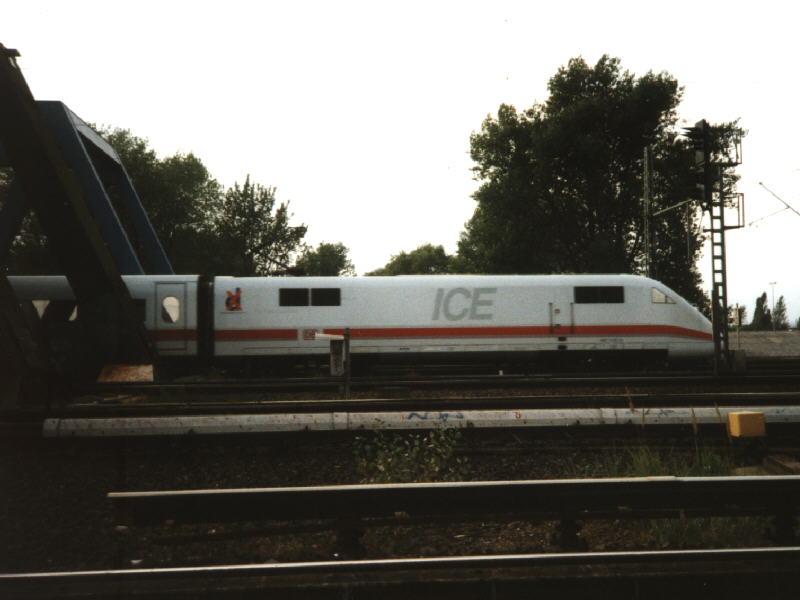
The new locomotives are based on the ECO 2000 modular design already applied in the SBB Class 460 and the DB ICE & Class 101, incorporating mechanical and electrical components which have proved themselves in practical operation, such as the Flexifloat bogie, IGA drive and MICAS S computer-assisted traction control system. Therefore, experience with the equipment of these locomotives has been gained with a number of predecessors. On the other hand, the locomotives are designed to meet the specific requirements of the CH, mainly:
|
ό |
Highest fuel economy |
|
ό |
Optimal running performance, in order to reduce track maintenance costs on the sharply curved and steeply inclined stretches of the mountainous sections.. |
|
ό |
A maximum weight of 80 tons on four axles, given the 20tons per axle restriction throughout the mainline |
|
ό |
Future conversion into straight electrics. |
|
ό |
Modern, maintenance-free equipment built to high standards, yet well proven equipment with a high degree of standardization within OSE. |
Building a diesel-electric locomotive with 2100 kW within the nominal 80t weight limit presents certain difficulties, however, the use of the Flexifloat bogie and the considerable low weight of the MTU diesel engines helped to keep the design within the set weight limits.
The locomotives incorporate two-engine technology, already well proven in industrial service with the Class DE 1003 at Ruhrkohle, Germany, that allows optimal use of thermal power by switching one of the two diesel engines off and on as required. Each of the MTU diesel engines, similar to ones already in OSE service in the IC 2000 DEMUs, develops a nominal power of 1050 kW.
Fuel economy is ensured by the use of three-phase drive technology, incorporating MICAS S for controlling and regulating tractive effort, speed and auxiliary services. Also, the complete auxiliary power and train heating demand is taken from the DC intermediate link, utilizing braking energy to the full. Furthermore, MICAS S supervises the operation of the locomotive by real-time evaluation and recording of the data acquired from the various sub-systems. A color digital display on the driver’s cab provides a wide range of indications, recognizes and announces malfunctions and suggests countermeasures
The simple, robust construction of the Flexifloat power bogies, same as those already in service under the DB ICE trainsets, ensures the best possible ride performance, provides good transmission of tractive and braking effort and requires minimum maintenance. The Flexifloat bogie is combined with IGA drive to reduce further the unsprung mass. The drive system forms one complete unit from traction motor through the gears to the flexible coupling on the wheel and it is suspended on one side from the bogie frame and on the other directly from the loco body.
The three-phase drive system comprises modular oil-cooled inverters with GTO thyristors. It uses the same module for the two-phase train heating and auxiliary supply as well as for the brake chopper, dissipating braking energy into a brake resistor, which can also be used for a static self-load test.
The Athens – Idomeni mainline is being electrified at 25 kV 50Hz AC, the section of 78km between Salonika and the border station of Idomeni has been completed already. Since electrification will be completed during the lifetime of the new locomotives, CH required that they were capable of conversion to straight electrics, replacing as little equipment as possible. Body, driver’s cab and bogies as well as the power converters and the major part of the electronic system will be retained. Furthermore the four traction motors are already installed for the power of the straight electric loco (of type-to-be E 5000 with app. 5500kW and Vmax=200km/h) allowing complete bogies to be exchanged between the diesel and electric locomotives.
The bogies were manufactured in the ADtranz Works at Kassel and Singen, the electrical parts at Manheim Works while the diesel engines were supplied by MTU. The lightweight steel bodies were made by ADtranz Pafawag in Breslau, the aluminum roof tops in Britain and the traction motors & alternators in Austria. The whole project was supervised by the ADtranz Kassel Works and the final erection took place at Oerlikon Works, Switzerland. The total cost of the 26 units reached 210 Mio DM.
The first two locos, carrying the running numbers A 475 and A 478, were shipped to Eleusis port via Triest on 19th March 1998, followed by A 472, A 476 and A 477 on 5th April 1998. They were carried by road to Eleusis station where lowered down on the mixed-gauge track and hauled to St.John Depot in Athens. According to ADtranz, completion of delivery will be accomplished by the end of the coming September.
Technical Data
|
Type |
DE 2000, Diesel-electric mainline locomotive with three phase drive |
|
Axle Arrangement |
Bo’ Bo’ de |
|
Gauge |
1435 mm |
|
Manufacturer |
ABB Henschel AG |
|
Units ordered |
26 (Order # 5711/1995) |
|
Railway Operator |
Hellenic Railways Organization, OSE |
|
Running Numbers |
A 471 – 496 |
|
Mass in Running Order |
81.6 t |
|
Adhesion Mass |
81.6 t |
|
Mass of Mechanical Equipment |
51.8 t |
|
Mass of Electrical Equipment |
29.8 t |
|
Number of Traction Motors |
4 |
|
Continuous Rating at Crank Shaft |
2100 kW |
|
Continuous Tractive Force at Wheel Rim |
230 kN |
|
Corresponding Speed |
25 km/h |
|
Starting Tractive Effort at Wheel Rim |
260 kN |
|
Max. Dynamic Braking Effort at Wheel Rim |
160 kN (μ = 0.2) |
|
Diesel Engine |
2 X MTU 12V 396TC13 |
|
Maximum Power (both engines) |
2100 kW (2850 HP) |
|
Service Speed |
160 km/h |
|
Gear Ratio |
1/3.6500 |
|
Length Buffer to Buffer |
19400 mm |
|
Overall Width |
2950 mm |
|
Height to Roof |
4260 mm |
|
Bogie Base |
11400 mm |
|
Wheel Base |
2650 mm |
|
Diameter of Wheels, new |
1100 mm |
|
Diameter of Wheels, worn |
1010 mm |

 OSE locomotive A475 Diesel during tests in Switzerland.
Return