
UPDATED 5/17/00
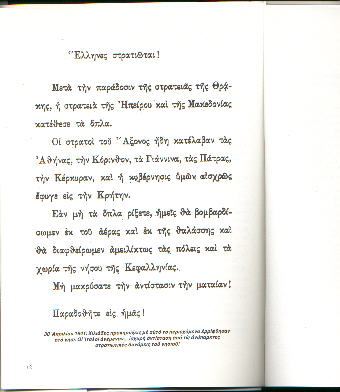
GREEK SOLIDERS!
After the surrender of the Army of Thrace, the armies of Epirus and that of Macedonia surrendered arms. The Armies of the "Axis" (Germany/Italy) already conquered Athens, Corinthos, Ioannina, Patras, Corfu, and your goverment has shamefully run off to Crete.
If you don't surrender your arms, we will conduct bombardment from air and sea and will unmercifully destroy the cities and villages of the island of Kefallonia.
Do not prolong a futile resistance. Surrender to us.
(NOTE: April 30, 1941 - thousands of fliers with the above content were airdropped on the island. The Italians were expecting strong resistance from the islands' non-existent military forces).
A Summary of the Italian Occupation of Kefallonia and the Composition of the ex-Allied German and Italian Forces
The Italians had a 29 month stay on the island. They instituted economic, administrative and other measures while there.
Kefallonia island was captured on 30 April, 1941 by paratroopers dropped on the Plain of Kranea (NOTE: area is on the way coming from the airport near Argostoli). They regrouped on the Plain and headed for Argostoli, where they immediately took over the Mayor's building.
The next day, 1 May 1941, at the Port of Argostoli, Italian military ships landed. They were headed by Marino-Marino.
To these men, the Greek officials surrendered the island.
After the establishment of the new political administration on the island, the Italians made unofficial statements that Italy claimed the Ionian Islands "as the heir of Venice" (see Facts section of this website - Venetians on Cefalonia). They stated this was not a temporary occupation but permanent -- aiming at formal annexation of the area after the war.
Around June 1941, the Italians, during an official ceremony, brought down the statue of the British High Commissioner Maitland at the city square named after Maitland (former governor of the island when the British ruled it) in Argostoli and put in its place a fascist emblem.
 Italian Army in Argostoli's central square
During his speech, General Marino-Marino turned to the Greek officials and said "We conquered you -- therefore today you're broken away from Athens and "glued" to Rome."
After the first day of occupaton, the Italians renamed all centrals streets and squares of Argostoli -- they were given Italian names. Store signs were changed by force to Italian as well.
All communication with mainland Greece was banned, also the sale and importation of Greek newspapers.
Various Italian banks opened branches in Argostoli (Banca di Napoli, Banca Di Italia were two). All Greek banks were banned from work activity, effecting their demise.
Italians put into circulation matchboxes with these slogans:
"Monopoly of the Ionian Islands"
and
"The Ionian Joins Us to the Destiny of Rome"
Weekly flights by hydroplane were establised between Kefallonia and Italy. The mail service to Athens was conducted through Rome. Educational reform was attempted -- the Italian language became mandatory.
On 20 April, 1942, a new currency was put into circulation - the Ionian Drachma". It had the value of the Greek Drachma. This measure aimed ot put the Ionian Greek banks in financial strain and orient the Ionian Islands towards Rome both economically and politically.
During 1943, the war took a different turn, with the Allies scoring more victories against the Germans. The Germans, not trusting the Italians, on July 5th & 6th, 1943, landed their own military forces on the island.
These German forces consideted of two Battalians, with a total of 1,600 men and 9 tanks:
Festungs Grenadier - #909 and 910 Battalions, headed by Leiut-Colonel Hans Barge
The Germans' prediction was correct. on 25th July, 1943, Mussolini's fall and capture were announced.
After the German army arrived, there was a geographic redistribution of the occupied military forces on the island.
The Germans occupied the Paliki Peninsula (Lixouri/Palis area) with a force of 1 thousand men and 3 tanks.
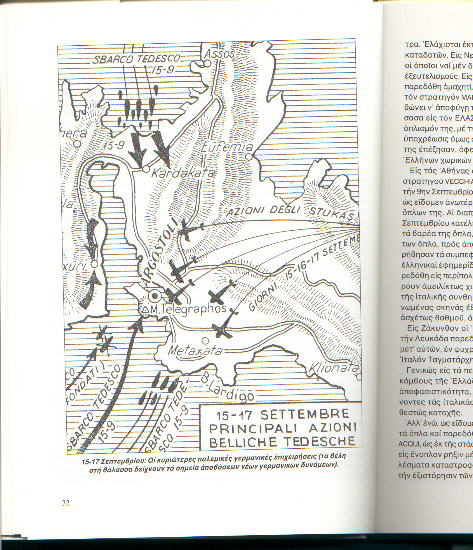
Three areas in Palis still were under Italian Battery command. At the same time, 500 Germans and 6 tanks were stationed at the Northern part of the Argostoli peninsula.
The Germans also controlled with 100 men, the Battery at Mouda (the southernmost part of the island, across from Zakynthos).
The Italian forces on Kefallonia, during the time that Italy surrendered unconditionally to the Allies, were as follows:
Acqui Division - Headed by Lieut-General Antonio Gandin
The Acqui Division at that time had plenty of mobile artillery and additional auxilliary forces and some naval units.
Before the conflict with the Germans, the Italian army was reinforced by additional artillery units and anti-armor weapons. In addition, the proceeded to reinforce their defenses on key areas of the island, including the areas of:
- Helmata
- Spilia (air raid shelter)
- Farao
- A 7 metres deep, 10 metres long anti-tank trench was built in the middle of Kranea Plain (outside Argostoli near Prokopata village)
There were 100 sea mines around the coast of the Port of Argostoli, making the waters very dangerous to navigate
On September 8, 1943, durring the surrender of Italy to the Allies, the Italian force on the island consisted of 11,000 men, 525 officers and plenty of heavy artillery.
Often the construction of the Italian defenses were comic -- an Inspector General would land on the island, see the defenses and demand changes immediately. This happened so often, and the changes were so constant that the Kefallonians constantly made the Italians' methods the butt of their jokes.
The Italians had many resources of food, ammunition, and spare parts. There was a stockpile of food enough to feed 10 thousand men for three months, and enough ammunition to last for 35 days of constant fighting.
Ratio of Germans to Italians: 1-8
- Germans= 1,600 men + 9 tanks
- Italians= 11,000 men + heavy artillery
These two armies faced one another on September 8, 1943.
CHAPTER TWO Events that Led to the Conflict
 Go Home
