Official Home Page
Nibbana-Mexico Foundation
Vipassana meditation in
Denver and Mexico
|
|
 |
|

Fundación Nibbäna, Vipassana Meditation Center,
México City;
Calle Cozumel 76, Col. Roma, México 06700, Capital,
México.
Tel: 52 11 46 41; Fax: 52 11 08 84.
Information in Spanish, English spoken.
Meditations twice a week.
INFORMATION.
Vipassana Dhura Meditation Society
At Wat Buddhawararam of Denver
4801 Julian St.
Denver, CO 80221(303) 480 9509
Previous email: [email protected]
HAPPINESS IS IN THE MIDDLE
EXCHANGING THE ATTITUDE OF THE MIND
FROM SUFFERING TO HAPPINESS
Everyone born on this earth wants to find the way of happiness.
No one likes pain; no one wants to suffer. Every human being, no
matter what his religion or nationality, asks him or herself the same question:
how can I find happiness? 2541 years ago, Lord Buddha asked this
question and devoted his life to finding an answer for himself and for
others. The path that he discovered thousands of years ago in India he
called, “the Middle Way.”
People usually practice meditation because
they want happiness. However, the real purpose of practicing meditation
is to dilute ignorance in the mind, until we have wisdom to see the truth
and destroy greed, hatred and delusion. It is most important, however,
to understand the correct way of practicing; it is very common for mediators
to go the wrong way when they follow the way they want to practice, or
when they practice according to what they only think is correct.
We have to practice to know the truth or to understand the mind.
People often pursue meditation in order to control the mind and suppress
emotions. When they succeed in doing so, they think that they have
attained happiness when in fact they have not. When they realize that their
minds have the defilement's greed, hatred and delusion, they will understand
that they need to practice; they will do so not because they want to, but
because they acknowledge their mental “sickness.” The meditator’s
intention will then be analogous to that of someone who is ill; he has
to take medicine regardless of whether or not he wants to.
WHAT IS THE MEANING OF MEDITATION?
Meditation is the task of training the mind in order
to cultivate concentration, knowledge and wisdom.
There are two types of meditation: the first
is tranquility or concentration meditation; the second one is insight or
mindfulness meditation.
By training the mind through tranquility
meditation, one develops sufficient concentration to suppress emotions.
With this technique, the meditator fixes the mind one one object only until
she goes into a trance; psychic powers may also develop.
The practice of Vipassana or insight meditation,
on the other hand, develops mindfulness and clear comprehension in order
to clearly see the three characteristics of all existence: unsatisfactoriness,
impermanence, and non self. The activities of daily life are the
objects of mindfulness: bodily actions, feelings, thoughts and emotions.
WHY DO WE MEDITATE?
We meditate because we need to find out where unhappiness
comes from. If we don't know why we are unhappy, how can we find
happiness? So, before we get happiness we have to know why we are
unhappy. People make the mistake of thinking that they have happiness
when actually they are still dissatisfied. Through meditation we
can discover the cause of unhappiness, thereby enabling us to eradicate
suffering.
Desire or attachment is the cause of all
dissatisfaction. What is suffering? Suffering is that which
is unsatisfactory or unstable; whatever cannot stay long. Suffering
means conditional existence. That which is conditioned is only temporary,
“existing” only one moment at a time. When, for example, we feel
relaxed, the feeling itself doesn't last long. Relaxation changes
to tension, and then changes back again. Therefore, we have to find
out why what we call “happiness” is not permanent. That's very important
to understand.
THE DIFFERENCE BETWEEN
CONVENTIONAL AND ULTIMATE TRUTH
There are two kinds of truth: one, conventional truth,
i.e., the name of the thing, which is permanent. For example, the name
“Buddha,” or the name “Jesus,” or the name of some other well known person
in the world never changes. But, by the truth, the person is already dead,
already gone; only the name is still there. The name of the object is conventional
truth. But ultimate truth is without a name; it is just the truth.
WHAT ARE THE BENEFITS OF PRACTICING
VIPASSANA MEDITATION?
The word “Vipassana” is a Pali word meaning “clear seeing”
or “to see through” to the characteristics of the truth. Vipassana
is concerned with seeing directly, in the present moment. When we
see the truth directly, rather than by means of the intellect, we will
see the characteristics of the mind and body as they really are.
We practice Vipassana meditation in order
to see the mind; to know the mind rather than to control the mind.
Vipassana is a meditation technique which we use to dust the mirror of
the mind until it becomes clear - so that we can see the reflection.
It is a way to become the boss of our mind so that the mind is working
for us instead of us working for it. The usual habit of the mind is
to be lost every moment in desire, hatred, and delusion; through Vipassana
we can overcome this habit and free the mind.
Everyone has some bad habit that he or she'd
like to get rid of because it is unproductive or unhealthy or causes discomfort
- whether it be the habit of smoking cigarettes or the habit of mental
procrastination. When you give up one habit you substitute a more
healthy one for it; when you give up smoking you begin an exercise routine,
for example.
The habit that all of us share is the mental
habit of either liking or disliking every object that contacts the mind.
in The Buddhist name for this habit is “attachment.” Attachment makes
the mind constantly agitated because the mind cannot let go of anything.
Whenever the mind touches an object, it either tries to get it or it tries
to get rid of it, rather than understanding that the object must change
by itself, according to the law of impermanence. Attachment is the
cause of unhappiness. The constant mental push and pull of attachment
creates more pollution to cloud the mirror of the mind until we cannot
see a reflection.
Lord Buddha taught a way to change this
habit: the Middle Way, or mindfulness. When we cultivate the habit
of mindfulness, our minds become healthy.
Just observe the body and mind that we have;
observe the postures of the body, the motion of the body. For example,
when I raise my hand - who makes this hand move? The mind does. Moving
comes from the mind, not from the body, not from the hand. Everything comes
from the mind.
Everyone has feeling in the body. Because
we have a body, everyone has pain or numbness. In meditation we just observe
the feeling from moment to moment, in the present moment only. Also,
because we have consciousness, we are always thinking; usually we
think about either the past or the future; the process of thinking never
stops because thinking is the duty of consciousness. So we have to
observe thinking without attachment, without saying that it belongs to
us; it just belongs to the universe, to the truth.
Emotions come from the mind; when the mind
receives an object or remembers something from the past and repeats it
over and over, we feel anxiety or doubt or fear. We call these obsessions
“mental objects,” or “mental factors.”
Everyone has the same thing; everyone has
a body for sitting, standing, walking,, and speaking. Everyone also
has feelings: physical and mental pain, and physical and mental happiness.
And everyone always has consciousness.
Just observe what we are doing now. We are
sitting here now. How can we separate sitting from the physical body and
just watch the objects of the mind?
Sitting is an object of the mind.
The mind causes sitting to arise in the present moment. The physical
body doesn't know that it's sitting. It's the mind that knows that
the body is sitting here now. Sitting is Rupa, not you. Also,
sitting is not male or female; it's only an object of the mind. That's
why, when we practice mindfulness, we have to observe only sitting is Rupa;
or we have to concentrate on the mind, on Nama, the “one who knows.”
RUPA AND NAMA
Nama is a Pali word used to refer to the mind. The mind
includes consciousness and mental activity. Rupa is a Pali word which
refers to the body.
When we practice insight meditation we give
up the name of the thing. When we give up the name, we only have
2 objects of mindfulness: Rupa and Nama. When observing the
body, in other words, we do not think, ”my leg” or “my back” or “my hand,”
or “I feel a pain in my left arm.” We do not repeat the name. It
doesn't matter which part of the body we observe; they are all Rupa.
Every Rupa or object of the mind is, by ultimate truth, no different from
any other object, in the sense that they are all only Rupa. The only
difference between one mind object, or Rupa, and another one is that they
occur in different moments.
“Subject,” that is to say, the one who knows
or receives the object, is Nama, or consciousness.
Who, for example, is the one who knows,
“I am sitting here now”? It is the mind or consciousness, “Nama.”
“Body” or “Rupa” is the object known by consciousness. Ultimate truth
consists only of the following two things: Rupa and Nama.
If we think, “I am sitting,” that's delusion
or wrong view. That's more ignorance, more pollution to cover the truth,
just as smog hides the mountains from view sometimes. It is
the same thing in the mind: when there's a lot of pollution -- delusion
or desire or hatred -- in the mind, we cannot see the truth. We cannot
separate that which is merely conventional truth from that which is ultimate
truth.
When we say, “the man is sitting,” or, “the
woman is sitting,” that is conventional truth. But, “sitting is sitting,”
or, “sitting is Rupa,” or, “knowing sitting,” is only the mind knowing
the object; that's ultimate truth.
We practice insight meditation in order
to separate conventional truth from ultimate truth. We then follow
ultimate truth in order to see the three characteristics of existence:
impermanence, unsatisfactoriness and non self. We see that everything,
even sitting, is just arising and passing away right away; rising again
and passing away, again and again. When you observe “sitting, sitting,
sitting,” you see that sitting arises in the present moment. Knowing
sitting is the object in the present moment; then the object disappears,
and we observe sitting again, again in the present moment. The cycle keeps
repeating.
Sitting is never permanent; it's unstable
and unsatisfactory and non self.
When there is only the object and knowing
the object, we have separated from attachment with the ego already.
During a moment when there is only nama-knowing-rupa, ego attachment does
not have a chance to occur.
How could you find an easier technique than
this one? You only have to raise your hand. This technique is easy to follow
because it uses the activities of daily life as meditation objects.
Consider, for example, my hand: the hand
itself is an object for developing concentration. But if I observe the
moving of the hand, that is an object for mindfulness, because the action
is happening in the present moment.
Everyone, from childhood until this moment,
has always been either sitting or walking or standing or lying down.
The body is never without one of these four postures.
In order to follow this technique you have
to understand the difference between a correct and an incorrect object
for mindfulness. If you do not separate the objects from moment to
moment, you will find yourself practicing concentration. So you have
to separate the physical body from the activity of the body.
Go back to the moment. Observe yourself
now. Make yourself comfortable and relaxed. Give up everything
in the past and in the future. Practicing is not hard; what is difficult
is to separate the right object of mindfulness.
The activity of daily life can be used to
feed either attachment or mindfulness. The sitting posture, for example,
can feed the habit of attachment when you observe, “I am sitting,” during
meditation practice. Observing “I am sitting,” is wrong view, because
the sitting posture has become an object for developing concentration rather
than mindfulness.
In order for the bodily postures to become
a foundation for mindfulness rather than attachment, we have to give up
the way we are accustomed to thinking. Normally, we attach with the
physical body and think that it belongs to us. But the physical does
not know itself. We have to separate the body from its posture in the present
moment, observing the position of sitting without attachment to “I am.”
Doing so constitutes a correct object for mindfulness. If you know the
difference between sitting and the body, you will only observe sitting.
Sitting does not belong to anyone.
If meditators do not separate posture
from the body, they might think that all types of meditation
are the same. They will not find the right object with which develop
mindfulness. Sometimes, students try to follow the tradition or the
instructions without knowing whether they're practicing correctly or not.
Sometimes the teacher might give wrong instructions; even when he or she
gives the correct instruction and the student tries to follow it, if the
latter does not understand the correct object, he or she may end up practicing
concentration rather than Vipassana.
WALKING MEDITATION DEMONSTRATION
We practice insight meditation in all of the four postures:
sitting, walking, standing, and lying down.
We have six different steps for walking
meditation; these are for training mindfulness, the same way that people
use weights for muscle training. By increasing the number of movements,
or moments, per step, we give mindfulness more “work” to do.
After mindfulness becomes stronger, the
meditator gives up this technique and uses the first step, which is the
same as natural walking but a little slower. Unlike most of our daily
walking, however, the meditator has to know that he is walking.
The second step has two parts; lifting the heel,
stopping; then placing the foot. Heel up, placing, heel up, placing.
Third step; lifting the whole foot, stopping; moving forward, stopping;
and, finally, placing; lifting, moving forward, placing. Fourth
step: heel up, lifting, moving forward, placing; heel up, lifting, moving
forward, placing.
Keep observing from moment to moment.
First of all you have to stand up slowly, keeping your hands in front of
you. When you're finished standing, observe, “standing is Rupa.
Standing, standing.” After that, observe, “intending to walk.”
Concentrate on the intention to do; after that, begin walking; lift the
heel up, stop; lifting, moving, placing. That's fourth
step; heel up, lifting, moving, placing. When you stop, just stop
and observe standing, standing, and intending to turn. Then right
turn; turning as the left foot lifts from the floor. Turning, second turn;
until turning is finished. Observe standing and then continue walking:
heel up, lifting, moving, placing; heel up, lifting, moving, placing. Continue
walking for at least 20 minutes; don't give a chance for delusion to take
place during the step by step, moment to moment process of walking.
When you're finished walking, return to sitting.
SITTING MEDITATION INSTRUCTION
Most teachers will give any one of the four following instructions for sitting meditation:
1) Observe the sensation of air contacting the nostrils
when breathing in and breathing out.
2) Follow the air coming in and coming out.
3) Count from one to five when breathing in, and from
one to five when breathing out.
4) Focus on a single point over the abdomen and observe
the movement of the abdomen when breathing in and when breathing out.
In insight meditation, however, there are only two ways to focus the breathing:
1) Focus on the air contacting the nostrils.
2) Observe knowing the movement of the abdomen.
MEDITATION PRACTICE
You have to observe the rising of the abdomen when you
are breathing in. When breathing out, observe the falling of the
abdomen. When breathing in, the abdomen expands again, rising; observe
in order to know that the movement of the abdomen comes from the mind.
The rising and falling of the abdomen comes from the mind. It is
the mind which causes the life process to continue. By ultimate truth,
life is the duration of only a single breath. But we don't die because
the mind continues to cause the respiration process to happen over and
over. Life continues because of the conditions which support its
continuance.
Observe: How you feel when the abdomen
is expanding? Does it appear clear or unclear? When you breathe
out, how do you experience the abdomen falling? Can you observe it?
You have to observe one point on the abdomen. When you breathe out,
air starts from the abdomen to go out, and then you breathe in, and then
out again, over and over, continuing the life process.
Just observe the abdomen rising and falling.
Who is the one that knows that the abdomen is rising? The one who
knows is disappearing, too. When the abdomen falls, the one who knows
can see impermanence; the one who knows can see rising and passing away
with each breath.
Observing in this way loosens the attachment
which results from wrong view. It's a mistake to think that because
you still breathe in and out you have a long life. You can only know one
breath at a time. When you know that the abdomen is expanding with
an inhalation, you know only that you have life at that moment. When
the abdomen stops rising, that means that your life is gone. But
you still breathe out again; that means that conditions continue the life
process. Please try to observe for one minute, to find out the truth
for yourself.
From the moment of your birth until today,
perhaps, you have never paid attention to see yourself; but at this moment
you can see the process of breathing in and out.
While observing the in and out breath, if
a feeling appears, the mind wanders, or an emotion arises, just observe
the mind, and then return once more to observing the principal object,
the rising and falling of the abdomen.
Always, in Vipassana, you should be concerned
with observing your own mind. Don't be interested in observing someone
else; that is not the meaning of practicing insight meditation. We
have to see ourselves to know ourselves. We have to clean the pollution
of our own minds because we are trying to find out how we can destroy greed,
hatred and delusion in ourselves, not in somebody else.
THE FOUR FOUNDATIONS OF MINDFULNESS
Lord Buddha taught in the Satipatthana discourse how to
use the four foundations of mindfulness and the eight fold path to develop
the mind. He called this method the Middle Way.
We use four kinds of objects for developing
mindfulness:
1) The body
2) Feelings
3) Consciousness
4) Mental objects
5)
Any one of these objects has to appear
in the mind at the present moment in order to become a foundation of mindfulness.
When all the conditions are complete, wisdom will appear. It is similar
to the foundation of a building. If you want to build a building
you need to lay the foundations first. If the builder is smart
and the materials are of good quality, the foundations will be strong.
We need four types of material, four objects with which to build the foundations
of mindfulness in order to get wisdom.
These four objects can be used only to develop
wisdom; they are not for developing concentration or the temporary happiness
that results from it. If the foundations are not built correctly,
wisdom cannot appear, cannot grow.
And, as I mentioned before, everybody
already has these four objects within him or herself. You do
not have to go and find them; they are always right here.
THE EIGHT FOLD PATH
We can follow the technique and use these four materials
to lay the foundations of mindfulness; the tool we use is the eight fold
path. The eight fold path is not really the path; the path
is just our own body and mind. Because we have bodies, we have
to sit and stand and walk; because we have minds, we have to think
and feel and we have to receive mental objects. That's why
the body and mind become the path, become the way.
The eight fold path is: right understanding,
right thought, right speech, right action, right livelihood,
right effort, right mindfulness and right concentration.
The eight fold path supports our practice
with the right object in the present, moment to moment. We start
with right effort: making effort to observe the object of the mind in the
present moment. Right mindfulness means that we try to separate ultimate
truth from conventional truth. We try to see ultimate truth only.
For example, when I make the effort
to move my hand, that's right effort; I observe moving as the object of
the mind. I pay attention to the moving, not to the hand; that is
right mindfulness. The hand is conventional truth, moving is ultimate
truth. Ultimate truth is mindfulness observing Rupa and Nama correctly
in the present moment. When I continue sitting, standing, walking,
and when I keep observing with moment to moment mindfulness, that is right
concentration. Right effort, right mindfulness and right concentration
complete Samadhi.
If I continue to see each moment as it is
arising and passing away, that is right understanding. When the mind
is mindful of rising and passing away, I will see: oh, that is impermanent;
it is unstable or unsatisfactory. Moving is unstable; it cannot stay
permanently as the hand does. We say that the hand is self or stable; but
moving is unstable, unsatisfactory. Moving is non self. It
doesn't belong to anyone. That is right thought. Right understanding
and right thought complete Panna, which means wisdom.
The Nama, or one who knows, is mind and
knowledge. At each moment, mind and Rupa are passing away together
all the time; that is wisdom arising to see the truth.
We have to separate ultimate truth from
conventional truth, just as we separate moving from the hand or we separate
sitting from the body. When we can see the truth of Rupa and Nama,
or body and mind, in the present, moment to moment, that is correct practice.
We are walking on the right path.
Right speech during meditation practice
means talking mindfully; observing the physical movement of speech moment
to moment, moving the jaw. Usually, when we practice mindfulness
meditation during a retreat, we keep silent.
Right action: when we're observing the body's
activities, walking, moving, sitting, eating - that is right action.
Right livelihood means: living with mindfulness
all the time, in every moment, in every activity: while going
to the bathroom or brushing our teeth or eating - eating food slowly,
observing chewing and swallowing, not attaching with a delicious taste
or disliking a bad taste. We eat to live rather than live to eat.
Right livelihood means using every daily action for practicing mindfulness;
we do not just meditate while we are sitting on a cushion in the
meditation hall. Right speech, right action and right livelihood complete
Sila, which means morality.
When all of these eight factors come together
in one moment, in that moment the eight fold path is complete, and we approve
this way for ourselves, by ourselves. That is correct practice, from
which we will get real happiness and continue to the end of suffering.
This is why we try to find the right path; so that we can find ultimate
happiness. That's why we have to practice mindfulness. That's why
we practice the Middle Way;
Happiness is in the middle. By following
the middle way we exchange the attitude of the mind from suffering to happiness.
The reason we cannot exchange the attitude
of the mind from suffering to happiness is because the mind doesn't stay
in the middle between good and bad.
We are victims of the habit we have formed
- the habit of not keeping the mind in the present, of letting it wander
back to the past or forward into the future. Everyone has this same
mental habit which causes un-ease, or dis-ease in the mind. The antidote
for this disease is mindfulness; it is the tool with which we are able
to resist becoming slaves to desire and aversion.
THE MIDDLE WAY
The Lord Buddha explained the middle way
using the example of a tree trunk. The Buddha asked a disciple: if
you put a tree trunk in the river and it stays in the middle, not getting
stuck on the left bank or on the right bank; if it doesn't sink, and if
no one takes it out of the water, where does it go? The disciple
answered: it goes to the ocean. Absolutely, Lord Buddha said.
It will go all the way; it's impossible that it not. The tree trunk
is analogous to meditation practice: if meditators aren't pulled
to the left or right, if they don't sink, and if someone doesn't remove
them from the path, they will without question have to reach supreme happiness,
nibbana, non attachment, where there is no suffering, forever.
But some of the Buddha's disciples wanted
to know: what do you mean by the right side? Or: what
do you mean by the left side? What's the meaning of sinking in the
middle? Lord Buddha answered: compare it to the senses; the
right bank means eye, ear, nose, tongue, body and mind. The left
bank means color, sound, smell, taste, contact, and the object of the mind.
Sinking in the water means ego. If someone removes the trunk to build
a raft, that means that the meditator is following desire. Or it means
that a friend tells the meditator that she is following the wrong path,
or that another teacher or another technique or another meditation center
will be better.
HOW TO APPLY MINDFULNESS IN YOUR DAILY ACTIVITIES
When we cultivate the habit of mindfulness, our minds
become healthy.
So, the question is, where is happiness?
Happiness is in the middle, between the
good object and the bad object. For instance, the eye is always seeing
a picture; when the picture is a beautiful one, such as a sunset, the mind
attaches with it because you like it. You want to get it in
order to keep looking at it. On the other hand, when you see something
ugly, you try to avoid it because you don't like it.
When the ear hears a sound, the same process
operates. The sound causes you to react from desire. When you hear good
words, you are happy and your mind reacts by attaching to that sound and
wanting to hear more; when you hear bad words, the mind reacts by getting
angry or feeling hatred.
It is the same for the senses of smell and
taste also; everyone has the same feeling, either liking or disliking.
When you eat something good - a mango, for instance -you like it.
When you eat some junk food, for example, you don't like it.
You feel attachment to good food; all day
you think about how good the mango was. But instead of satisfying
your desire, the delicious food causes you to want more.
It is the same with the sense of touch;
your body makes contact with something cold, or hot. If it's too
hot, it makes you suffer; if too cold it makes you suffer, too, and you
dislike it. But if it is too good, you attach with the feeling.
You follow desire or hatred with the sense of touch or contact.
Everyone, at some time, asks himself or
herself: how can my mind be calm or stable, not agitated, not up
and down? How can I find happiness when all life ends in sickness,
old age, and death?
The mind is like a runaway train which we
can't stop; it's out of control, always wandering off and dragging us along
with it. Even right now, at this moment, isn't your mind wandering?
Just go back to the moment and observe the
object from the eye seeing, the ear hearing, the nose smelling, the
body touching and the mind thinking. Then let it go. Regardless
of whether the object is good or bad, only mindfulness can keep us in the
middle.
In ordinary life, people can't get happiness
because they can't stay in the middle between good and bad, between liking
and disliking, between being attached and being detached. Detachment
is a subtle form of disliking or hatred.
By practicing mindfulness, we can change
the habit of the mind and find a different way to live. When we cultivate
mindfulness, or, in the beginning, awareness or clear comprehension, the
mind is more able to stay poised and balanced. It is less likely
to be pulled to the left or the right by liking or disliking. Eventually
it will be able to stay centered.
The purpose of meditation is to stop the
process of the mind whereby it constantly generates new defilement's.
But if you can't see defilement's as they arise in the mind, how can you
stop them? This is the reason we need to know the mind. This
is why we observe the mind moment-to-moment.
Only mindfulness is fast enough to catch
anger or another defilement as soon as it arises, and so intercept the
process.
When you don't stay in the middle, how can
you have peace of mind? It's impossible. Happiness doesn't
belong to desire; it does not come from the cycle of wanting and getting
what you want.
If we stay in the middle, we will not be
thrown off balance whenever a strong emotion such as anger arises.
We will be able to observe it without trying to repress it, without it
controlling us, or without indulging it, which is the other extreme.
Just observe, that's all. Watch everything arise in turn and then
let it go. Focus and forget it. No one can control the arising
of emotion, but if we just observe and let it go, it will not grow bigger.
Mindfulness will check the growth of that emotion.
The practice of Vipassana meditation gives
us tools to help us follow the middle way. When the eight fold path
is complete, the meditator can see suffering clearly. After that
he or she will destroy the cause of suffering and arrive at the end of
suffering. That is the meaning of enlightenment according to the
four noble truths. This is the way we will be able get supra mundane
happiness forever.
ACHAN SOBIN S. NAMTO
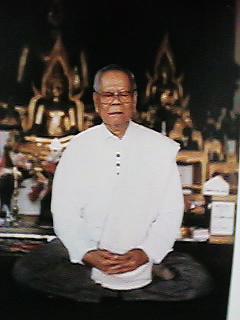
Achan Sobin S. Namto was born in Thailand in 1931.
He has spent more than 45 years teaching insight meditation, Buddhism and
Abhidhamma. He was a monk for 32 years. For several years he
lived as a wandering forest monk and entered long periods of intensive
solitary practice.
Achan Sobin had many teachers. His
principal teacher was Chao Khun Bhavanabhirama Thera who introduced
him to a meticulous step by step method for developing mindfulness.
At age 24, Achan Sobin became a recognized teacher of Vipassana meditation
and Abhidhamma and taught for many years at Wat Maha Dhatu monastery and
other centers in Thailand, establishing meditation centers in southern
Thailand, where meditators may participate in training courses of various
durations.
In 1972, the Most Venerable Phra Dhammakosacharn,
who later became PhraBiImoldhamma, was the Chief of the First Buddhist
Mission Division of the Buddhist Missionary Department of Thailand,
with the approval of the Thai Sangha Council selected Achan Sobin
and other four monks to establish the first Thai Temple in the United States,
in North Hollywood, California. Maha Sobin was appointed the first
Abbot of this Temple. The Thai Sangha, sensing the growing interest
in Buddhism and meditation in America, confirmed his appointment as a highly
competent monk in both knowledge and ability to effectively represent Buddha
Dhamma in America .
In 1976, Achan Sobin founded the Thai temple,
Wat Buddha Wararam of Denver, Colorado where people could practice Vipassana
meditation.
In 1980, Achan Sobin decided to disrobe as a Thai Buddhist monk to become more familiar with American culture and to assist with his meditation teachings in the West. In 1986, Achan Sobin also established the Vipassana Dhura Meditation Society in San Bernardino, one hour east of Los Angeles, as a retreat center to practice Vipassana meditation. In 1993, Achan Sobin founded the Nibbana Foundation in Mexico City, Mexico to further train teachers in Vipassana meditation, continue the practice, and to translate the teachings into the Spanish language.
In 1990 he was awarded a certificate of appreciation from the Major of Los Angeles. His other honors include a Dhammacakka award from the King of Thailand in 1995, which recognizes individuals who have made outstanding contributions towards the spreading of Buddhist Dhamma abroad. In 1997, a recognition for his work from the Mahachulalongkorn University of Bangkok.
Achan’s close students describe him as the compassionate and wise Dhamma friend who shares knowledge with them.
Achan Sobin currently resides and teaches at the Vipassana Dhura Meditation Society in Denver, Colorado, but travels across the world where he hopes to contribute his skills and energies towards the further development of Insight meditation.
The logo of the Vipassana Dhura Meditation Society represents
the Amata Dhamma, or the Deathless Realm. Amata Dhamma is the Immortal
Truth proclaiming no death, no birth, no cause-and-effect and no revolving
in the Wheel of Birth-and-Death. The outer circle represents the meditation
practice based on the 32 parts of the body and the Four Elements of life
represented by air, earth, fire and water.
VIPASSANA DHURA MEDITATION SOCIETY
The Vipassana Dhura Meditation Society was established
in 1986. It is a non-profit organization seeking to assist anyone who is
searching for the path leading to the development of Mindfulness and Wisdom.
The purpose of the Society is to:
1.- Share the theory and practice of the Buddha's teachings.
2.- Teach Vipassana techniques.
3.- Coordinate efforts with other organizations sharing
the same or similar goals.
The PhraBimoldhamma’s Fund is a project established for the purpose of the free distribution of Dhamma books in English, Thai and Spanish.
ACTIVITIES
Please join us for sitting and walking meditation every
Wednesday from 6:30 - 8:00.P.M.
Wat Buddha Wararam of Denver.
Everyone is welcome.
You can contact us at our E-mail: [email protected]
Feel free to contact us with any meditation questions.
Weekend retreats available.
If you are interested in attending a weekend meditation
retreat please contact the Vipassana Dhura Meditation Society. W/ Achan
Sobin and assistant.
Look forward to Vipassana Dhura’s correspondence course. One of the topics will be: How to apply the teachings to the practice of meditation.
JOIN US FOR A 10 DAY MEDITATION RETREAT
The Thai Temple is available for meditation groups looking for a meeting place. Please contact Vipassana Dhura Meditation Society for arrangements.
For questions or further information pertaining to the practice, training courses or to receive Achan Sobin’s monthly newsletter, please contact the Vipassana Dhura Meditation Society.
Vipassana Dhura Meditation Society
At Wat Buddhawararam of Denver
4801 Julian St.
Denver, CO 80221(303) 480 9509
[email protected]
WAT BUDDHA WARARAM OF DENVER
Wat Buddha Wararam of Denver was incorporated under the
Colorado Non-Profit Corporation Act on the 15th of March, 1976.
The main purpose of Wat Buddhawararam of Denver is to
promulgate the Buddha's teachings through the practice of Vipassana meditation.
The temple provides meditation instruction, classes and retreats open to
the community, as well as provides facilities for Thais, Thai-Americans
and the non-Thai community.
Achan Sobin S. Namto, is one of the founders
of the temple, and is also the founder and the president of the Vipassana
Dhura Meditation Society
Meditation Society. He was requested by the monks and
the Board of Directors to be the temple’s meditation master since he founded
the temple as a venue for the practice of Insight meditation.
Achan Sobin S. Namto is one of the founders of the templePhraBimoldhamma,
the Chief of the First Buddhist Missionary Department of Thailand, from
his office in Bangkok, bestowed a name upon the temple. It was called Buddha
Wararam, “The Dwelling Place of the Buddha, the Place of Enlightenment.”
PhraBimoldhamma appointed Achan Sobin to be in charge
of the committee formed to manage the fund raising and assure that all
legal requirements were met. The Vipassana Dhura Meditation Society is
located on its premises. It offers to the public Insight meditation classes
and retreats.
Buddhist study classes are also offered to the general
public.
2.- The second purpose is to offer THAI CULTURAL PROGRAMS,
which include classical Thai and dancing, instruction in Thai arts and
crafts and Thai cooking classes. Denver.
During the summer we plan to offer an English as
a Second language class and a Thai language class.
3.- The third purpose of the temple is to encourage the
Buddhist education of American born children of Thai ancestry.
In 1975 The Chief of the first Buddhist Missionary Department
of Thailand, Dhammakosacharn, who later became PhraBimoldhamma, together
with five other monks, visited Denver The monks were warmly received
by the Thai community. As a result of this visit the Thai community began
to search for a suitable place to establish the first Theravada Thai Buddhist
Temple in Colorado. At the end of that year the present building at 4801
Julian Street was found. The place was available
PhraBimoldhamma appointed Achan Sobin the monk to be
in charge of the committee formed to manage the fund raising and assure
that all legal requirements were met.
A Memoir of Wat Buddhawararam
Before I became acquainted with the Thai people in the
early 1970s I knew very little about Thailand except that it was very far
away and had been the setting for a long running musical people through
children; my daughter befriended the daughter of Bangorn Hasadinratana
while both children were in kindergarten and from that association grew
the circle of friends from Thailand that I
treasure to this day.
In the mid 1976, the Thai community began
searching for a location for a Thai Buddhist Temple here in Denver
Working with a small committee headed by Sukhum Samleerangkul and Bangorn
and assisted by an energetic real estate agent many locations were considered
but were found to be no satisfactory. Finally the present building
at 1801 Julian Street became available when the owner, the Salvation Army,
moved to a new location. Under the able, and in my opinion the heroic,
direction of the committee and the first abbot of the temple, the Venerable
Maha Sobin Namto, an offer was made and accepted for the purchase of the
building. I was pleased to do the necessary legal work for the organization
of the not-for-profit corporation, the tax exempt status, and the title
work for the property.
The group had been able to make a substantial
down payment and had committed themselves to pay the balance in one year..
The contract was a troubling one; church loans in our country, if they
can be obtained at all, average about fifteen years. The Thai community,
while vigorous and enthusiastic, was small, and many of them were struggling
in a new country, learning a new language, and unable to find work commensurate
with their education and skills. Through fundraising events and other efforts,
the money was coming in but it became obvious to me that there would be
a considerable shortfall, perhaps almost half, at the end of the year.
I received calls from Major Morland of the SAlvation Army expressing concern
that the money would be forthcoming, as they had also extended themselves
a bit on the transaction.
I met with the committee several times to
determine what we should do to get an extension. I was told, by everyone
talking at once and with great happiness, that things were very well, that
there were yet to be some big fundraising parties, that large gifts were
to be made, and for the remainder, I was told not to worry, that the BUddha
would provide. A few weeks before the deadline Phra Maha Sobin flew
to Bangkok and came back with the balance of the money so that the Wat
could honor his commitment, and the debt was paid on time. It was
then that I learned that the reference to the Buddha providing did not
mean an expectation of divine intervention,
but that the world headquarters of the Thai Buddhist organization, impressed
by the efforts of this small group, had agreed to assist as necessary.
I have watched Wat Buddhawararam flourish
through the years. It arose from the ashes of a catastrophic fire
in the mid 1980s to a larger and better temple. It is well accepted
and respected by its neighbors and by the entire city. The Thai community
has grown considerably since the beginning, and they find in the temple
a center of comfort and hospitality It is a place of beauty, culture, and
serenity, of which not only its adherents but all residents of our city
may be justly proud.
E Lee Hamby
E. Lee Hamby
1228 Jersey Street
Denver, Colorado 80220
[email protected].
|
May all people come out of their defilement's, their misery. May they enjoy real happiness, real peace, real harmony. May the above information help you to obtain maximum benefit from your meditation retirement. We are happy to have the opportunity to serve, and wish you peace and harmony from you experience of Vipassana meditation. |

INFORMES SOBRE LOS TALLERES DE ARTE FLORAL
en la ciudad de Puebla, Pue,. México

¿Ya tienes tu tarjeta de Donación Voluntaria de Organos y Tejidos?
Pide tu tarjeta de Donador Voluntario a AMPRAC®

BUSCADORES EN ESPAÑOL
Página actualizada el 1° de enero de 1999 
Página creada por el Ingeniero Rene Schwebel Ransenberg
Co fundador activo de AMPRAC®
Actualizada constantemente a partir del 10 de mayo de 1998. México, Capital.
Copyright © 1998. All rights reserved ®