Time Dilation and the Effects of Special Relativity on Space Travel

Time Dilation and the Effects of Special Relativity on Space Travel


TABLE OF CONTENTS:

SPECIAL RELATIVITY

TIME DILATION
.....The Clock Paradox
.....The Twin Paradox

ACCELERATED TIME DILATION AND SPACE TRAVEL

CRYOGENICS AND SPECIAL RELATIVITY

TIME TRAVEL AND FASTER THAN LIGHT TRAVEL

CONCLUSION

WORKS CITED

SPECIAL RELATIVITY

We have all seen movies or read stories in which a character, knowing that their planet is doomed, or by some freak of nature, just jumps in his space ship and flies so fast that he moves backward in time. Not only that, but when her returns to his own time, he is back almost as soon as he left. Well, there was once a great thinker, mathematician, physicist, and philosopher named Albert Einstein. He had a few ideas of his own about this. He postulated that reverse time travel (travel backward in time) was not possible, but that forward time travel (travel forward in time) was possible in a certain fashion. This raises some interesting philosophical questions which I will go into later. But for now, let us begin with Einstein's theories of Special Relativity. These will open up many doors that could lead anywhere from another galaxy, to a far distant future, or even (with a little imagination) the end of the universe as we know it.

When Einstein was asked about his ideas of relativity and what they meant, he explained it like this: One hour with a pretty girl seems like a minute, but one minute on a hot stove seems like an hour. That is the basic idea of special relativity. What seems like a long time for one person may indeed be just a fraction of that time for another. But let us move out of the philosophical for a moment and into the physical, for anything can be proved within the minds of humanity, but that doesn't necessarily make it a fact. So here are some mathematical and physical facts:
Light moves at the incredible speed of 2.99792458X10⁸ meters per second. That comes out to roughly 186, 282 miles per second. (Almost as fast as it takes your average Pinto to break down.) Einstein's first theory stated that as objects approach the speed of light, their physical properties change. The begin to simultaneously contract and gain mass. We could ask how this is possible, but then we could get ourselves into a lot of trouble, so we are just going to trust Einstein on this.

For Example: Let us pretend for a moment that you have your own little chunk of rock in space, which you are currently sitting on. Let us also say that your rock is completely still and unmoving.
[NOTE: This causes a small problem. Because we measure movement relative to the universe, and the universe is constantly moving and changing around us, nothing can truly be completely still and unmoving. So, for the sake of these exercises, we are also going to assume that the entire universe has temporarily frozen, and we are the only ones capable of movement.]

Now let us also say that I happen to have a spaceship that, when it is not moving, is exactly one mile long and exactly one million tons in mass. (Coincidentally, that also happens to be the average size and mass of your normal Pinto station wagon.) I see you sitting on your rock and I decide that I am going to buzz you. I come flying past you at exactly sixty miles per hour (m/h), not accelerating in any way.
[NOTE: Although we usually tend to think of acceleration as simply speeding up, it is more than that. Acceleration is ANY deviation from your current direction or speed. So if you slow down, you have accelerated. If you change direction, you have accelerated. Kinda weird, huh?]

When I do, you take very sensitive measurements of my ship as it passes. You pick up the note pad that just happens to be next to you and you perform this calculation:

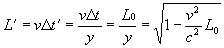
The length of my ship being L0=X2-X1 (X2 being the back of my ship, and X1 being the front of my ship) measured by you (If I were taking the readings of my own ship, they would be different from yours.). Since I am moving relative to you, my distance traveled in time t is vt. Thus . According to you, I move past you with a speed v and I take a time of t' to pass you. The length of my ship in your frame is L'=vt'. Since your time interval (t') is less than my time interval (t), then your measurement of my ship (L') will be shorter than my measurement of the same ship (L0). These lengths are related by

Length Contraction
(Tipler)


So while I would measure my ship as being the same size as it always has, you would measure it to be shorter by one ten-billionth of an inch.

Let us also assume that you had a scale sitting out there in space, and I just happened to fly over it. It was a very special scale, and was capable of measuring my exact mass. Using the calculation

Mass Increase
(Schaum)


you would discover that my ship's mass had increased by a total of one hundred-thousandth of an ounce.

But what is the big deal about one ten-billionth of and inch and one hundred-thousandth of an ounce? Can something so small have any real applications to real life? Well, as it just happens to turn out, it does. For many years it was believed that the atom was the smallest form of matter. Even the name atom means indivisible. But we soon discovered that the atom was composed of even smaller particles called protons, neutrons, and electrons. This caused great speculation as to whether or not the components of an atom where indeed made of smaller particles themselves. Well, there is no known way to cut a protom, so scientists had to devise another way to get "inside" of one. It was found that if you separated a proton from the nucleus of an atom, put it into an extremely large electromagnetic "donut", accelerated it past 90% the speed of light, then smashed it into a wall without letting it slow down, its mass would be dramatically increased. It was in this way that quarks where discovered. There are currently six to eight flavors of quarks (Although eight possibly exist, general belief is that there are only six). Thus the principles of length contraction and mass increase became extremely useful in the study of an atom's nucleus. I guess good things can come in small packages.

TIME DILATION

All of the length contraction and mass increase stuff is interesting, but when it comes to space travel they are really nothing more than an oddity. What does it matter if a space shipe increases in mass or contracts in length when you know that when you slow down, everything will just go back to the way it used to be? They leave no trace on the ship or its passengers. But there is a third law of Special Relativity that has an enormous impact on space travel: Time Dilation. Time Dilation is the idea that time has different meanings in different frames of reference. I know what you are thinking: Isn't time the same everywhere? NO! Time itself changes depending on which way you are looking at it. It can stretch a second out into years, and it can compact years into a second. Still skeptical, huh? Well, let's look at an example from your own life for a minute:

It is 6:00 P.M. Monday night, and you are planning on going out with your friends at 7:00. You are already dressed, and you are just waiting for them to get there. You pace the room, flip the television on and off, walk around some more, and finally, ignoring your better judgment, you look at the clock. To your surprise and horror you see that only 30 minutes have passed! So you take your plunger and SMASH THE CLOCK UNTIL ITS INNARDS ARE FLYING ALL OV... Ahem. Sorry. Hate when that happens. Now where was I? Oh, yeah. Well, now it is 6:00 P.M. on Tuesday night, and you are writing a last-minute report for your boss (who asked you to work on it at home because he is a tirant). The report is so importnat that your boss has decided to come by your house and pick it up himself (isn't that against some sexual-harassement law or something?), and he will be there promptly at 7:00. You are typing furiously on the computer when you hear a knock on the door. Knowing it is way too early for your boss to be there you open the door to see, gasp, you boss standing there! Looking at the clock you see, also with horror, that it is 7:00 on the dot! Time has "flown" by.

Now I want to make something very clear here: Neither of the two previous examples were indicative of time dilation. I just wanted to show you how time can seem different in different frames of reference. But can time every really be different? To answer that I must first tell you about the third property of near-speed-of-light travel (186,282 m/s). As an object approaches the speed of light, time will literally slow down for that object. But how can time slow down for an object? Isn't time a constant that should be the same anywhere in the universe, at any speed? The answer to all of those questions is a resounding NO! Sorry again. I hate yelling. I just get a little emotional sometimes. *sniff* We measure time in reference to our surroundings, and if our surroundings change, we tend to change with them (Excluding Hippies, of course). So we have come to believe that time is an immutable object that can be measured, but never changed. Einstein proved different. Time is, in fact, completely separated from the physical world.
[NOTE: Although, as Einstein pointed out, no one has ever been any place without being at a certain time. And no one has ever been at a certain time without being some place]
But let us use some examples here:

THE CLOCK PARADOX

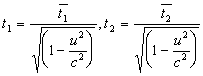
Let's assume (I know, we assume a lot here. Please, no ASS-U-ME jokes, thank you.) that we are back up in space again, I in my ship and you on your rock. Let's also assume that each of us are holding two clocks. I am holding one clock that is connected to my ship, and one that is connected to your rock. The one on your rock is OUT of my time reference. You also have two clocks, one showing the time on my ship, and one showing the time on your rock. these clocks are connected in such a way that we will always be able to see exactly what the other clocks are reading. Now imagine for a minute that I come zipping past you at a sizable fraction of the speed of light. We both start our clocks the exact moment that we pass each other. While you are sitting on your rock, you are taking notes on what our clocks read. The times, t1, t2, of these events are given by

(Lawden)


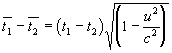
Hence that
(Lawden)


This equation shows that the clock on my ship will seem to slow down by a factor of compared to your clock. In other words, time will seem to slow down for me relative to you! The previous formula will give you these results:

My constant velocity
(in miles per second by your clock)
with respect to you
Time elapsed on my clock
After 1 hour by your clock
1,000
59 min. 50 sec.
50,000
57 min. 47 sec.
100,000
52 min. 18 sec.
120,000
45 min. 54 sec.
140,000
39 min. 36 sec.
160,000
30 min. 40 sec.
162,000
30 min. 00 sec.
170,000
24 min. 25 sec.
180,000
12 min. 13 sec.
185,000
7 min. 48 sec.
186,000
1 min. 50 sec.
186,282
no time at all
(Asimov)


This is amazing because time actually changes according to how you are looking at it. Another interesting feature about how the clock paradox is that although you see my clock as slowing down, I don't see it that way at all. When I am in my ship, and I fly past you, I am also watching my clocks. To me (inside the ship) it appears that I am the one sitting still, and you and your rock go flying past me at an incredible speed. And since that is the case, I not only see my time as remaining constant, but I also see YOUR clock as the one that is slowing down! It does not matter which one of us is "moving", because that movement is always relative to the other person. We will always see the other person's clock as the one who is moving slower

So who is right? How do we know which one has the clock that is actually slowing down? Actually, if I were flying past you (Or you were flying past me, depending on which way you look at it) at a constant velocity (not changing speed of direction), then that question would never arise. If neither of us accelerates in any way, then we will never meet each other again. We will both keep shooting off in different directions, never changing course to meet each other. So both of us will be right, in our own frame. But lets pretend for a moment that we want to meet again so that we can compare clocks. Let's also assume that it is I who decides to accelerate. I change my course and head back to where you are. I then slow down so that we can have the same velocity. Because I was the one who accelerated, it will be MY clock that shows the temporal displacement. Now let us try something different, let's say that I go flying past you, and you decide to catch up to me. So you accelerate until you catch up to me, at which time you keep your velocity constant so as to match mine. When we compare clocks it will be yours that shows the displacement, not mine. The effect of time dilation depends on the acceleration, and the object which is accelerating.

THE TWIN PARADOX

There is another interesting paradox which is extrememly popular in the field of special relativity, and that is the Twin Paradox. Time displacement is interesting and all, but how does it affect us as humans? Let's assume that we have the technology to safely bring a person close to the speed of light and back. As an experiment, we take two identical twins, put one of them in a rocket ship, and keep one on earth.

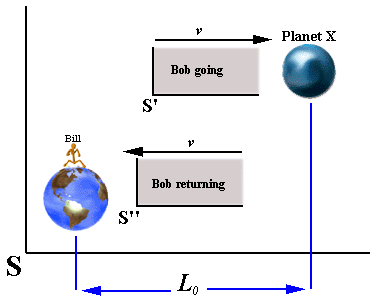
Now we are going to let Bill, the Earth, and planet X all be in the frame of S . Inside that frame, nothing except Bob's ship will be moving (But time is going to flow regularly on the Earth, even though it is not revolving around the sun). Here is some info for you:

The Earth and planey X are L0 distance apart.
Bob is moving with a speed of v toward and away from the earth.
Bob will quickly speed up to the speed of v, then he will coast in S' until he reaches the planet.
He will rest for a second, then quickly turn around and speed up to the speed of v once again.
Once he reaches v he will coast in S'' until he reaches Earth.
When he reaches Earth, he will slow to a stop in the frame of S

For this example we are going to assume that the accelerations are negligible. They will not have any effect on the overall time.

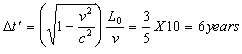
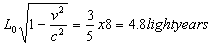
It is easy to look at this problem from Bill's point of view. According to his clock, Bob coasts in S' for a time of L0/v = 10 years, and he will coast in S'' for the same amount of time. That way when Bob reaches the earth, it has been exactly 20 years since Bob left. That way Bill is 20 years older than when Bob left. But let's look at it from Bob's point of view for a minute. To him (Bob), the time interval S' is shorter because it is the proper time; the time to reach the planet by Bob's clock is

(Tipler)


Since the same time is required for the return trip, Bob will have recorded 12 years for the round trip and will be 8 years younger than Bill. From Bob's point of view, the distance from Earth to planet X is contracted, and is only
(Tipler)


When Bob gets back home he is completely confused about how Bill could be 8 years older than him. Luckily, the scientists that headed the project (being the sly little devils that they are) had that brothers transmit a signal to each other once per year, on their birthday. That way they could count up the signals and see how many years each of the brothers had aged. But the arrival of the signals will not be one per year, because of the Doppler Shift. Let's first consider this from Bob's point of view. During the 6 years that it takes him to reach planet X (keeping in mind that the time is contracted in his time frame), he recieves 2 signals. As soon as he turns around and starts back to earth, he recieves 3 signals a year.

Now let's look at it from Bill's point of view. He receives signals at the rate of 1/3 per year not only for the 10 years it takes Bob to reach planet X, but also for the 8 years that it for the last signal sent by Bob in S' to get back to Earth. (He cannot know that Bob has turned around until the signal reaches him.) During the first 18 years, Bill receives 6 signals. In the final 2 years before Bob gets back home, Bill receives 6 signals, or 3 per year. The first signal sent after bob turns around takes 8 yeaers to reach Earth, whereas Bob, traveling at 0.8c (0.8c is 80% the speed of light). Thus 0.9c would be 90% the speed of light.), takes 10 years to return and therefore arrives just 2 years after Bill starts to receive signals at the faster rate. Thus Bill expects Bob to have aged 12 years.

ACCELERATED TIME DILATION AND SPACE TRAVEL

In the previous example neither Bill nor Bob had to consider acceleration in their equations. But in real life we have to. Suppose for a minute that we wanted to send Bob to our closest neighboring star, Alpha Centauri. we could not just snap him instantly to 0.8c and expect him to live through it. He would have to undergo a constant, gentle acceleration. Let's say that we have invented a ship that is able to store enough fuel to undergo a continual acceleration of 1 g ( A g is 9.86 m/s2, which is the force of gravity on earth). The crew would feel a centripetal effect that would seem like "gravity" toward the rear of the ship. The time dilation would increase proportional to the distance of thier destination. But remember that time dilation is only occuring inside the ship, it is not happening anywhere else. So although the ship may be "frozen in time" to the observers on Earth, the universe around them will still be aging at a normal rate.

This table will demonstrate the effects of a one-way flight from earth to some various places in the univese:

Desitination
Time lapse on ship
(in years)
Time lapse on Earth
(in years)
Alpha Centauri
3.5
10
Vega
7
30
Pleiades
11
500
Center of the Milky Way
21
50,000
Megellanic Clouds
24
150,000
Andromeda Galaxy
28
2,000,000
(Asimov)


So do you see the impact this could have on space travel? If we could find a way to accelerate a group of travelers up close to the speed of light, then we could cross absolutely incredible distances in relatively short periods of time. We could even imagine our astronauts traveling all the way to another galaxy, and doing it in a quarter of a lifetime! The very prospect is amazing, but there is one problem. Although it seems that the astronauts have jumped forward in time, they have not. They have simply been suspended in time. There is no going back to their own time. They are there to stay. They are forever stuck in the "when" that they stop. This would not be too bad in the case of distances as far as Alpha Centauri or Vega. The astronauts would be back before their children had died (Although it would cause a little bit of an upset when the parents realized that they where younger than their children.). But in the case of other galaxies, the trip would have to be one way. If we planned on colonizing other planets, then there would not be any real trouble at all. We would be able to move a large group of people quickly to another solar system with a habitable planet and, hopefully, colonize it.

But how would we get to the speed of light? Well, I have a few theories on this. But there are a few problems with this. This first comes in the flavor of fuel. We expend an immense amount of fuel just breaking free from Earth's orbit. To carry enough to get us to the speed of light would be unfathomable. So my guess is that we would have to accelerate before leaving the solar system, then just coast in to where ever it was that we where going. Because there is no friction in space, you can literally coast, without slowing down, forever. So once you got to a speed, you would be staying at that speed until something changed that. You could then use any fuel that you might have solely for slowing down once you reach your destination.

One method of acceleration might be an ion drive. It would be fairly easy to create a craft that emit highly charged ion particles. This method would take an incredible amount of time to build up speed, but it would require no fuel at all. It would be an inexhaustable force.

Another method might be to use the sun as a "slingshot". A ship could fly in toward the sun at an extremely eccentric orbit (flat and long). The sun would pull it faster and faster until the ship shot past the sun and started going the other way. Then it would continue to slow down until it was pulled back toward the sun again. It would continue to gain more and more speed until it shot past the sun again, this time going even farther out. (This is pretty much how the orbit of a comet works). This could continue until the ship had reached unheard of speeds. Unfortunately, this also takes a very long time. Halley's comet only comes back once every 75 years. The Hale-Bopp comet only once every 3000 years! So although this might be economical, I doubt it would be practical.

One final method that might work is Solar Power. We could store many batteries on the ship that would hold the energy from the sun. We could use as much power as we wanted, because the sun never sets in space. But we would only be able to use it while we where within our own solar system. During that long space between, there would be no light to power us. But that would not be a problem. We could expend all of our energy speeding up, then just coast on in. (Remember, no friction) Then, when we reached that foreign star, we could simply use their sun as a power source to recharge our batteries.


CRYOGENICS AND SPECIAL RELATIVITY

Special relativity is interesting, but is it only good for space travel? Actually, there could be other uses for it. I realize that we do not have the technology to accelerate someone to a considerable fraction of the speed of light safely, but if we did its uses could be immeasurable. Imagine for a moment that we do indeed have the ability to get people up close to the speed of light safely and in a relatively short period of time. Its uses in the medical field would be enormous. We could take a patient with a terminal illness or disease, put them in the capable ship, fly them around the earth or the sun at close to the speed of light, keeping them suspended (in our time reference), unti la cure for the affliction had been found on earth. We could then slow them down and treat their illness. Although the poeple with the illness had only been on the ship for about 4 or 5 of their years, earth time had elapsed about 20 to 30. That way by the time the ship had slowed down, the disease was not only curable, but might not even be considered to be anything more serious than a common cold. People who knew they only had a couple of years of life left would probably jump at the chance o live a long, full life. The only problem with this is that althought they would be cured, they would not have many of their old friends of family left. They might also be considered an oddity. In this case the cure might indeed be worse than the disease.

Another way in which speed-of-light travel could prove useful is in future history. Lets say that we decide to load up a ship with items of everyday us from our time (Geological, Topographical, and Economical maps. Bottled air and water. Census reports. Technology. Etc, etc) We could move the ship rapidly to the speed of light (We would not have to worry aobut comfortable speeds like we do with humans), then have an on-board computer slow it down after, say 10 years. All of the equipment and itmes on board would be in relativly new condition (If they had never been used or where preserved in some way. My guess would be in a vacuum.), and almost 500 years would have passed on earth. The addition to future history would be immeasurable. Scientists of today are excited about finding pieces of broken clay and shattered pots from 200 years ago. To have an entire "time capsule" full of perfectly preserved historical items from 500 or more years ago..... the thought is staggering.


TIME TRAVEL AND FASTER-THAN-LIGHT TRAVEL

So if we can move forward in time, can we move backward? NO!! You see, when a person undergoes time dilation, they don't actually move forward in time. What actually happens is that they "sit still" while time moves past them. It is like being on a raft in the river. If you are moving at the same speed as the water then it might appear (if you only looked at the water around you) that the water wasn't moving. But if stop all of the sudden, then the water will keep on going. Even though the water is moving past you, you are not moving back up the river. The river is just moving forward without you.If we can imagine time as being like a river, we can also imagine each moment as being a drop of water in that river. We move in tandem with each moment in our lives, so we stay even with our own time, our "drops of water." However, when we experience time dilation we slow down as the time continues to move past us at a constant rate. We are not jumping forward in time, time is moving forward around us. We will never be able to catch up to our old time again, it is gone, forever.

But how about if we move past the speed of light? Would our clock then begin to move backwards? To answer that we have to understand that the speed of light is the universal "speed limit." Nothing can move past the speed of light in a vacuum.
[NOTE: The only exception to this rule is the Tachyon. The Tachyon is a hypothetical particle that can move faster than the speed of light IN WATER. Its speed is thought to be c=3x10⁵ km/s]
I know that people said that we would never move past the sound barrier, but that was different. The sound barrier was a technological problem. We didn't have the ability to break it for a long time, but we always knew it could be done. Not so with the speed of light. For an object with mass to move past the light barrier, it would take all of the energy and matter in the universe, including the engergy and matter from that object itself. So how does a photon (A photon is a tiny piece of light. A light beam is made of photons) move the speed of light? Isn't that impossible? Actually, the photon is a unique, massless particle. It contains no mass, so it is not effected by the laws of a massive universe. The laws of physical matter don't apply to it. To prove this I will give two more examples:

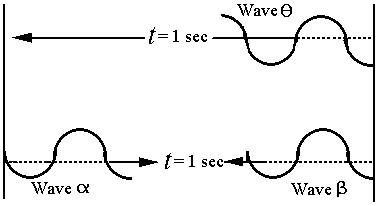
LIGHT BETWEEN A MIRROR

Let's say for a moment that you manage to catch a wave of light (wave ) in between two mirrors. You clock how long it takes for the light to move from mirror A to mirror B. We will also say, just to make things easier on ourselves, that it takes exactly one second (the mirrors are very far apart). Now lets say that you trap another wave of light between the mirrors. Wave hits mirror A at the exact moment that wave hits mirror B. They move toward each other and meet in the center in exactly one second! It takes the same amount of time for wave to move the full distance between the mirrors as it does for waves and to move half the distance between the mirrors.


SPEED OF LIGHT CONSTANT

Now lets say that you are in a space ship that is not moving. When you look out your window you see little photons moving past you. You clock their speed and see that it is 186,282 miles per second. You decide that you are going to catch up to the photons (you promised your kid you would bring one home), so you start to speed up. When you are going 100,000 miles per second, you look outside the window again and expect the photons to be moving at 86,282 miles per second relative to you. But when you measure their speed you see that they are moving at 186,282 miles per second still, relative to you! So you speed up even more, take another reading, and get the same results. Frustrated, you speed up unti lyou are moving at 186,281 miles per second. You are thinking "You may be fast, you little buggers, but I have you now! You are only going 1 mile per second faster than me. My grandmother runs faster than that!" Satisfied that you can finally catch one of the photons you reach your hand out the window and get it whacked off by a mailbox. JUST KIDDING!! Actually, you take another measurement and realize that the photons are still moving 186,282 miles per second relative to you AND the rest of the universe! The speed of light is what is known as a constant. It will ALWAYS be moving the same speed, no matter what frame of reference you are viewing it from. You have heard the question "If you are driving your car at the speed of light and you turn on your headlights, what happens?" Well, now you know. It would appear that the speed of light is the one true constant in the universe (besides the Saints never winning a game, that is).

CONCLUSION

So is near-speed-of-light travel possible? Definitely. Is it practical? Not now. The resources and funds required to accomplish any real fraction of c are just too great for it to be a feasible goal right now. But the time is coming when this will not be true. We have made such incredible strides in such a short amount of time that humanity will not allow itself to be constrained to one solar system, much less one planet, for much longer. When you consider the fact that from the beginning of the universe until the mid 19th century the fastest that someone could travel was simply the speed of their fastest animal, it is amazing to think what we can do now. 50 years ago men looked at the moon and could only imagine walking on it, and look at us now. We have made bigger strides in the last 50 years than we had in the previous 2,000,000,000! Soon humanity will spread its wings and soar among the stars, and that time is not far away.

WORKS CITED

Asimov, Isaac. Is Anyone There? New York: Doubleday & Company, Inc., 1967.

Atkins, Kenneth P.. Physics Once-Over Lightly. New York: John Wiley & Sons, Inc., 1972.

Childers, Richard L., and Edwin R. Jones. Contemporary College Physics. United States of America: Addison-Wesley Publishing Company, 1990.

Halpern, Derek F.. Tensor Calculus and Relativity. Great Britian: Spottiswoode Ballantyne & Co Ltd, 1965.

McVittie, G.C.. General Relativity and Cosmology. Great Britian: Butler & Tanner Ltd, 1965.

Taylor, John R., and Chris D. Zafiratos. Modern Physics For Scientists and Engineers. New Jersey: Prentice-Hall, Englewood Cliffs, 1991.

Tipler, Paul A.. Physics. New York: Worth Publishers, Inc., 1976.
Copyright Richard McRae, 1995 1
Hosted by www.Geocities.ws