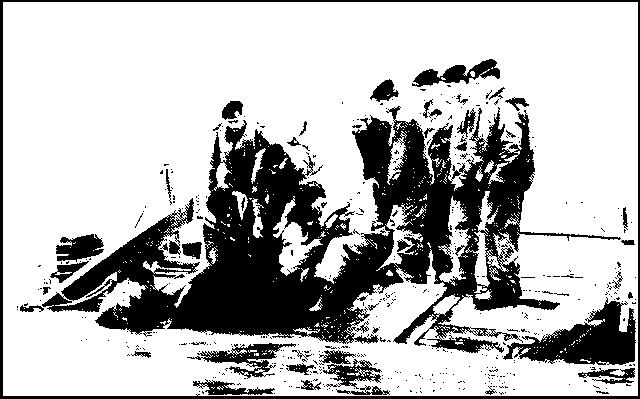
The following article appeared in the Oct 1974 issue of 73 Magazine and describes the Amateur Radio contribution to the 1973 flood rescue on the Saint John River in New Brunswick Canada in the spring of 1973
The Saint John River rises in the State of Maine, and flows half of its total length northward to the very tip of Maine, then turns southward and flows through the west and central part of the Canadian Province of New Brunswick.
There are no flood control dams on the Saint John River in northern Maine,a conservationist's paradise, and consequently, by the time a large rainfall in Maine reaches New Brunswick, little can be done except "run for the hills." This can be done quite easily on most stretches of the river, with one exception; just east of the capital city of Fredericton, the northern bank of the river flattens into a flood plain which forms the market garden area of central New Brunswick. Slightly more than 1000 dwellings and about 150 farms are located in the 40 mile stretch of interval land. Most years the St. John River floods its banks and gently submerges the area. When the water subsides the further enriched thick black soil will grow most anything fast!
On the last weekend of April 1973 such a gentle innudation was taking place, however, in Northern Maine and New Brunswick the equivalent of an additional eight inches of water lay in the woods in the form of snow. On Saturday, April 30, Northern Maine and Northern New Brunswick experienced in the order of 2 1/2 inches of warm rain which would have been bad enough in itself but it also melted the snow and to repeat a famous saying, "then the fun began." Within four days, the previously recorded record flood level in Maugerville - Sheffield set in 1887 was exceeded by some three feet and previously accepted levels of preparedness for flooding were proven to be inadequate.
The Emergency Measures Organization(EMO) here in Canada has of recent times been giving more serious consideration to civil emergencies of reasonable magnitude and probability. In early 1973, the New Brunswick Amateur Radio Association was asked to define what sort of communications capability could be provided in an emergency and in due course a brief was prepared and presented to EMO.
Little was it then realized that less than three months after completing that report, it would form part of the discussion papers during the organizational meeting of a massive flood rescue and relief operation.
The Flood Forecasting Task Group is a joint effort of Federal and Provincial Departments of the Environment and N. B. Power, an electric utility with hydro generating stations on the river. This year the task group was located in an office of N. B. Power and fortune dictated on that wet Saturday evening that I visit the task group and come upon the organizational meeting of the rescue operation. In due course, the opportunity was given to define once again the services that could be provided by Radio Amateurs and within one hour the "Wet Net" was in operation on 80 meters with VEITC, BM and ACA alternative as net control and on two meters a station was set up in one of the N. B. Power offices taken over by EMO for the emergency operation; this gave us a completely independent communications link with the EMO office should the telephone circuits become inadequate.
It was emphasized to EMO officials that our automatic repeater VEIGT gave solid coverage of the low lying area and that we could assure direct communications with their field staff anywhere in the area. As a test of this VE1 AJT (now AKT) and a hand held unit was dispatched with a helicopter patrol unit early Sunday morning and provided the EMO official doing the patrol with communication directly with his confreres in the office.
On Sunday morning the record flood was still only a forecast and the water in Maugerville - Sheffield was as yet some feet below previous record levels. A road patrol was then mounted using a large utility vehicie, with VElAEK, (now HL) in operation.
N. B. Dept. of Agriculture representatives were on board and the purpose of the patrol was to advise each farmer of the impending increase in the water level and to evaluate the situation of each so that subsequent rescue operations would be as effective as possible. The patrol barely made it back, with water well up on the tires and sitters on the front fenders peering down through the water to ensure that the driver stayed on the road.
The rest of the day was spent in preparation for rescue by means of scows, barges, ferries and military amphibious vehicles.
There is a saying "Nothing like good service is so effective in increasing the demand for that service." I won't say how good our service was but we began to get swamped with demands. Hand held units were required on board the rescue craft and base stations were required at the marshalling points where livestock were to be transferred to transport trucks. This was obviously beyond the resources of Fredericton Amateurs and a call for two meter equipment and operators for 24 hour a day operation was made on 80 meters. And did it come? You bet! A contingent of 9 from Saint John led by Ken VElAVA and one of 6 from Moncton area led by Ron VEISH and Reed VEINU, who brought walkie-talkies, Don VE1DK came 300 miles from Truro, Nova Scotia to lend a hand; this gave us a total of 33 operators. Ken and Ron covered the marshalling points at Burton, across the river from Maugewille and the others manned the boats. The object being that anyone requiring assistance could get it with the least possible delay. A battery of telephones had been installed in the EMO temporary headquarters and from this coordinating centre rescue craft were dispatched from the Burton marshalling point by amateur radio. The net also proved of value to the rescue craft when one got both propellors tangled in a barbed wire fence and another lost its engines and grounded.
I would be remiss in not mentioning the part played by the several GRS (CB) clubs in
support of the operation. Base stations were in operation both at Burton and the EMO Headquarters on a 24 hour basis and many CB equipped small patrol boats made reports of conditions. Many of the transport trucks hauling livestock were CB equipped and were more effectively dispatched than would otherwise have been possible, particularly as the scows would often miss their scheduled landing wharf and be swept downstream to the next one. Much co-ordination was needed to get the trucks and the scows to the same wharf.
The rescue operations were complicated by the fact that to reach the barnyards rescue craft had to cross over the highway, covered by only 3 to 4 ft. of water and consequently, only very shallow draft vessels were of use. The operation continued through Monday, Tuesday and Wednesday, dawn to dark; navigation on the river after dark was too risky.
Government offices and the legislative buildings also suffered from the flood, and we soon found that the Premier's temporary office was just down the hall and he, as well as various ministers, came in from time to time to inquire about various things and were briefed on the role of amateur radio in the emergency effort, in addition to getting the answers they came for.
On Tuesday night the 200 prize cattle of Gerald Hoogendyk stood on dry land with a foot to spare. On Wednesday morning, they stood in icy water belly high when the Second Field Artillery came to take them out. By now these cows were in panic and the sound of roaring motors as the soldiers executed an aquatic roundup was drowned out by bawling cows and calves. Often the men were obliged to jump into the icy waters to assist an animal to get on board the scow. At Waterbury's farm, having rescued the 30 cows from the corral, one brave lad went in to get the 1800 Ib. bull and was promptly thrown out through the fence. Doug Nielson, the EMO Rescue Co-ordinator, 6'4" 200+ Ibs, then went in and after running the bull around the corral several times made for the scow. Both he and the bull got on all right but couldn't get stopped; two cows and several soldiers were pushed right over the other end of the scow. A helicopter patrol later reported seeing a scow crossing the river with 30 cows and a group of soldiers crowded up in one end while a large bull glowered at them from the other.
At Henry Shuttenbeld's farm, there was another problem of slightly different dimension: 300 pigs, and time was of the essenGe in this evacuation because pigs can't stand cold water very well. It was the same thing all over with the action speeded up to almost comic proportions to the tune of the high pitched squeal of the pigs.
Communications by now had been worked down to a simple routine, with operation on 94 simplex between the rescue craft and Burton, and via VEIGT for other operations. On Thursday morning we were advised by EMO that since things were now tapering off they wished to rely on the commercial and military communications systems for the balance of the Maugerville Sheffield operation.
The crest of the flood was now proceeding towards the City of Saint John on the south coast of New Brunswick and both the EMO and the radio amateurs turned their attention to this city, 70 miles south of Fredericton. The Saint John EMO office had limited telephone access and this was soon jammed so the two meter station of Dick VElATG was set up and a relay maintained through the 80 meter Wet Net. Phone patches proved useless because of jammed phone lines but a 2 to 80 meter patch made by alternately holding speaker to microphone enabled a direct relay at one point when such was needed to precipitate action.
By Friday noon, the danger of further flooding was passed and all amateur operation in support of EMO ceased.
To emphasize the magnitude of the operation, some 1500 people were temporarily relocated and 1200 cattle, 400 pigs and 20 horses were rescued with the loss of only four and with no loss of human life or major injury.
In conclusion, there are several observations on emergency communications that can be made on the basis of this operation:
1. The amateur is there to provide a communications service and not to involve himself in the operation, that's the problem of the emergency officials. Just pass the traffic and give them direct access when they need it to sort out a difficult problem.
2. The most ineffective repeater has a pair of ears and a mouth. Traffic handling is one area where hams as well as CBers alike fall down; for this reason, and my observation that emergency officials seem to prefer to be able to talk directly to their counterparts, I recommend that when such a need is evident HF-VHF and CB patching be used where repeater links do not exist.
3. Frequencies and repeaters used in the emergency must be kept free of chatter. It gives a terrible impression unless the stations interfacing with the emergency organization uses earphones and net control quiets everybody down while the emergency officials are at the mike. This is hard to do on VHF, worse on HF and well nigh impossible on CB.
4. Patrol vehicles must report what they see, without assumptions, or opinions, and do it briefly, clearly and slowly. Many a wild goosechase has been precipitated by the embelleshment of report. Checking up on such reports is easier to do when the reporters can be grilled directly rather through a number of relay stations.
5. It is my opinion that in subsequent
emergencies of this magnitude the use of
VHF and repeaters is a must. Means must be
found to erect temporary repeaters during
such emergencies in areas not permanently
served and to link them on VHF full time or
patch them on HF when necessary, to the
emergency control centre. HF has its place
for long distance communications and should
not be cluttered up with local communication
activities. CB has the advantage that there are
many portable and hand held units in service
today but range must be limited to distances
such that the desired signal will not be
swamped in the ever present interference.
...VE1AIL/GT