 realities.
Hands on Experience
with the Performance Improvement Process
David F.Farr (Senior Member IIE), Farr & Associates, and
Frank H.Ryder P.Eng (Senior Member IIE)
1. INTRODUCTION:
This paper will first describe the academic
foundations of the Performance Improvement
Process identifying some of the steps normally
followed. Secondly it will describe the practical
aspects, adding the details necessary to convey a
better understanding of the process. Thus, this
paper will tie together the theoretical concepts to
the practical realities.
2. ACADEMIC FOUNDATIONS
The performance improvement process often
begins with a feeling of dissatisfaction. This may
be with the operation of a department, function
or process. This dissatisfaction is usually on the
part of someone who has responsibility for all or
part of it. The feeling of dissatisfaction may be founded on intuition or it may be the result of
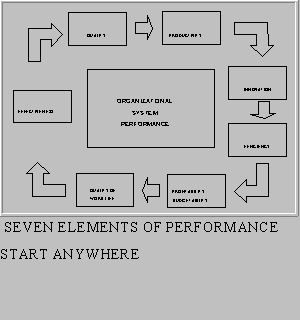
education in any of the seven elements that contribute to the organizational system performance
(ref 4.)
Three possible levels of education are suggested:
AWARENESS- Of the objectives, general principles and processes; this is usually sufficient to
enable management to make a decision on a report, or to enable an employee to effectively
participate in an improvement team.
UNDERSTANDING -. Understanding the techniques needed to achieve each step in the
performance improvement process. Understanding how to facilitate a performance improvement
team, the tools available to resolve difficulties and finally economic analysis, to make an effective
recommendation for a performance improvement initiative.
PROFOUND KNOWLEDGE - Sufficient knowledge of the subject to inform, to train and to
inspire others and to provide leadership in the performance improvement process.
A manager who has come to an awareness of the performance improvement process is well armed to begin to identify a starting point. While we have been talking so far about organizations and departments and functions, it's important to recognize that business processes are to be the subject of our efforts. These do not always fit neatly within sometimes arbitrary departmental boundaries. If the process to be studied is not under the full control of one manager, then the proponent will have to enlist the co-operation of those managers who control those external parts of the process. At the outset, higher levels of management must be at least neutral. This means willing to approve proposals for change that are backed by solid technical and economic analysis.
A more fundamental approach to the identification of the most significant business elements is
total factor productivity (TFP) analysis. (ref 5.) The most significant feature of TFP analysis is
that no costs or processes are excluded from consideration. Creative accounting cannot be
employed to give the illusion of improvement. On the other hand, if process measurements are
made before the "process and it's objectives are made clear", then the simple making of those
measurements may build resistance to the process. In this process, certain steps must be followed
before measurement takes place, as will be made clear further on in this paper.
The scope of study in the first instance is a definite concern. If the scope is too narrow, the
process will be perceived as trivial. If it is too broad, it may be over ambitious and beyond the
capability of the team and facilitator to bring to a successful conclusion. Several smaller but
significant successes are better than one grand failure.
Essential to the performance improvement process is a facilitator, preferably an industrial
engineering professional who can be responsible for the adequacy of the technical and economic
studies that follow. The facilitator must have backup resources that he may call upon.
Also, essential to the stability of the process is a study team of between two and five persons.
These persons do not need to be proficient in industrial engineering techniques, but should be
familiar with the process under study. They must not be administratively part of the area under
study. The purpose of the team is to provide the educated intuition and company culture
necessary to ensure that proposals will not only be technically and economically feasible, but will
fit the company.
The first step is for the team to conduct interviews of all employees who are either, in the organizational unit or involved in the process. The team should start from the bottom or front line and work backward through the organization or process to determine everyone's perception of the problems. The team will encounter lots of other problems, as employees become comfortable with the process and start talking about everything that's bothering them. Whether or not the problems seem to be relevant to the scope of the study, the interview team must allow sufficient time for the employee to feel that he/she has had their say.
Once the interviews have been documented, they can be used to help define the measurements to
be taken to validate the perceptions both of management and of the employees. These
measurements can include time and motion studies, but a more effective technique has been found
to be a tick chart. Employees use the chart to effectively measure themselves, and through
discussion, reconcile those measurements with their previously stated perceptions. This provides
objective documentation of problems most times supporting employees perceptions rather than
managements.
Time and motion studies must obviously be conducted by those proficient in the technique and for
such a length of time as to minimize the "watched employee syndrome". However, a more
constructive approach is to extract proxy data from a transactional computer system used by
employees, or to prepare tick charts, on the basis of interviews, defining what the employees
think they do. The employees can then use these charts to record their activities. With this data,
the volume of activities can be quantified and flow diagrams of the work processes can be created.
This is carried out by the facilitator assisted by the study team. The charts are reviewed with the
employees from time to time to ensure that they truly represent the work that is being performed.
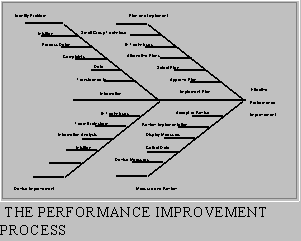
The analysis consists of two basic steps: the conversion of data to information, and the
quantification of problems defined initially or in the interview process. The analysis step is very
dependent on the skill of the facilitator in ensuring that the appropriate industrial engineering tools
are properly applied to convert data into useful information, and to honestly use this information
to substantiate or refute the perceptions gathered throughout the process.
The study team, with all this information in hand then secludes itself to brainstorm for alternative
solutions, defining cost and benefit cash flows for each alternative. An economic analysis then
follows which provides the means to prioritize the solutions.
The next step is to share the results of the analysis process with all employees in the work group
or groups under study, and to share the prioritization of problems to be addressed. Not all
identified problems will be addressed, only those of high priority. When these high priority
problems have been satisfactorily resolved, others on the list can be considered. The second
purpose of this sharing is to gather ideas on possible solutions to the problems. This step is
essential if the employees are to perceive that they are part of the improvement, and that their
perceptions and ideas are being listened to.
Many management consultants keep this part of
the process to themselves, in this manner they
think they can be perceived to be making vital
and exclusive contributions, and to control the
process. In our opinion, this is not a wise
approach. This step is a vital learning process
for both the study team and the employees. It
does not take away from the need for the
facilitator to be every bit the expert, but rather to
exercise leadership in bringing the study team
and employees to the same level of
understanding of the problems as he or she has,
without imposing ideas unilaterally. The only thing on which he must insist is that concept of
"management by data" be respected. (ref 7.)
A report is then prepared by the team defining the problems, including information supporting or
refuting the problems as initially perceived. The second part of the report includes solutions
leading to a series of recommendations for improvement. These recommendations should include
supporting cost and benefit cash flows. The report should also include a page for the team
members and management to sign off as having approved it.
Management approval of the report documents commitment to the improvement process and to
the actions which the employees must now take to give effect to the improvement.
The area or location manager then has a document which defines for him the actions he must take
to effect the improvement. Employees see some of their recommendations contained in that
document and consequently will enthusiastically support the implementation of the changes.
The final essential element in the process is an audit, preferably conducted by the same study team
after a year or so to determine if the recommended changes were achieved within budget and if
the benefits were also as budgeted.
The audit provides a good starting point for a renewed improvement process selecting several
more items from the previously prioritized list, or developing new ones if that seems more
appropriate.
The repetition of this cycle constitutes Continuous Performance Improvement.
When the scope of the processes under study includes the entire company the cycle constitutes
Business Process Re-engineering.
3. THE PRACTICAL APPLICATION
This section will deal with some of the same topics previously identified, expanding them as
necessary and will introduce others, necessary to achieve a successful performance improvement
process.
3.1 BEGINNING THE PROCESS
Before a performance improvement process can begin the senior managers must be sensitized to
the need for improvement in your organisation, even though they may be aware of the importance
of such a program through the media. A simple method is to develop a file of performance
improvement success stories related to your industry from trade publications,professional journals
such as Industrial Engineering, etc. Your local university and library are also a great source of
information.
By distributing these success stories to senior levels of management three important steps are
achieved. These are:
(a) To make management aware of what the competition is doing, in the area of performance improvement.
(b) To provide feedback that will identify those managers sympathetic to the cause.
(c) To identify you as the knowledge center for performance improvement techniques.
3.2 EDUCATION
As a facilitator or team leader you must have sufficient knowledge to inform, train and lead the
performance improvement process. This is the second level of education described in section 2 as
"understanding". This can only be accomplished by training: formal training through courses
offered by the local college and/or a professional association such as I.I.E., or informal training -
phone calls, discussions, and visits with facilitators of successful performance improvements.
3.3 IDENTIFICATION OF POTENTIAL PERFORMANCE IMPROVEMENT OPPORTUNITIES
In all likelihood, the facility, area, function or process requiring improvement will be identified
through the feedback from the senior managers. This will allow you the opportunity to discuss
with the specific manager the type of intervention and the support he must provide, both in terms
of resources and commitment to act on any suggested improvements.
3.4 PICKING THE STUDY TEAM
The selection of the team is probably the most critical item you will have to address, as it will
make or break the review. The team members should have certain core attributes. These are:
knowledgeable in one or more of the areas under review, open-minded, good communicators and
volunteers. They should not be from the facility or area under review.
3.5 SIZE OF THE TEAM
The team should be sized between two (2) and five (5) people including the facilitator/team leader
for maximum effectiveness.
3.6 CONFIDENTIALITY OF REVIEW PROCESS
The development of a Code of Ethics is essential to the success of this type of program and should include the following criteria: team members must be independent of the normal line of authority to ensure their objectivity, team members must act in a professional way, and team members must not discuss team actions or information gathered with any person not authorized to receive it.
Should pressure by their immediate management or other persons be applied to reveal such
information, the facilitator/team leader must be informed.
3.7 PRE-REVIEW TEAM MEETING
One or more pre-review meetings should be held to: explain the performance improvement
process approach, provide training, discuss tasks, develop questionnaires, tour area under review,
etc.
3.8 STARTING THE REVIEW
After assembling the team at the location under review, the team should meet with senior manager
and his/her direct reports. This will allow the manager and his/her staff to update the team on any
changes since the pre-review visit.
3.9 INFORMATION MEETING
One or more information meetings must be held, with the senior location manager present, to
explain the purpose of the performance improvement review and explain the techniques to be used
to all the personnel covered in the review.
3.10 INTERVIEWS OF LOCATION PERSONNEL
Two man teams carry out closed door interviews with each employee,the confidential interviews
must begin on the front-line and rollup through supervision to management.The interviews
identify the employees perception of the areas of greatest concern and potential solutions. Each
interview will normally take about one and a half (1 1/2) hours to complete.
3.11 COMMUNICATION
Daily meetings must be scheduled with the location manager or his designate, these meetings
allow for a free and open exchange of information and are significant tools in the process.
3.12 MEASUREMENTS
The earlier use of interviews to establish a broad perceptual consensus can only be validated
through objective measurement. While time and motion studies spring to mind, they do not
encourage participation by the employees. A better method is to use historical data and data
which is transparent to the employees such as computer transactions, phone company records of
calls received, etc., together with tick charts prepared from the results of the interviews.
The tick charts define what the employees believe their activities are. The employees record the
frequency or time taken for each activity occurrence for a period of time, typically two (2) to four
(4) weeks. The data gathered quantifies the work volume by activity, employees are encouraged
to add to the chart as they identify additional tasks.
3.13 DATA ANALYSIS
The team members collect the tick chart data daily and discuss with individual employees the
results obtained. While this is under way, a parallel process is the collection of the historical and
transparent data. All the data collected is converted to useful information through the use of
statistical process control tools such as pareto charts, run charts, scatter/trend diagrams, cause
and effect diagrams.
3.14 BRAINSTORMING
The team meets as a group to discuss the results and brainstorm for solutions which are both cost
effective and practical. Not all problems are addressed, usually those which are seen as
significant, ie. the twenty percent (20%) which cause eighty percent (80%) of the costs.
3.15 SHARING THE SOLUTIONS
The solutions from the brainstorming exercise can be shared by the review team in several ways:
(A) A group session with all the affected employees,
(B) A meeting with the designated employees representing each sub process group in the trades affected,
(C) A meeting with supervisors and management,
(D) A combination of the above.
The facilitator should choose thwe most effective approach to encourage both management and
employees to buy in to the process, while minimizing the disruption to the workplace.
3.16 MANAGEMENT REPORT
With the brainstorming complete, the team drafts a preliminary report and meets with the
management group to discuss in detail the areas of concern and possible solutions. This allows
management to review the result before the report is finalized and discuss potential problems in
implementation. Once this has been done, the final report is prepared, including a performance
improvement action plan which defines objectives, time-frame and costs where appropriate.
3.17 MANAGEMENT APPROVAL
The performance improvement action plan must be signed off by the senior facility manager and
the line manager responsible for the area under review. Thus demonstrating commitment to the
process and the solutions.
3.18 IMPLEMENTATION
As the solutions are implemented, the employees see that their concerns are addressed and
support the change process.
3.19 AUDIT
A critical element is the follow up action. This can be in two parts: firstly, a request for a formal
progress report at regular intervals, secondly, a follow-up review after a year or so.
3.20 REPEAT THE CYCLE
Once the actions from the original study are complete the process can be renewed and further
improvements made. This constitutes continuous performance improvement.
4. CONCLUSION
This version of a performance improvement process has been successfully used in processes as diverse as: power plant maintenance, purchasing, administration, translation bureaus and financial institutions.
The authors hope that this paper will re-emphasis the importance of the inputs that employees can
provide and layout a framework which will allow the reader to TRANSFORM EMPLOYEE
KNOWLEDGE INTO PRO-ACTIVE SOLUTIONS FOR THE TWENTY-FIRST CENTURY.
5. FOR FURTHER READING
1. BAIRD, C.F. and FARR D.F., "Successful Productivity Improvements in the Maintenance
Operations of a Public Utility", IIE Maintenance Conference, 1988.
2. BAIRD, C.F. and RYDER F.H., "Applied Productivity, The Strategy and Techniques of
Managing Performance and Productivity at New Brunswick Power", Canadian Electrical
Association, 1988.
3. RYDER, F.H. and FARR D.F., "Improving the Performance of the Performance Process at a
Power Company", Industrial Engineering Magazine, July 1991.
4. RYDER, F.H., "The Continuous Improvement of Organisational System Performance",
Engineering Management Journal, August 1992.
5. SINK, D.SCOTT, "Productivity Management: Planning, Measurement and Evaluation, Control
and Improvement", John Wiley, 1985.
6. SINK, D. SCOTT and TUTTLE, THOMAS E., "Planning and Measurement in your Organisation of the Future", Industrial Engineering and Management Press, 1989.
7. INSTITUTE OF INDUSTRIAL ENGINEERS " Criteria for Award for Excellence in
Productivity Improvement"
---------------------------------------------------------------------------------
DAVID F. FARR, HNC, is the founder of Farr and Associates, a service company providing
support to business in the area of Performance Improvement. He has over 30 years of expertise in
the areas of Quality Assurance and Performance Improvement. He is a Senior Member of IIE.
FRANK H. RYDER, B.Sc. M.Eng P.Eng., is an Electrical Engineer with over 30 years of experience covering HVDC Transmission, Nuclear and Conventional plants, System and Corporate Planning, Economic Analysis and management of Quality Assurance and Internal Audit Programs. He is a Senior Member of IIE.