PERFORMANCE MANAGEMENT
The challenge of the decade is not just to compete on the
basis of a worldwide quality standard, but to do so profitably.
by Frank H. Ryder, C.Eng FIEE
The Challenge
There is a challenge for engineers out there today. It's not
a new challenge, but it's a challenge that we as engineers and
managers have not been very effective in dealing with. We have seen
many innovative British designs in aircraft and machine tools and
numerical control and television and automobiles overtaken or more
effectively applied by foreign competition.
In America W.Edwards Deming suggests that it is perhaps the
most underdeveloped nation in the world - we do so little with so
much. Mostly, we do so little with our human resources.
The challenge manifests itself in other areas, for example, in
postal delivery where courier companies have taken over the high
class sector of that service and left the junk mail to the GPO. We
see government expenditure forming an increasing percentage of the
gross national product, while, at the same time, the quality of the
service delivered is perceived to be declining. What's going on
here? Are these different problems or different manifestations of
the same problem? How can we analyze them? Are the techniques
transferrable from industry to services to government to academia?
These are some of the questions I hope to address. To start let us
focus on industry.
The Concept, part 1: Quality and Customer Satisfaction
The capture of markets by our industrial competition was
realized simply by applying greater efforts to customer
satisfaction with the product and it's quality, to the point where
the customer ceased to consider the alternatives to be competitive.
While that concept may be simply stated, the achievement requires
a lot of ingenuity and hard work.
Two examples come to mind:
* the capture of the world motorcycle market by Japanese
manufacturers and the subsequent recovery of Harley Davidson as a
quality manufacturer of motorcycles. (1) ,
* Xerox practically invented the photocopying process but
nevertheless saw it's resulting monopoly taken over by more
reliable Japanese machines, serviced when required by more
responsive technicians, it was subsequently able to recapture much
of it's former reputation (2).
The achievement of customer satisfaction requires two things,
generally stated:
* That products and services be refined so as to meet the
requirements of the end user with a minimum of further processing.
* That products and services be perceived by the customer as
being of such superior value and quality that they can carry a
premium price.
This has several implications for the suppliers of products and
services and for the skills and dedication of the people who
produce them.
* There must be a sensitivity, on the part of all employees,
to the needs of the end user, and the function to which the product
is put, and a willingness, more than that, an enthusiasm to tailor
the product to his needs.
* The customer must perceive that he is part of an effective
feedback control system assuring the quality of the product and
feel confident that his observations on the product quality will be
quickly acted upon in a professional manner to relieve the cause of
the problem , and not merely it's effect. For example increasing
inspection may relieve the effect, but does nothing to alleviate
the cause, and does not give the customer comfort that he may
indefinitely expect to receive a quality product. On the other hand
British Airways' video customer complaint booths, discussed later
herein, provide a very effective means, in the heat of the moment,
to give the customer comfort that he or she has some control over
the quality of service.
br wp="br1">
The National Response to Quality
Around the world government response to quality issues has
been typically bureaucratic. An alphabet soup of national standards
setting bodies, created in the bad old days, when among other more
worthy objectives, standards were the technical means of excluding
competition from the marketplace, are now devising reciprocal
agreements , mutually recognizing each other's standards, including
standards of quality.
Governments are providing technical and financial assistance
to companies to define programs by which they will meet and
document their meeting of these recognized quality standards.
While this part of the program may be very helpful in
providing a common language for the discussion of quality and of a
product's merits, an essential part of getting a product in the
customer's door, it does not substitute for a proactive attitude on
the part of individuals within a company in satisfying customer's
needs, also it does nothing to address the issue of doing all this
profitably, amongst the other organizational system performance
issues.
The Concept, part 2: Productivity Efficiency and Profitability
An obvious question is :
How can an organization that apparently focuses so much of
it's energy on tailoring it's products and services and their
quality to the whim of it's customers and to the documented quality
requirements of the government bureaucracy ever be profitable?
The response has two steps , as in the Midas Muffler
commercial about their "Top Guns":
First you get good
Then you get fast
Repairing auto exhaust systems and changing silencers is a grubby business, and the people who do it have never had much respect. Midas Muffler, in this advert, have achieved three things.
* They have given their employees a message that they are worthy of respect.
* They have given their customers a message that Midas service
is the best , and it's fast.
* They have motivated their employees to satisfy the customer,
increased market penetration and increased profitability.
This message could obviously be perceived as a simple
marketing gimmick, on the other hand it could be the external
manifestation of a profound cultural change, the tip of the iceberg
as it were.
Operational Definitions and Conceptual Models
In attempting to research this field one was gripped with a
sense of frustration. The frustration that comes from an inability
to grasp a complete picture of the concept; the portrayal of an
inconsistent picture by writers and even more disparate
recommendations as to the methodology for it's achievement; and
finally by the use in the field, of common terminology given
specific new meaning, not always consistent with the common
meaning. This frustration is verbalized in the following quotation
from Sink and Tuttle (3), page 170:
" The field is filled with practitioners
with no conceptual models and weak operational definitions.
The field is filled with academicians
with weak conceptual models and no operational definitions."
In an attempt to contribute to lessening this frustration on the part of those who would attempt further investigation of the subject after reading this article the following definitions (4) are offered:
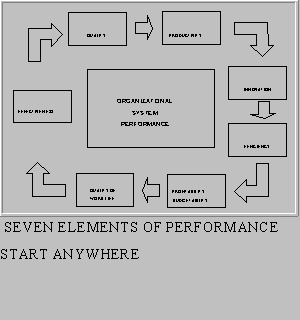
The performance of an organizational system is composed of
seven interrelated criteria: (Figure 1.)
Effectiveness Are we doing the right things?
Quality Are we doing things once, and to the satisfaction of the customer?
Efficiency Are we doing things right, according to plan, budgets to actuals?
Productivity The trend of output/input by accounting period.
Quality of work life Are employees motivated to continue
to work in and for the organization?
Innovation Are we continuing to enhance the fitness
for use as perceived by the customer?
Profitability Also means budgetability in the public sector.
One should now start to see where the activities I have so far
identified as important fit into the picture. In practice,
improvements effected in any one area may be expected to positively
effect other areas, as the diagram illustrates.
Management has the responsibility to determine the corporate
direction of the company, but that does not mean that they have a
monopoly on good ideas for new products or applications of existing
products, or for improvements to processes to make them more
responsive or efficient; management must find means to capture
those ideas from both their employees and their customers. This has
direct implications for effectiveness productivity and innovation.
I have indicated there is no shortage of help in the
definition of robust quality programs designed to help firms meet
national quality standards, but by itself that may or may not be
enough to satisfy customers.
It is at this point that many companies fail to give adequate
consideration to efficiency, productivity, quality of work life,
and innovation, but rather, taking a bean counter approach, jump
right to the profitability issue and sacrifice long term survival
for short term profits.
Quality of product and the sincere cultivation of customer
satisfaction can be a powerful force for increasing revenue in an
organization. That's only the first step however, it must be
accompanied by the second step, an integrated complementary force
for efficiency and productivity , a capability to analyze the
process and to reduce if not eliminate those functions which do not
effectively add value to the product or service, and to ensure that
those functions that must be performed are done in the most
effective and efficient manner possible, thus reducing costs. It
should seem obvious that a productivity focus by itself is not
enough; one runs the risk of efficiently producing products that
customers do not want. The focus on customer satisfaction in the
product and in the quality of the product is a prerequisite to a
productivity improvement program. These concepts are explained
clearly and in detail in the books and videos of Tom Peters (5) and
W.Edwards Deming (6) to name only two of many who link quality
causally with profitability.
The Expertise
Industry programs which support this activity are given titles
like Performance Management, or Total Quality Management , or Total
Quality and Productivity Management among other more esoteric
names. While many authors impart a clear and sometimes eloquent
understanding of the conditions that must exist in support of a
Quality and Productivity Management program, for the most part they
are not too clear in defining the means to achieve the requisite
conditions. The consequence of this is that there are many
offerings of educational and consulting programs some of which are
perceived to be more complicated than they need be to address the
problem and others of which seem to be divorced from the academic
field supporting these endeavours.
In America the field of academia supporting these programs is
modern Industrial Engineering , and in particular a specialty
called Management Systems Engineering, and it is upon this
foundation that further discussion of the Continuous Improvement of
Organizational System Performance will be based.
What Performance Improvement is
and more important, what it is not!
An effective work activity requires four elements:
1. Motivated employees.
2. Who have adequate training and skill to do the job.
3. Who have the appropriate materials and tools at hand.
4. Who have a clear job plan to satisfy their customer.
Performance Improvement is focused on improving the
effectiveness of employees through the removal of roadblocks to
performance caused by inadequate training, materials,tools,and ill
defined or nonexistent job plans. That is , helping them to work
smarter in removing the limitations to getting the job done, while
at the same time identifying and eliminating those activities which
do not contribute to satisfying customer needs.
Performance Improvement is not about motivating employees to
put up with or otherwise work around inadequate work situations
through working harder.
Performance Improvement is about the creation and
communication of clear statements of corporate mission and vision
and strategic and tactical objectives so that every employee may
clearly understand what it takes for the company to be effective
and what his or her role is in that process.
Performance Improvement is about helping employees to identify
those training , material, tool,or planning inadequacies that
prevent them from being effective and providing the means to make
changes.
Performance Improvement may lead to broadening of skills,
creating well rounded employees who may, in due course, make a more
effective contribution to company management than a parachuted
candidate with a general or accountancy degree. (7)
Performance Improvement Strategy
The development of a strategy to approach performance
improvement could be the subject of an article in it's own right,
at this time only three points of issue will be identified:
1. One does not need to consult employees to identify many
improvements, in fact many traditional Industrial Engineering
practitioners do not. (Figure 2a. )
2. One can effect more significant results by capturing the
employee's performance improvement ideas for two reasons , they are
probably good ideas, and they motivate employees to ensure they are
implemented. (Figure 2b. )
3. One can effect even more significant results by means of a
corporate quality and productivity program which focuses management
team effort on Quality Customer Service. This helps employees
identify their customers, the services they provide, and the
required level of customer satisfaction. Quality and Productivity
improvement in such a culture is faster and more effective because
everyone is committed to implementing changes which are seen to
improve quality of service and productivity in providing that
service. (Figure 3. A trap into which some may be disposed to fall
is to try to achieve this result solely by means of the
establishment of Mission, Vision and objectives, without, or with
inadequate Industrial Engineering and Operational Audit skills to
support the process.
A "close to home" example of the proper approach may be found
in British Airways, where the "Putting people first" program (8)
provides a corporate vision focused on customer service and
satisfaction. Though not discussed by Lord King this approach when
combined with management support of front line customer service
people, effectively inverts the traditional organizational pyramid
in supporting those employees who must service the customer.
Further when this process is combined with an in house publication
that communicates the causes of delays suffered by passengers,
without attempting to assign blame, and supported by tapes from
video complaint booths at Heathrow and Kennedy Airport in New York
it really concentrates everybody's mind on the problems and
encourages their resolution.
Motivation
The persistent communication of a vision may at times have
other than the desired effect. British Airways'" Putting people
first" (meaning the customer) program became known by it's initials
PPF which were after a time reinterpreted by the company grapevine
as "Pounding people flat" ( the employees). (9)
The issue of motivation is an essential element of a
performance improvement program. The techniques of professional
sports coaching and of Alcoholics Anonymous provide useful examples
on the effective application of the positive reinforcement of
desired human behaviour. Dr. Aubrey C. Daniels, an applied
psychologist demonstrates (10) that most attempts at performance
improvement are less effective than they could otherwise be if
professional sports coaching techniques were employed. He goes on
to document how to integrate these techniques into a programme for
the improvement of organizational system performance.
Closure
In summary:
A focus on customer satisfaction and quality of product or service,
increases revenue.
A focus on productivity, increasing cost effectiveness in
production or service delivery, leads to increased profitability,
survival of the organization, and to greater employee satisfaction
with the quality of their work life. (11)
To be part of such a performance improvement process in an
organization can be a powerfully satisfying experience,
particularly when one understands the whole concept.
This article has been an attempt to share that concept and it's
academic foundations.
References
1. Peter C Reid, Well Made in America; Lessons from Harley Davidson on being the Best (New York: McGraw Hill, 1990)
2. Gary Jacobson and John Hillkirk Xerox; American Samurai (New York: Collier, 1986)
3. D.Scott Sink and Thomas C.Tuttle, Planning and Measurement in Your Organization of the Future (Norcross GA: Industrial Engineering and Management Press)
4. D.Scott Sink, Productivity Management, Planning Measurement and Evaluation, Control and Improvement.(New York, 1985 John Wiley)
5. T.J.Peters and R.H.Waterman, In Search of Excellence (New York, 1982 Harper & Row)
6. W.Edwards Deming, Out of the Crisis. (Cambridge MA., 1986
MIT Press)
7. Norman Willis, General Secretary TUC, Skills: Just Not British
(London, IEE Recruitment, 21 Feb. 1991)
8. Lord King of Wartnaby, The transformation of British Airways
(London: Engineering and Management Review, Feb, 1991)
9. Richard C. Whiteley, The Customer Driven Company (Reading MA: Addison- Wesley, 1991)
10. Aubrey C. Daniels, Performance Management; Improving Quality and Productivity through Positive Reinforcement ( Tucker GA: Performance Management Publications 1989)
11. Frank H. Ryder and David F. Farr, Improving the Performance of the Performance
Improvement Process, at a Power Company ( Norcross GA: Industrial Engineering, Jul,
1991)
Frank H.Ryder B.Sc., M.Eng, C.Eng FIEE is an Electric Utility Engineer with over 30 years experience in the field. His assignments have included the Eel River HVDC project,(the world's first large solid state HVDC station) and the Nuclear Power Program (which lead to construction license for the Point Lepreau Generating Station, currently holding the No.2 lifetime performance record in the world).
His current assignment is Director, Internal Audit and Corporate Quality Assurance for New Brunswick Power. This paper represents his personal observations and opinions developed in the course of defining a Performance Improvement program.
His American associations include Senior Member IEEE, and Senior Member Institute of Industrial Engineers. He is a nationally certified coach in the olympic sport of pistol shooting.