
LinkExchange
Member |
The Dzopa : Skywriters and Ancient Astronauts
By : W. Saitsew - dated 1968
Date: Tue, 2 Sep 1997 10:50:00 -0400 (EDT)
Subject: The Dzopa : Skywriters and Ancient Astronauts
While I was unable to locate the Lolladoff Plate in a cursory search of
the web, I was able to find this article and pass it along for your
perusal under the heading of: The Stonedisks of Baian-Kara-Ula
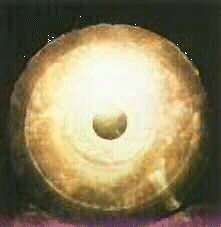
Note: No ethnological minority with the name "Dropa" or
"Dzopa" respectively is recorded in china.
Science or Phantasy 1968: W.Saitsew's paper
In the borderland between Tibet and China there is the cave region
of the Baian-Kara-Ula mountains. 25 years ago, remarkable finds of tablets
with writing and hieroglyphics were made there. Several thousand years
ago a people whose looks chinese archeologists are only vaguely familiar
with, had been cutting phonograph record like stonedisks out of the
hardest granite with a set of completely unknown tools.
The 716 stonedisks found so far also have a hole in their center
just as phonograph records do. From there, spiralling out towards the rim,
aredouble-grooves. These grooves of course are not like sound-tracks but
rather the most peculiar writing-system which has never been found in
China and possibly even the world. It took archeologists and scientists
over two decades to decipher it. The contents are so phantastic that the
academy of pre-history in Beijing didn't want to publish the report of
the scientist Prof. Tsum Um Nui at first.
Backed by four colleagues, archeologist Tsum Um Nui stated: "the
groove-writing tells of aerial vehicles which, according to the stonedisks
existed 12.000 years ago". In one place it says literally: "The Dropa came
down from the clouds with their airgliders. Ten times the men, women and
children of the Kham hid in the caves until sunrise. Then they understood
the signs and saw that the Dropa came in peace this time." Finds of the
Dropa and Kham races have been made earlier already in these mountain
caves. Archeologists were and still are unable to ethnologically assign
these only up to 4 ft. 4 in. tall humans. There are no similarities with
the chinese, mongols or tibetans. One could of course suggest that a few
thousand years ago a Kham literate was playing a joke, or that it was
mere superstition when he was talking about aircrafts.
But then, what does one do about the statement, all sensations
excluded, reported in other groove-hieroglyphics of a great mourning
about the own airfleet's destruction during landing in the very
inaccessible mountains and the lack of means to rebuild it. The
hieroglyphics of Baian-Kara-Ula appear to be so mysterious to the chinese
archeology that only very careful scientific use has been made of them.
On one occasion a sensational discovery had been made. The disks contain
a lot of cobalt and other metals. When testing a disk with an oscillograph
a surprising oscillation rhythym was discovered, just as if the disks with
their groove-writing had once been charged or had functioned as electrical
conductors. Nobody can tell what's behind these 12.000 year old
stonedisks.
Assumptions would be too risky and not objective enough. But
one is reminded of the ancient chinese tale of the small and slender
yellow people who came from the clouds and were shunned by everyone due
to their ugliness - large, wide heads and very slender bodies - and
hunted by the "men with the quick horses" (Mongols?). In fact there had
been finds of grave- and skeleton remains in the caves from 12.000 years
ago and it's also a fact that these finds, classified as remains of the
Dropa and Kham race, carried the signs of a small body frame and very
large heads. The very first archeological reports tell of an extinct
mountain gorilla species. But has anyone heard of ordered monkey-graves
and writing-tablets?
In 1940 the archeologist Chi Pu Tei was widely mocked at for making
such a claim. But Chi Pu Tei defended himself by declaring that the stone
disks had been added to the caves by later cultures. This is all rather
confusing, but it does not change anything about the hieroglyph-mystery
of Baian-Kara-Ula, which gets even more complicated by the fact that the
cave walls show carved pictures of the writing tablets, in several places
the rising sun, the moon and stars in between whole swarms of pea-sized
dots that are descending towards the mountains and the earth in graceful
curves.
The above text is a translation of the original paper written by W.
Saitsew and has not been altered in any way.
From: [email protected]
Date: Tue, 2 Sep 1997 23:08:03 +0000
Subject: A Cosmic Puzzle (And Earthly Thanks!)
Priority: normal
Dear Friends,
The symbols bear a striking resemblance to those found on a curious
"plate" purchased in Mussorie in Northern India in 1945 by Dr. Sergei
Lolladoff, a Polish Professor of Anthropology and Ethnology (1903-1949).
The plate is shown in a black and white photograph that appears in a
book called "Sungods In Exile". This book, which I have never seen
another copy of save my own, was edited from the works of Dr. Karyl
Robin-Evans, M.A., D.Phil, by his secretary, David Agamon, M.A. It was
published in Great Britain, after Robin-Evans death in 1974 (as per his
request), by Neville Spearman Limited. Driven by his desire to learn
more about the plate, Robin-Evans journeyed to the mountains of Tibet in
search of the mysterious Dzopa people, the guardians of this and other
similar "plates".
Professor Lolladoff brought the object to Oxford (where he met and
worked with Robin-Evans) so that it could be studied. He described it in
considerable detail in a paper in the Journal of Comparative Ethnology:
"It's thickness, they noted, was nearly 2 1/4 inches at the centre, and
it was nearly 9 inches across. One side was blank. On the other a band
ran from the edge inwards to the centre, decorated with light reliefs,
which lacked artistic merit. Reading out clockwise from the centre,
where there was a twelve rayed design representing the sun (or a sun),
one could see (1) a squirrel-like creature, (2) a band of four shapes,
one repeated, the other resembling them in general size, leading the two
to guess that they where probably a form of writing, (3) a shape like a
lens or a disc seen edge-on, with a line that did not meet its sides,
(4) further "lettering", this time in two rows of six, (5) a large
headed figure with its head towards the centre, (6) two spider-like
shapes (possibly small suns or planets?), and (7) what is possibly
intended to represent a lizard."
Of further interest - for its size, the plate was remarkably heavy,
slightly slippery to touch, grey inclining toward black. It was "so
intensely hard that even a diamond pointed drill could make practically
no impression." The actual weight of the object fluctuated and was never
constant. "Those who tried to read its mystery with a magnetometer
reported curious resonances that could not be explained by any internal
structures that they could imagine. One of these physicists suggested
that, far from being the handiwork of primitive people, what they held
was in fact some highly advanced kind of recording machine."
The plate secured by Professor Lolladoff as one of several such
plates. The Dzopa, who claimed that their ancestors came from the
stars, where charged with preserving the plates and protecting their
secret. These people averaged 3-4 feet in height and were in possession
of what may have been (according to Robin-Evans journals) a centuries
old crashed disc.
Please note, the plate pictured in this book is NOT like the ones
shown on the Stonedisks of Baian-Kara-Ula website. After following my
compulsion to dig this book out from it's storage box, I did a search on
Lolladoff - I was shocked to have a site listed containing some
information. I would urge anyone interested in this story to visit the
web site, there is more information on the Dzopa. Again, the plate that
I am talking about is not like the ones pictured. I will scan the
picture in the book and send it with a post so that you can compare it
with the more recent mystery symbols.
Where did the "alien" writing material come from? I have a copy of the
JPEG, but no explanation as to how it was obtained, etc. If anyone has
any further information, please contact me. I would love to know where
the plate is now. Are the Dzopa gone or might some of them still be
living in Tibet?
This is a fascinating, and I think, important, story. I hope to find
more pieces of the puzzle. We are each others best resource, thanks
again!
Best Regards,
Mark
MainPage