
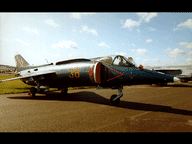
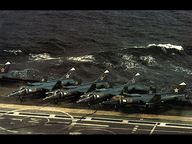
Yak-38 Forger
Yak-38 'Forger-A': Developed from the Yak-36 'Freehand' experimental VTOL type via the Yak-36MP prototype that first flew in 1971, the Yak-38 is a carrierborne tactical warplane with STOVL capability although up to 1984 Western analysts thought the type capable only of VTOL performance. The Yak-38 is superficially a conventional all-metal warplane with a modestly swept flying surfaces that include a sharply anhedraled shoulder-set wing and conventional tail surfaces with inset control surfaces.
The type's most unusual feature, however, is the powerplant that provides STOVL performance. This comprises a single main engine and two auxiliary lift engines: the main engine is located in the central fuselage and exhausts through two hydraulically operated vectoring side nozzles between the wing trailing edge and tailplane leading edge; the two auxiliary engines are located immediately behind the cockpit in a tandem installation inclined 13 Degrees forward of the vertical. The engines are aspirated via a louvered upper-fuselage panel hinged on its rear edge to open when the auxiliary engines are operating and, exhausting downward and slightly rearward, are used to modify pitch and trim as well as to provide direct lift.
The 'Forger-A' entered service in 1976 as the world's second operational STOVL warplane. Though it is a limited type designed to provide operational experience with such warplanes in roles such as reconnaissance, attack on small warships, and fleet air defense, it nonetheless provides Soviet helicopter carriers and aircraft carriers with useful interception and attack capabilities when out of reach of land-based air assets.
Until the first months of 1990 it was thought that the vectoring engine was a NPO Saturn (Lyul'ka) AL-21F turbojet rated at 17,989 lb st (80.02 kN) dry.
 Get your own Free Home Page