
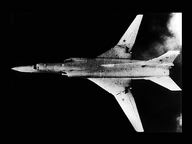
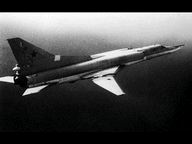
Tu-22M Backfire
A powerful bombing, missile-launching and reconnaissance warplane, the Tu-22M was clearly derived from the Tu-22 'Blinder', which had proved disappointing in field and cruise performance as a result of its wing planform, which had been optimized for supersonic flight.
The process of turning the Tu-22 into the Tu-22M in some respects parallels the evolution of the variable-geometry Sukhoi Su-17 'Fitter' from the fixed-geometry Su-7 'Fitter'. This involved replacement of the fixed-geometry wing with a revised type whose fixed inner section supported pivoting outer panels to provide improved field performance with the wings in the 20 degrees minimum sweep position, better range in the cruising regime with the wings in the intermediate sweep position, and high dash performance with the wings in the 65 degrees maximum sweep position.
In the case of the Tu-22M the revision was extended further, the engine installation being modified from two afterburning turbojets pod-mounted on each side of the vertical tail surface to two afterburning turbofans in a conventional lateral installation with variable-geometry inlets.
The revised type featured a number of other improvements and differences, and the first of two Tu-22M-0 (Tu-136) prototypes flew probably in 1971 at the beginning of a flight test program that also involved seven pre-production aircraft.
The Tu-22M-1 (Aeroplane 45-01) initial production variant was built to the extent of only nine aircraft (perhaps enough to equip just one squadron) and entered service in 1973. As might have been expected, the most notable aerodynamic feature of the type was its wing, which was interesting not only for its variable-geometry capability but also for its complex high-lift and control features. The high-lift devices on each half of the wing comprised four-section flaps (including outer sections often claimed to be ailerons) of the double-slotted type on each trailing edge, and an automatically operated slat along the full span of the leading edge. The control features on each wing half comprised three-section spoilers on the upper surface for lateral control, and some of these spoilers were also designed for use as air brakes and lift dumpers. The rest of the flying surfaces comprised a slab horizontal surface in two halves extending outward from points alongside the lower corners of the two engines' afterburner units, and a vertical surface with an inset rudder.
Despite its improvements over the Tu-22, the Tu-22M-1 was still disappointing in range, possibly as a result of the drag imposed by the pods projecting rearward from the wing trailing edge. It was at first thought in the West that these pods were of the typical Tupolev type and therefore accommodated the retracted main units of the tricycle landing gear, but this is now known not to have been the case.
 Get your own Free Home Page