
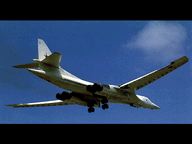
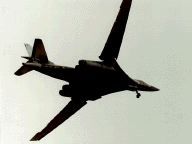
Tu-160 Blackjack
Conceptually akin to the Rockwell B-1B Lancer in being a variable-geometry supersonic penetration bomber designed for the strategic role, the Tu-160 is thought to have entered service in 1987 after a first flight in December 1981.
This Soviet type is some 20% longer than the B-1B and offers both a higher maximum speed and a considerably greater unrefueled combat radius on a mission using high-level subsonic cruise, low-level transonic penetration and high-level supersonic attack. The sweep of the outer wing panels can be manually selected at angles of between 20 and 65 degrees, and these low-set wings are mounted at the outboard ends of fixed glove sections characterized by acutely swept leading edges nicely faired into the narrow-diameter fuselage, which is of circular section.
The warload is carried in two lower-fuselage weapons bays, each 32 ft 9.75 in (10.00 m) long and able to carry a rotary launcher. The primary weapons are free-fall nuclear bombs and/or Kh-55 (AS-15 'Kent') subsonic cruise missiles that were to have been replaced by BL-10 (AS-19 'Koala') supersonic cruise missiles whose development was canceled in 1992, although an alternative is a variable number of Kh-15 or RKV-500B (AS-16 'Kickback') short-range attack missiles used for the defense-suppression role.
Production of the Tu-160 was halted in the first half of the 1990s as the type was suffering a large number of in-service problems, was expensive to build and maintain, and was largely superfluous to the strategic requirements of the CIS. The dissolution of the USSR into the CIS left the force of 31 aircraft divided as 12 for Russia and 19 for Ukraine. Ukraine lacks the ability to maintain its aircraft, which are now largely unserviceable and are scheduled for transfer to Russia.
 Get your own Free Home Page