
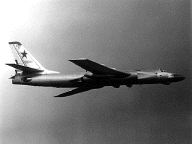
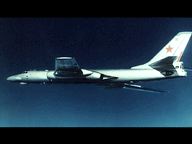
Tu-16 Badger
For its period a remarkable warplane, the Tu-16 was built to the extent of some 2,000 aircraft up to 1959, and in mid-1995 it was estimated that some 600 of these aircraft still remained in declining service with the air arms of the CIS (350 of them in the bomber and strike roles, and the other 250 in a number of other roles including reconnaissance and inflight refueling).
The factor that made this thoroughly modern bomber possible was the design of the Mikulin AM-3 turbojet, a slender axial-flow engine offering high power at a comparatively modest specific fuel consumption. The imminence of this engine opened the way for the Tupolev design bureau to terminate its efforts on some smaller turbojet-powered bombers so that a major effort could be made for the speedy design and development of the larger Tu-88 type intended for long-range operations on the power of two AM-3 turbojets.
In the summer of 1950 the bureau was ordered to proceed as rapidly as possible with the construction of three prototypes (one of them for static test) that were to be evaluated in competition with the smaller Ilyushin Il-46. The fuselage of the Tu-88 was larger than that of previous Tupolev turbojet-powered bombers but based on the same design and construction principles, while the wing was altogether more novel as it was not only larger but of swept configuration and based on a new alloy making possible the use of comparatively thick skins for great strength. Another novelty were the main units of the tricycle landing gear, for these four-wheel units introduced the bogie to Soviet practice and were also designed to retract rearward into large trailing-edge pods that became a trademark of many larger Tupolev aircraft. Mounted in the mid/shoulder-set position, the wing was characterized by a leading-edge sweep of 42 degrees declining to 35 degrees slightly outboard of the main landing gear units, and carried area-increasing flaps inboard and slotted ailerons outboard. The tail unit was also swept, the vertical surface at 40 degrees and the horizontal surface (tailplane with separate elevators) at 45 degrees.
The two engines were installed in large nacelles built integrally with the fuselage center section, and which in turn carried the wing. During the Tu-88's development, these nacelles were revised to an area-ruled configuration and provided with outward-angled jetpipes to reduce asymmetric thrust problems in the event of an engine failure. Fuel for these engines was carried in fuselage fuel cells and integral wing tankage.
Accommodation was provided in two pressurized compartments that were linked by a tunnel only in the prototypes: the forward compartment was occupied by the navigator/bombardier, two pilots, and a radar operator/gunner with an upper-hemisphere sighting dome for the two 23 mm cannon in the dorsal barbette, while the rear compartment was occupied by two more gunners, one in the tail turret with its two 23 mm cannon and the other farther forward with port and starboard sighting positions for the 23 mm cannon in the ventral barbette. The fixed armament was completed by a seventh 23 mm cannon fixed to fire straight ahead and controlled by the pilot.
The Tu-88 first flew in April 1952 with a powerplant of two AM-3A turbojets, and the later evaluation against the Il-46 confirmed that the Tu-88 was an altogether superior warplane. The second Tu-88 flew later in 1952 with AM-3M turbojets, slightly increased span, an improved autopilot and improved avionics that included Argon nav/attack radar with its antenna in an undernose radome, 'Bee Hind' tail-warning radar, IFF, and a remotely controlled chaff/flare dispenser.
Late in 1952 the Tu-88 was selected as a major service type with the designation Tu-16. Considerable development had to be undertaken as the type was initially overweight and lacked adequate performance, but the Tu-16 entered service in 1954 as a conventional strategic bomber with the 19,841 lb (9000 kg) FAB-9000 free-fall bomb or larger numbers of smaller weapons, and was later allocated the NATO reporting name 'Badger-A'.
Early aircraft were fitted with Mikulin AM-3 turbojets each rated at 19,290 lb st (85.81 kN) dry, but later aircraft received the AM-3M engines that increased unrefueled range to 3,885 nm (4,474 miles; 7200 km) and boosted maximum speed by 54 kt (62 mph; 100 km/h).
 Get your own Free Home Page