MiG-29 Fulcrum
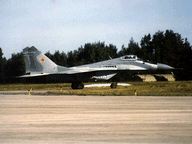
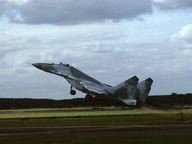
The Mikoyan-Gurevich MiG-29 Fulcrum is one of the newest Soviet fighters. It is very maneuverable, and can carry a large missile load. Its nearest Western counterparts are the F-16 Falcon and the F/A-18 Hornet, and it would be a match for either. It has a very sophisticated radar, not as good as those produced by the West, but much better than previous Russian models. The Fulcrum would be used to escort strike aircraft, intercept incoming air targets, and attack ground targets. They have a relatively short range, but it is not unreasonable for a small fighter. The Fulcrum is probably expensive for the Soviets to build, costing perhaps $25 million in US terms. As of late 1987, despite the cost, the Soviets had built over 300 of these fighters. MiG-29 is a twin-engine jet aircraft. The fuselage is flat and wide with a pronounced teardrop canopy with a small infrared seeker/laser designator on the side and in front of the cockpit. Swept tail fins are located on the sides of the fuselage. Engines are located in separate pods protruding down from the fuselage. Each pod has a rectangular swept air intake with movable cover and smaller air intakes on top. Wings and tailplane are swept along the leading edge. Landing gear with nose wheel retracts into the fuselage. MiG-29 was developed as a successor to MiG-25, but was also given a high payload capacity. First prototype flew in 1977 and the airplane soon went in production. MiG-29 is produced in two main versions - a single-seat fighter and a two-seat fighter/trainer (MiG-29UB). Though designed for air-to-air combat, MiG-29 is also capable of performing air-to-surface strikes. The Fulcrum ranks with the McDonnell-Douglas F-15 and Grumman F-14 as a highly maneuverable air-superiority fighter. It is fitted with sensitive radar/electronics systems that provides a responsive "look down, shoot down" capability, where the pilots can detect targets below his aircraft with greater accuracy (such as terrain-following bombers). Exports have been made to Cuba, the former Czechoslovakia, Germany, India, Iran, Iraq, North Korea, Poland, Romania, Syria, and the former Yugoslavia. The former USSR had about 450 deployed as of 1991.
 Get your own Free Home Page
