
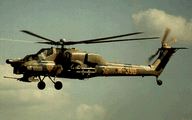
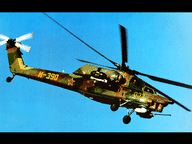
Mi-28 Havoc
First flown in November 1982 for service from the mid-1990s, the 'Havoc' seems to have confirmed Western doubts about the battlefield viability of the Mil Mi-24 'Hind' gunship models, for while this new machine is clearly derived from earlier Mil helicopters (including the dynamic system of the Mi-24 driving a new five-blade articulated main rotor), it adopted the US practice of a much slimmer and smaller fuselage for increased maneuverability and reduced vulnerability over the modern high-technology battlefield.
The Mi-28 thus bears a passing resemblance to the Hughes AH-64A Apache in US Army service, and among its operational features are IR suppression of the podded engines' exhausts, IR decoys, upgraded steel/titanium armor, optronic sighting and targeting systems for use in conjunction with the undernose 30 mm cannon and disposable weapons (including AAMs) carried on the stub wing hardpoints, and millimeter-wavelength radar.
The type clearly possesses an air-combat capability against other battlefield helicopters, and other notable features are a far higher level of survivability and the provision of a small compartment on the left-hand side of the fuselage, probably for the rescue of downed aircrew.
In 1992 the Russians revealed that the type had been developed in competition with the Kamov V-80 (later Ka-50), and that the latter had been selected for Russian service as the Ka-50. Mil then offered the Mi-28 on the export market with a view to placing the type in production only should such an order materialize, but in 1993 it was announced that the type is in fact to be procured for Russian service alongside the Ka-50.
The Mi-28N Havoc-B is due to fly in 1995 for a possible service debut in 1997, this a night and adverse-weather derivative of the baseline Mi-28 with a specialized nav/attack system including a mast-mounted sight incorporating the antenna for millimetric-wavelength radar, FLIR and a low-light-level TV.
 Get your own Free Home Page