
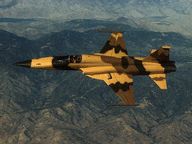
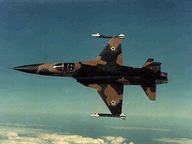
Northrop F-5 Freedom Fighter
The F-5 was developed as a cheap 'export fighter' for military assistance programs. It was a smalll jet fighter with short-span wings, twin-engined and optimized for easy maintenance. The F-5 was never used on a large scale by the USAF, but because of characteristics similar to the MiG-21, the F-5 was used as 'agressor' aircraft. The USAF did also use the closely related T-38 supersonic trainer. While the F-5A (799 built) was a very basic aircraft with minimal equipment, the F-5E Tiger II (1166 built) was much more capable. Finally, the much-modified, single-engined F-5G was renamed F-20.
The original configuration of the F-5A provided for only minimal fighter capability. Following approval of the F-5A project, the Defense Department called for the addition of two internal 20-mm cannon and provision for nose fuel tanks and cameras. In addition, trials with the first two prototypes had indicated the need for a stronger wing structure that could accommodate an additional stores station underneath each wing and a stronger undercarriage to accommodate the added load. It was expected that up to 6200 lb of ordnance could be carried on four underwing pylons and one under- fuselage pylon. These changes were built into the third N-156F (59-4989), which became in effect the first production F-5A. At the same time, uprated J85-GE-13 turbojets were fitted, each offering 3050 lb.s.t. dry and 4080 lb.s.t. with afterburning. 59-4989 took off on its maiden flight on July 31, 1963 with Hank Chouteau at the controls. The first and second prototypes were subsequently brought up to F-5A production standards.
An initial production contract for 71 F-5s was awarded on October 22, 1962, and a further contract for 99 was awarded on August 27, 1963. About 1 out of 9 of these machines were to have been two-seat F-5Bs. Each plane was to have cost about $600,000, with the bill being paid partially or wholly by the US government under the provisions of MAP. A production rate of twelve F-5s per month was to be attained by the end of 1964, with first deliveries taking place early in 1965.
The first two genuine production F-5As (63-8367 and -8368) joined the test program at the end of 1963. Initial deliveries, beginning in April of 1964, were to the 4441st Combat Crew Training Squadron based at Williams AFB in Arizona, where the USAF trained the pilots and maintenance personnel of nations receiving F-5s. This base acted as the instructional center for foreign personnel who were to act as instructors on the F-5 in their own countries.
The F-5A is optimized for the air-to-ground role and has only a very limited air-to-air capability. In the interest of achieving low cost, the F-5A was not equipped with a fire-control radar, the weapons being aimed by a simple optical sight acting in conjunction with a smalll Emerson radar ranging set installed in the extreme nose. The initial avionics fit was rather austere, the standard electronic equipment including an AN/ARC-34C UHF radio, PP-2024 SWIA Missile AVX, AN/AIC-18 interphone, J-4 compass, AN/APX-46 IFF and AN/ARN-65 Tacan receiver.
The F-5A has very docile handling attributes. It is almost unspinnable, and exhibits little, if any, wing drop at the stall. By grouping the two J85 engines so closely together, Northrop has greatly reduced engine-out asymmetric effects.
Production of the F-5A by Northrop ended in June of 1972, after 617 examples had been manufactured.
 Get your own Free Home Page