
Northrop Grumman F-14 Tomcat
The F-14 Tomcat is the US Navy's standard carrier based fighter. Its missions include Combat Air Patrol (CAP), Deck-Launched Intercept (DLI), and air superiority. It is a large, fast, heavy aircraft designed around the long-range AIM-54 Phoenix Air-to-Air Missile (AAM) and the powerful Hughes AWG-9 weapons control system, which weighs 1,300 lb (590 kg) and occupies a volume of 25 cu ft (0.71 cu m).
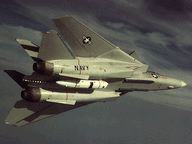
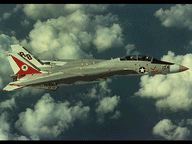
The Tomcat is a 2-seat, twin-engine fighter with twin tails and variable-geometry wings. Its general arrangement consists of a long nacelle containing the large nose radar and 2 crew positions extending well forward and above the widely spaced engines. The engines are parallel to a central structure that flattens towards the tail; butterfly-shaped airbrakes are located between the fins on the upper and lower surfaces. Altogether, the fuselage forms more than half of the total aerodynamic lifting surface. The original design airframe life for the F-14 was 6,000 hours, but was later extended to 7,200 hours.
The wings are shoulder-mounted and are programmed for automatic sweep during flight, with a manual override provided. The twin, swept fin-and-rudder vertical surfaces are mounted on the engine housings and canted outward. The wing pivot carry- through structure crosses the central structure; the carry through is 22 ft (6.7 m) long and constructed from 33 electron welded parts machined from titanium; the pivots are located outboard of the engines. Normal sweep range is 20 to 68 deg with a 75-deg "oversweep" position provided for shipboard hangar stowage; sweep speed is 7.5 deg per second.
For roll control below 57 deg, the F-14 uses spoilers located along the upper wing near the trailing edge in conjunction with its all-moving, swept tailplanes, which are operated differentially; above 57-deg sweep, the tailplanes operate alone. For unswept, low-speed combat maneuvering, the outer 2 sections of trailing edge flaps can be deployed at 10 deg and the nearly full-span leading-edge slats are drooped to 8.5 deg. At speeds above Mach 1.0, glove vanes in the leading edge of the fixed portion of the wing extend to move the aerodynamic center forward and reduce loads on the tailplane.
The sharply raked, 2-dimensional 4-shock engine intakes have 2 variable-angle ramps, a bypass door in the intake roof, and a fixed ramp forward; exhaust nozzles are mechanically variable. Viewed from ahead, the top of the intakes are tilted toward the aircraft centerline; from above, the engines are canted outward slightly to reduce interference between intake airflow and the fuselage boundary layer. The engines exhaust through mechanically variable, convergent-divergent nozzles.
The AWG-9 is a pulse-Doppler, multi-mode radar with a designed capability to track 24 targets at the same time while simultaneously devising and executing fire control solutions for 6 targets. The cockpit is fitted with a Kaiser AN/AVG-12 Head-Up Display (HUD) co-located with an AN/AVA-12 vertical situation display and a horizontal situation display. A chin mounted Northrop AN/AXX-1 Television Camera Set (TCS) is used for visual target identification at long ranges. Electronic Support Measures (ESM) equipment include the Litton AN/ALR-45 radar warning and control system, the Magnavox AN/ALR-50 radar warning receiver, Tracor AN/ALE-29/-39 chaff/flare dispensers (fitted in the rear fuselage between the fins), and Sanders AN/ALQ-100 deception jamming pod.
The Tomcat has an internal 20-mm Vulcan Gatling-type gun fitted on the left side, and can carry Phoenix, Sparrow, and Sidewinder AAMs. Up to 6 Phoenix missiles can be carried on 4 fuselage stations between the engines and on 2 pylons fitted on the fixed portion of the wing; 2 Sidewinder AAM can be carried on the wing pylons above the Phoenix mount. Although the F-14 was tested with conventional "iron" bombs on its external hardpoints in the 1960s, the BRU-10 ejection racks were not strong enough to provide a clean separation. Tests in 1988-1990 showed that BRU-32 racks could drop Mk 80-series bombs safely. Later tests would qualify the AGM-88 HARM and the AGM-84 Harpoon.
Since the early 1980s F-14s have had provision for the attachment of the Tactical Air Reconnaissance Pod System (TARPS), carrying optical and infrared cameras and permitting the aircraft to perform the photo reconnaissance role without degrading its performance in other roles. The only modifications required are wiring changes and cockpit readouts.
In 1989, the Navy decided to phase out the F-14's reconnaissance mission in favor of using F/A-18 Hornets. During Operation Desert Storm in January-February 1991, however, F-14s flew 781 TARPS missions.
Initial operational capability in 1973; first flight on 21 December 1970. 79 Tomcats were delivered to Iran before the 1979 Revolution. They are normally grounded for lack of parts; some were seen flying during December 1989 Iranian maneuvers. The US Navy has 699 in service or on order, with deliveries continuing. (The aircraft was not procured by the US Marine Corps.)
Production shifted to the F-14D in 1988. The original program schedules envisioned the first D delivery in March 1990 with an all-D fleet achieved by 1998. Plans called for 127 new-production F-14D and modification of 400 F-14A and F-14A+ to D configurations. The revised defense budget submitted in April 1989 proposed cancelling the new-construction portion of the program, but Congress authorized 18 new F-14Ds for 1990 with the stipulation that these would be the last new aircraft authorized--a total of 37. The first F-14D was delivered in February 1990.
The funding plans for remanufacturing F-14As into F-14D(R)s in the 1990-1994 period included 6 in 1990, 12 in 1991, 24 in 1992, 48 in 1993, and 60 in 1994; the schedule was later scaled back to 18 in 1992, 20 in 1993, and 24 aircraft in 1994 and 1995.
Further defense spending cutbacks eliminated almost all procurement funding for 1991 and provided no money at all in 1992-1993. Perhaps the final blow fell in mid-February 1991 when the Navy cancelled an already-funded $780 million contract for 12 remanufactured F-14, effectively ending the program.
 Get your own Free Home Page