
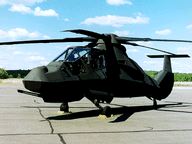
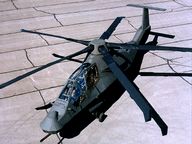
Boeing/Sikorsky RAH-66 Comanche
In the late 1970s and early 1980s, the US Army became increasingly concerned about the continued viability of its fleets of Bell UH-1 Iroquois, Bell AH-1 HueyCobra, Bell OH-58 Kiowa and Hughes OH-6 Cayuse battlefield helicopters in the face of defensive systems that were rapidly improving in terms of lethality, range and rapid reaction time. In 1982, therefore, the service issued its LHX (Light Helicopter - Experimental) requirement for a light battlefield helicopter that could operate successfully in the reconnaissance, attack and air combat roles through the combination of advanced electronics in an airframe that would be made as "stealthy" as possible through the adoption of a clean design with retractable main landing gear units, a structure of high-strength but low-observability composites, the rotor head faired into the upper part of the fuselage to ensure the minimum possible number of radar traps in this region and, wherever possible, internal weapons accommodation.
The original plan envisaged the procurement of 5,000 helicopters to replace the UH-1, AH-1, OH-58 and OH-6, but in 1987 the program was altered to 2,096 helicopters operating only in the scout and attack roles, and then in 1990 to 1,292 helicopters with a further 389 possible.
The US Armys request for proposals was issued in June 1988, and in April 1991 demonstration and validation contracts were issued to the Boeing/Sikorsky First Team and Bell/McDonnell Douglas Best Team. In April 1991 the Boeing/Sikorsky team was declared winner of the design competition and awarded a contract to provide four (soon three and finally two) YRAH-66 prototype and service trials helicopters as well as one static test airframe and one propulsion system test bed.
The LHTEC T800 turboshaft had been selected in October 1988 as the engine to be used in the helicopter involved in a program envisaged as witnessing a first flight in August 1995, low-rate production from October 1996, full-rate production from November 1998, initial operational capability in December 1998, and all 1,220 helicopters delivered by 2010. The program has since been delayed by the USA's politico-economic desire to secure a "peace dividend" from the collapse of the USSR into the CIS and the concomitant end of the "Cold War" in the end of the 1980s.
The first revision of the development and production program envisaged an initial operational capability in 2003, and then further alterations (mostly inspired by political antipathy to the program) have now resulted in orders for two prototypes of which the first should fly late in 1995 or early in 1996, six "early operational capability" helicopters equipped only with reconnaissance equipment for evaluation from 2001, and a production decision in 2003 for a total of 1,292 (plus a possible 389 more) RAH-66A helicopters.
The Comanche is based on a basically all-composite structure with the pilot located forward and below the weapons systems operator under a bulged canopy. The powerplant (aspirated via two small inlets on the sides of the fuselage immediately to the rear of the weapons system operator�s cockpit) and fuel tankage are buried in the central part of the fuselage and drive a five-blade main rotor and eight-blade tail rotor, otherwise known as a fantail, in the lower part of the vertical tail surface, which is in fact angled to port over its lower half and then to starboard over its upper part below the flat horizontal surface. All three units of the tailwheel landing gear are retractable.
Design and production responsibilities for the main rotor blades and tail section are allocated to Boeing, and for the forward and central fuselage sections to Sikorsky, which also undertakes the final assembly process.
There are two main components in the armament system, namely the fixed element provided by the 20 mm cannon located in a GIAT turret under the nose, and the disposable elements. This latter is generally carried on the insides of the two lateral weapons bay doors for the scouting and air combat missions, and on these doors and/or the four hardpoints under the optional stub wing for the attack mission. The primary-mission weapons load provides minimum "observability", for the doors are kept closed until the weapon are needed, only them being opened so that their inner surfaces become the undersides of the platforms from which the weapons are fired before the doors are closed once more. The secondary-mission weapons load increases the weight of possible fire by a considerable degree, but the combination of stub wings and weapons has an adverse effect on "observability".
The avionics are designed for maximum commonality with those of the Lockheed Martin/Boeing F-22 Rapier advanced tactical fighter, and control of the helicopter is entrusted to dual triplex fly-by-wire systems with a normal collective lever and sidestick cyclic pitch controller.
 Get your own Free Home Page