
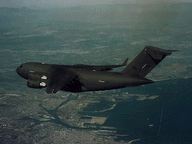
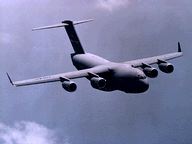
McDonnel Douglas C-17 Globemaster III
The C-17 is the most flexible airlift aircraft to enter the Air Force's inventory. The ultimate measure of airlift effectiveness is the ability to rapidly project and sustain an effective combat force close to a potential battle area. Threats to U. S. interests have changed in recent years, and the size and weight of U.S. mechanized firepower and equipment have grown in response to improved capabilities of potential adversaries. This trend has significantly increased air mobility requirements, particularly in the area of heavy outsized cargo. As a result, additional airlift is needed to meet possible contingencies worldwide. The C-17 helps address these shortfalls in the current airlift force.
The C-17 is capable of rapid strategic delivery of troops and all types of cargo to main operating bases or directly to forward bases in the deployment area. The aircraft is also able to perform theater airlift missions when required. The inherent flexibility and performance characteristics of the C-17 force improves the ability of the total airlift system to fulfill the worldwide air mobility requirements of the United States.
Reliability and maintainability are two outstanding benefits the C-17 system brings with it. The C-17's system specifications impose a demanding set of reliability and maintainability requirements. These requirements include an aircraft mission completion success probability of 93 percent, only 18.6 aircraft maintenance manhours per flying hour, and full and partial mission capable rates of 74.7 and 82.5 percent respectively for a mature fleet with 100,000 flying hours. The McDonnell Douglas Aerospace warranty assures these figures will be met.
The C-17 measures approximately 174 feet long with a 170-foot wingspan. The aircraft is powered by four fully reversible Pratt & Whitney F117-PW-100 engines (the commercial version is currently used on the Boeing 757). Each engine is rated at 40,900 lb of thrust. The thrust reversers direct the flow of air upward and forward to avoid ingestion of dust and debris.
The aircraft is operated by a crew of three (pilot, copilot and loadmaster). Cargo is loaded onto the C-17 through a large aft door that accommodates military vehicles and palletized cargo. The C-17 can carry virtually all of the Army's air-transportable, outsized combat equipment. The C-17 is also able to airdrop paratroopers and cargo.
Maximum payload capacity of the C-17 is 170,900 lb, and its maximum gross takeoff weight is 585,000 lb. With a payload of 130,000 lb and an initial cruise altitude of 28,000 feet, the C-17 has an unrefueled range of approximately 5,200 nautical miles. Its cruise speed is approximately 450 knots (.77 Mach).
The design of this aircraft lets it operate on smalll, austere airfields. The C-17 can take off and land on runways as short as 3,000 feet and as narrow as 90 feet wide. Even on such narrow runways, the C-17 can turn around by using its backing capability while performing a three-point star turn. Maximum use has been made of off-the-shelf and commercial equipment, including Air Force standardized avionics.
The C-17 made its maiden flight on Sept. 15, 1991. The aircraft is
operated by the Air Mobility Command with initial operations at
Charleston AFB, S.C., with the 437th Airlift Wing and the 315th
Airlift Wing (Air Force Reserve). The C-17 program is managed
by the Aeronautical Systems Center, Wright-Patterson AFB, Ohio.
Main Menu
 Get your own Free Home Page