
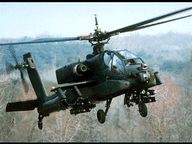
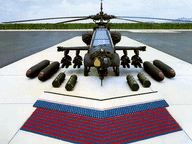
AH-64D Longbow Apache
This is an improved version of the AH-64A/B with a powerplant of two T700-GE-701C turboshafts, each rated at 1,800 shp (1342 kW), and the Longbow fire-control system based on a Westinghouse millimetric-wavelength radar with its antenna in a mast-mounted radome above the main rotor. This radar is the primary sensor of the Longbow system (initially designated Airborne Adverse-Weather Weapon System) and intended for rapid target-area search, automatic detection and classification of targets, and all-weather fire-and-forget engagement with a revised version of the Hellfire missile, namely the radar-homing Longbow Hellfire that carries, in addition to its semi-active laser seeker modified for improved resistance to optical countermeasures, a combined radio-frequency and IR seeker as well as a warhead optimized for the penetration of modern types of advanced tank protection.
The AH-64D will also carry lightweight AAMs (originally to have been FIM-92A Stinger weapons but now possibly to be Shorts Starstreak weapons) on the tips of its stub wings, have Plessey ASN-157 Doppler navigation, and be fitted with a MIL 1553B digital databus.
It is also possible that the AH-64D will introduce features from the canceled Apache Plus program such as a redesigned cockpit, a larger forward avionics bay for improved electronics, and a digital fly-by-wire system developed by General Electric and Lucas.
In other respects, the AH-64D differs from the AH-64A in details such as its height overall of 16 ft 1 in (4.90 m) to the top of the mast-mounted radome and 14 ft 1.25 in (4.30 m) to the top of the turning tail rotor, maximum vertical rate of climb at sea level of 2,530 ft (771 m) per minute, and hovering ceiling of 17,210 ft (5245 m) in ground effect and 13,530 ft (4125 m) out of ground effect. A number of export sales have also been made.
The AH-64 Sea-going Apache was a company proposal for an Apache version for the US Navy with the avionics bay moved to an underfuselage position to allow a fuel capacity of 853 US gal (710.3 Imp gal; 3228.9 liters) as the means of providing a mission endurance of 6 hours or more in defense of surface battle groups operating without an aircraft carrier; a retractable inflight-refueling probe would also be fitted. The type would have an IR search and tracking system, the APG-65 radar and much of the avionics of the McDonnell Douglas F/A-18 Hornet in a considerably-modified cockpit under a larger canopy for greater levels of crew visibility. The helicopter could carry AIM-7 Sparrow, AIM-9 Sidewinder, AIM-120 AMRAAM and AIM-132 ASRAAM AAMs for its primary air-defense role, but would have provision for a quartet of AGM-84 Harpoon and/or AGM-119 Penguin anti-ship missiles.
The Sea Apache would lack the underfuselage cannon of the land-based variant, and so too would the proposed version for the US Marine Corps, which would otherwise be similar to the land-based model in avionics and weapon capability.
 Get your own Free Home Page